Monday, August 29, 2011

Wiyot Return to Tuluwat

Wiyot in dance regalia.  Identities and year unknown. From Wiyot Tribe website.

Return To Tuluwat

by William S. Kowinski 
 The following article appeared on the front page of the San Francisco Chronicle Datebook section on Saturday February 28, 2004, the day of the annual vigil marking the massacre of the Wiyot in 1860.  I've kept the structure of the edited version, with some changes and my own subheads.  I tried for years to get some publication interested in this story. It finally happened in early 2004. Though I didn't know it at the time, negotiations were already underway for the return of some 40 acres to the Wiyot, owned by the City of Eureka--the subject of the next article in this sequence. I was later told that the appearance of this story in the Chronicle was one factor that helped move these talks to fruition.

 The 2004 vigil, which I think was the fourth I'd attended, seemed larger than the year before. I'd guess there were 400 people there, including Humboldt County's District Attorney. It was a dry but not entirely clear night. The event is held whether it’s raining (as it often does) or not, though in 2000 it was so stormy the event had to be moved indoors. That 2000 event is notable for several reasons: It was filmed for the Living Biographies project, so a professionally shot tape exists as an archive. Cheryl Seidner announced that the first 1.5 acres of Indian Island had been purchased by the Table Bluff Wiyot Tribe, the culmination of a grassroots fundraising effort that captured the imagination of the community and beyond.

 And during the course of the year 2000 vigil, Cheryl sang her "Coming Home Song" for the first time in public. That song has become a cherished part of these and related events ever since. It was included at the end of a documentary on Native Sacred Sites, which ran on PBS.  More people probably heard that song on PBS in one night than had ever heard a Wiyot song since first contact. Probably more North Coast people, Native and Non-Native, have sung it together than any other Native song.

Like 2003, several dark necklaces of honking geese flew over during the course of the evening in 2004. Brian Tripp, a Karuk artist and writer, recited his powerful poem about the massacre, which I'd heard Julian Lang recite two years before. The vigil ended with Cheryl Seidner singing her Coming Home song, with a "backup group" of Wiyot children joining in, and then everyone. It was dark by then, and I looked up to see a ring around the moon.

The last vigil was held in 2008, for by then the Wiyot had returned to the Tuluwat ceremonial grounds. The first World Renewal Ceremony since the 1860 massacre was held in 2014.  Other updates follow at the end of the post.

2009 Vigil


Just before dusk on the last Saturday in February, several hundred people gather each year at the edge of Humboldt Bay in Eureka, across from a small, tear-shaped island half a mile away.

Standing under a deepening blue sky flared with reds at the horizon (as they did last year) or under umbrellas in a North Coast late winter rain (as they did the year before), they will hold candles and share songs and prayers.

The forested land they can see across the bay, still called Indian Island, was the scene of one of the most notorious massacres in California history. At least 60 and perhaps more than 200 women, children and elders of the Wiyot tribe were slaughtered with axes and knives by six white men, known to be landowners and businessmen. This was one of three simultaneous attacks at different locations that sent this small tribe spiraling towards extinction, some 144 years ago.

For a long time, it seemed they were extinct. As late as 1996, correspondent Fergus Bordewich wrote, "Little is known about the Wiyots." But the Wiyot tribe, denied federal recognition in 1953, regained it in 1990, and moved to a new reservation at Table Bluff, south of Eureka's city center, where some 450 tribal members now live.

"We are still here," said Cheryl Seidner, the elected Wiyot tribal chair since 1996, and a direct descendant of an infant survivor of the Indian Island massacre. "We are still a people. We still cast a shadow, we are not gone."

History Is

By a quirk of the California coastline, Eureka is the westernmost city in the 48 contiguous United States. Through the fate of history, it was one of the last places in America where Indians and Euro-Americans confronted each other. In a sense, it recapitulated and condensed several hundred years of American history in a few decades.

In 1860, California had been a state for only a decade, and the city of Eureka, growing from its docks to push against the redwood forests around it, had been the seat of the newly formed Humboldt County for just four years. The Humboldt Bay communities of Eureka and Arcata began by supplying the gold miners prowling the northeastern mountains, but by 1860 had opened nine timber mills, and were busily engaged in agriculture and ship-building. In 1853 alone, 143 ships left the bay loaded with timber, bound for San Francisco and other ports.

But far northern California had many small tribal groups of Indians living in its forests and mountains, and along its rivers and coast, some for 10,000 years.

The village of Tuluwat on Indian Island was the physical and spiritual center of the Wiyot world, which was comprised of some 20 villages spread over forty square miles, with a population of perhaps 3,000. There is evidence of Wiyot presence on the island for at least 1,000 years. But for many white settlers, Indians were a not-quite-human barrier to progress. Local newspapers supported a policy of extermination.

On the last Saturday in February 1860, the Wiyot completed their week-long world renewal ceremony at Tuluwat, to bring the world back into balance and mark the equivalent of their new year. The small boat arrived late that night, while the Wiyot men were away gathering supplies.

The massacre on Indian Island was not the first in the region, nor would it be the last. It was part of an accelerated pattern of destruction, beginning with random killings and rapes by miners and ranchers, and including kidnapping and legal slavery of mostly women and children under California's 1850 Indian indenture law. Later, Indians were forced into forts and small reservations under concentration camp conditions, and finally, those still living on their lands were subject to organized warfare by local militia while federal troops fought the Civil War. Together with the ravages of disease, this history reduced an estimated 15 local tribes to five.

But Indian Island became the most infamous massacre in northern California probably because of the presence of Bret Harte, who before achieving literary fame, reported for a newspaper in Arcata. His account of the massacre and editorial condemning its cruelty made him a local outcast, but anonymous letters to a San Francisco newspaper rumored to be his work were largely responsible for the national knowledge of this event. Editorial writers in San Francisco and in New York began referring to Eureka as Murderville.

Though the names of those responsible for the Indian Island massacre were apparently widely known, no legal action was ever taken against them. As Eureka became a prosperous commercial center, and Humboldt Bay became the busiest port between Seattle and San Francisco, this part of the past seemed better left forgotten.

But unlike much of California, the Indian populations indigenous to the Humboldt County area remained significant. Besides residents on Yurok, Hupa, Karuk and Wiyot lands and several Rancherias of mixed tribal groups, many enrolled members of indigenous tribes live and work in Humboldt's cities and towns. Though less than 6% of Humboldt's population, Native Americans are its largest minority group. In this large but mostly rural county(some 80% of it forested or devoted to federal and state parks), a bare majority of its population lives in communities surrounding Humboldt Bay, on land that once belonged to the Wiyot.

"The past is not dead," as William Faulkner wrote. "It's not even past."


The Wounds of Murderville
1996 Vigil: Leona Wilkerson, Marian Seidner, Loretta Brown and Cheryl Seidner

Seidner and her sister, Leona Wilkinson, began the vigils in 1992, together with two non-Indians, Peggy Betsels. former pastor of Eureka's United Church of Christ, and Marylee Rohde, former president of the Humboldt County Historical Society.

I've known about the story of the massacre since I was a little girl," Rohde said, "so I hadn't realized how deeply it was buried in Eureka's psyche. Peggy didn't hear of it until her daughter was in school, from the Native American parent of another student. But in talking with Cheryl and Leona, we realized that the story needs to be told. There needs to be healing, but the wound tends to fester if it's been suppressed."

"It's a healing of two communities," said Seidner. "It's not just us or them. We need to come together as a community of learning, to understand each other. That rip in our society needs to be mending, and hopefully we've been trying to do that for the last 13 years."

Community awareness of the Wiyot story increased dramatically in the late 1990s when Seidner began to raise funds for the purchase of the 1.5 acres of Indian Island where the ceremonies had traditionally taken place. At the vigil in 2000, Seidner announced that as a result of many small contributions from the local community, together with donations from Indian organizations and individuals nationally, the tribe had reacquired this land. The Wiyot would return to Tuluwat.

More funds are needed to clear the site of debris left behind by an abandoned shipyard, to erect the new ceremonial building, and perhaps acquire more of Indian Island. The Wiyot Sacred Sites Fund continues to raise money, partly through events such as the third annual benefit concert earlier this month. One source of continuing support has come from the local churches that recognize a special responsibility.

An anonymous letter about the massacre thought to be from Bret Harte was sent in 1860 to the San Francisco Bulletin asserting: "The pulpit is silent, and the preachers say not a word." "They did nothing, they said nothing," said Clay Ford, current pastor of the Arcata First Baptist Church. "We realized that we needed to take responsibility before God and before the Wiyots, for what Christian people did not do, even if we weren't there." After making a formal proclamation of repentence, Ford handed Seidner the first of annual checks, on behalf of the Humboldt Evangelical Alliance.

Another group, the Humboldt Interfaith Council (affiliated with the United Religious Initiative based in the Bay Area) is dedicating its community fund-raising efforts this year to the Wiyot Sacred Sites fund, including the proceeds from its Interreligious Peace Festival, being held on the Humboldt State University campus today.

"We're very passionate about what the Wiyots are trying to do," said Ross Connors-Keith, director of the group. The theme is the sacred arts---"especially dance and music, said Ross Connors-Keith, the group's director, "in keeping with the Wiyots' world renewal ceremony, which involved dance and singing. We thought this would be a wonderful way of bringing the community together."

At the Interreligious Peace Festival on the last Saturday of February this year, the Council will also present the Wiyot with a quilt made of individually purchased and decorated blocks (with proceeds going to the Wiyot fund), assembled by two county quilting guilds. "We selected a fish motif," Connors-Keith said, "because the massacre destroyed the Wiyot culture, and this is a theme that relates to their traditional way of life."

There have been other signs of reconciliation in recent years, as when Cheryl Seidner, about to speak to the Arcata Planning Commission in a public hearing concerning a proposed new center for the United Indian Health Service, spontaneously decided to welcome everyone to Wiyot country. It is an American Indian tradition for the host tribe to give permission to others coming onto their land. "I don't know if anyone has ever welcomed you before, and I want to be the one to do that" she said, and now recalls, "the roar that went up in the building was monumental---I couldn't believe what I had heard...The whole community that was there, it just exploded."

But in other ways, progress has been slow. "It's been a disappointment to me that I haven't seen more of the white population of Eureka interested in the vigil," Marylee Rohde says. "I think the wound is finally being acknowledged, but...Peggy Betsel's theory, and she did her dissertation about this at the theological seminary in Berkeley, is that this community had so much difficulty pulling together partly because this wound wasn't acknowledged. That burying it continued to poison what tries to happen."

"But we have seen participation in the vigil increase over the years from the Wiyots and other Native Americans," Rohde adds. "When I look back at the Civil Rights movement, I think maybe the healing has to happen with the victims first, before the perpetrators can acknowledge their own wounds."


Return to the Center of the World


Wiyot Bear Mask, now at the Smithsonian
 "The Wiyot are a people who are beginning to learn about themselves again," Cheryl Seidner says. "Culture gives us our identity. We are not just a name. We have to learn to live our culture, and try to incorporate it in our daily life."

"Cheryl stepped in at a transition point," observed Julian Lang, a language scholar and cultural activist whose ancestry includes Karuk and Wiyot. "Before Cheryl, the effort was to regain the Wiyot identity at the political level, to gain recognition and stabilize. Cheryl was able to begin charting a path of development at the cultural level, to begin the cultural rejuvenation. She's looking forward, representing the idea that there is a traditional ceremonial life ahead for the Wiyot."

Cheryl Seidner has worked full time at Humboldt State University since 1979. She is currently an administrator for the Economic Opportunity Program(though Governor Schwarzenegger has recommended it be abandoned.) Her older sister, Leona Wilkinson, recently retired from the Upward Bound program at HSU. But some fifteen years ago, Cheryl persuaded Leona to begin traditional basket-weaving again, which she had learned as a girl from their grandmother. The beautifully designed and water-tight woven baskets, caps and other items have both practical and sacred purposes essential to Wiyot life. Now she teaches her niece and grand-niece, beginning with the proper gathering of materials.

Basketry was easy compared to reviving the Wiyot language. There are no fluent Wiyot speakers left- only some tapes made in the 1950s. Marnie Atkins, Wiyot Cultural Director, is hoping to attend the "Breath of Life" conference at UC Berkeley for the second time this June, where she will be paired with a linguist to investigate the archives.

Meanwhile, she will be working with these tapes to create usable lessons that can be disseminated on CDs and over the Internet. Her goal is to get the language "into our ears, and into our children's ears."

Julian Lang has also studied these tapes, and combined what he learned with some singing derived from the Karuk culture for classes he offered to interested Wiyot a few years ago. "There was instant acceptance of that, and an incredible aptitude," he says. "People learned very fast. Lynn [Reisling, his partner in the Institute for Native Knowledge] and I were amazed. Within a month it was like all the cultural knowledge had always been there. It was close to the surface of everybody's soul."

Because February 1860 on Indian Island was the last time the Wiyot performed their world renewal ceremony, Seidner acknowledges that they will look to other local tribes for help in reconstructing it. Several have similar ceremonies, and they have traditionally participated in each other's dances.

The rest, she says, "will come from our dreams. It's in our DNA."

With what Wiyot words she learned, she created her "coming home" song, which she sang at the end of a PBS airing of a documentary on American Indian sacred sites produced by the San Francisco based Sacred Land Film Project.

Sharing among tribes has already begun at the vigils. At last year's event, as participants gathered around the bonfire in the cold, clear night, Julian Lang looked up and remarked, "in Wiyot the word for 'stars' means 'God's eyes.'" Then he sang a song from the Karuk's world renewal ceremony, the Jump Dance. Joseph Orozco, a member of the Hupa tribe who is the station manager of KIDE-FM, the first tribally owned and operated public radio station in California, sang a mourning song based on the White Deer Dance.

All of this is also preparation for the future, when the vigil will be over and there will be ceremony at the end of February again.

"Cheryl recognizes that land is at the heart of the ceremony," Lang says. "Ceremony needs a place, and there's no more significant place than Tuluwat on Indian Island."

Seidner is not only a direct descendant of a baby boy survivor of Indian Island, but of the boy's father, who was the last Wiyot to lead the ceremony at Tuluwat.

She talks with enthusiasm about members of other tribes "who say, we can't wait to be back on the Island with you...It's getting to the point that they can feel it coming. It's been a real blessing. We realize we are not standing by ourselves.''


Postscript: In 2006 a Wiyot Flower Dance was held at the edge of Humboldt Bay.  This coming of age ceremony for a young girl was believed to be the first Wiyot ceremony held since the 1880s.  Some participants, From left: Leona Wilkerson, Joycelyn Teague, Hupa visitor Lorelei George, and Rosalinda Ruiz. Photo credit: Cheryl Seidner.

Further Update 2024:  The first World Renewal Ceremony since the 1860 massacre was held on Indian Island in March 2014. The city of Eureka deeded back the rest of Indian Island to the Wiyot in 2019, and more recently another culturally significant area of land in the Samoa dunes has also been returned to the Wiyot Tribe. In addition, the Wiyot Da Gou Rou Louwi' Cultural Center has opened in Old Town Eureka, with the goal of increasing cultural understanding.  It is open to the public.

Monday, August 22, 2011

Coming Home: The Wiyot Accept Return of Sacred Land


Coming Home: The Wiyot Tribe Gets Back Sacred Land

This augmented account of the transfer of 40 acres of Indian Island from the City of Eureka to the Wiyot Tribe on June 25, 2004, and events leading up to it, first appeared in News from Native California, Fall 2004.  It was an historical moment, not only for the North Coast of California, but in North America.  So I thought it was worth making and preserving a detailed record.

The efforts to reclaim Indian Island, are ongoing, requiring a lot of environmental cleanup.  Progress on those efforts is noted here on the Wiyot Tribe web site.

Humboldt Bay

Cheryl Seidner was driving in Connecticut when she began praying for good weather in Eureka the next day. She was leaving the National Congress of American Indians, on her way to the airport and across the country. In less than 24 hours, she would be riding across Humboldt Bay in a redwood canoe to sign papers as tribal chair of the Wiyot at Table Bluff. Those papers would officially transfer back to the tribe 40 more acres of Indian Island, the traditional center of the Wiyot world and its most sacred site. She prayed for calm waters.

For at least a thousand years before non-Natives came into far northern California, the Wiyot gathered at Tuluwat village on what came to be known as Indian Island, often with guests from other tribes, to perform their world renewal ceremonies. In February 1860, a few settlers crossed Humboldt Bay from Eureka and brutally massacred Wiyot women and children, while the men were away gathering supplies to continue the dance. It was one of three coordinated attacks that day that almost wiped out the Wiyot, whose traditional lands spread across some 40 square miles surrounding Humboldt Bay, including the present cities of Eureka and Arcata. The Wiyot have not danced on the island since.

Denied federal recognition as a tribe in the 1950s, the Wiyot reorganized at the Table Bluff reservation and regained official tribal status in 1990. A few years later, Cheryl Seidner---a direct descendant of the only known survivor of the Indian Island massacre---began an annual candlelight vigil commemorating her ancestors, together with Maryle Rhode, president of the Humboldt County Historical Society, and Peggy Betsels, then pastor of Eureka's United Church of Christ. The February vigils are open to everyone, and soon grew from some 75 people to several hundred, including members of other tribes and non-Natives. So began two journeys: the Wiyot's revival, and efforts at reconciliation between the Wiyot and the non-Native community.
after the Eureka City Council vote, with Cheryl Seidner and Leona Wilkinson in center 

In the year 2000, after several years of fundraising, the Wiyot purchased 1.5 acres of Indian Island, the location of Tuluwat Village itself. There was some confusion about the legal borders of this purchase, and it was in the process of clarifying them with Eureka city officials that the longstanding discussions leading to the larger land transfer began in earnest. "That was about a year and a half ago,"Cheryl recalls. "But the real hard core stuff, with attorneys and things like that, started around Thanksgiving[2003]."

The city of Eureka owns most of Indian Island, except for a few private residences. The 40 acres deeded back include the Wiyot burial grounds and shell midden. The negotiations, Cheryl said, "were all done in good faith. Everybody was working to make sure it was going to come out right." The land is to be developed as a sacred site, and not for commercial or residential purposes. The resulting agreement was presented to the Eureka City Council in May.

Maria Tripp (Yurok), chairperson of United Indian Health Services, told the Council, "Every tribe has a center of the world, and Indian Island is the center of the Wiyot world...The healing has begun. The return of this land to the Wiyot people will be an important step in that healing."

UIHS director Jerry Simone pointed out that their facility in Arcata was called Potawat Village, a Wiyot word for the nearby Mad River. "I strongly believe that this site on Indian Island has as much if not more to do with the healing of the Wiyot than all the health services UHIS can provide."

Those speaking in support of the resolution included representatives of Mike Thompson, Member of U.S. Congress for the district, and Wesley Chesbro, state Senator for the district; John Wooley, Humboldt County Board of Supervisors; a representative of Roland Richmond, President of Humboldt State University, and the vice-president for academic affairs from College of the Redwoods; the Humboldt County superintendent of schools, and Peter Pennecamp, executive director of the Humboldt Area Foundation.

Several private citizens also spoke in favor, including Jan Kraepelien, who worked behind the scenes to encourage the transfer. He complimented Eureka City Manager David Tyson. "This simply would not have been possible without his courage, understanding, and patience," Jan said. "He is the very model of a dedicated public servant acting in the best interests of the community."

Each member of the City Council present spoke in favor, most with visible emotion. The resolution passed unanimously, and June 25 was set as the date for the official signing. The voluntary transfer of land, especially a sacred site, from a municipality back to its indigenous people, may never have happened in California before. It's safe to say that even in all of North America, it is a rare event.


So on the morning of June 25, Cheryl Seidner got ready. She brought a ceremonial basket cap and buckskin shawl to wear, both of them designed and made for her by her sister, Leona Wilkinson. She wore two necklaces. One was made from abalone beads belonging to her grandmother, Hazel James. The other had been made for her several years earlier by Eureka school children. Later she would wear one more-a large dentilium necklace with cobalt blue beads given to the Wiyot tribe that day by the Elk Valley reservation.

Julian Lang (Karuk, whose great great grandmother was Wiyot) took on the challenge of developing a meaningful Native component for the transfer event, to be held at the Adorni Center on the Eureka waterfront.

He began with the idea of something based on a traditional boat dance. "Not really a boat dance," he said, "but as a model from within our Native cultures that we could use for this event." The crossing of the waters is a journey to the afterlife, and so it links the present and people today with the past and the ancestors on Indian Island. It could also suggest a journey to unity among Native peoples, and reconciliation of all peoples. "It's symbolic, based on our cultural knowledge."

Julian began by approaching Walt Lara (Yurok) with the idea. " He said, 'count me in. It's really important, and an Indian presence is incredibly important in this case, especially because we are the dancemaker families, the dancemaker people within our Indian community, and it's our job.' He made it a possibility."

Walt Lara would bring the redwood canoe made in the late 1990s, with a grant from the Seventh Generation Fund. Julian hoped for a total of five canoes, including the oldest to still be in use, but most of them were damaged, being repaired or couldn't be properly prepared in time. Richard Myers (Yurok) volunteered a smaller dugout canoe, and the Yurok tribe provided their water marshal boat as an escort. "But ten boats or two boats, it doesn't matter," Julian said. "It's the same thing. It's the way our ceremonies work."

Julian consulted others about various elements of the event. "We reached out to include many ceremonial folks from all the tribes, because we are related not by blood but by ceremony. They were inspiring at every stage. Everybody recognized the significance of the event---not as a civic or government to government event, but as a Native American event, bringing together the past and the present in healing. As it got closer, I realized these people were really important people who made it an incredibly big event, full of meaning. It just blossomed. It said, this is who we are today."

Cheryl agreed. "It needed to have something to do with who we are, where we are coming from, and what we plan to be doing with our lives from that point forward."


Most who became involved were present on Indian Island that morning. After the television crew and reporter from the Associated Press were gone, they gathered for prayer. Then for the first time in 144 years, two redwood canoes left Indian Island. In the larger boat with Cheryl was Walt Lara and his grandson, Walt Lara III, Chris Peters (Pohlik-lah/Karuk), Jessie Sherman (Hupa, Wiyot) and Thomas Wilkinson (Wiyot.) In the smaller boat were Frank Myers, Julian Lang, Skip Lowry(Yurok, Pitt River) and Frank Tuttle (Yuki/Wailaki/Konkow Maidu, who supplied much of the regalia).

By the time they paddled across Humboldt Bay it was afternoon. The thin veils of mist hovering near the surface of the water had dissipated. In the deep blue sky only low wisps of white clouds floated in the distance across the forested mountains. It was the first sunny day after weeks of gray summer clouds. The waters were calm.


In fact, the boats made surprising progress. "We didn't know how easy it was going to be," Julian Lang said. "We thought it was going to be really hard, but those canoes just took to the water. So we were half an hour early."

They also put in at a different dock than many on shore expected. When the canoes glided past the place where the crowd had gathered, many ran along the shore to the right dock, getting doused by the Adorni Center sprinklers.


Cheryl was then escorted to the building by a group of young women from the various tribes, in traditional regalia. They sang a welcoming song. Peter La Vallee, the Mayor of Eureka also welcomed Cheryl, and Julian Lang spoke briefly. "People have come here today from the Hupa tribe, the Yurok tribe, the Karuk tribe, the Tolowa tribe as well as the Wiyot tribe---all these different tribes are represented because we are one kind of people: we are 'fix the earth' people. That's our job as human beings." (As Julian noted later, these were also the tribes most likely to have sent participants to the Wiyot "world renewal" ceremony on Indian Island, even when it was last held the night before the massacre.)

There were Indian representatives from other places as well. Cheryl said later that she had been particularly impressed by the delegation from the Redding Rancheria. "I found that very heartening that they came from a couple of counties away," she said.

Before everyone went into the building, Julian had the crowd repeat the Wiyot name for Eureka: CuruCiCi.

Once inside the auditorium that doubles as a basketball court, it became apparent that quite a few people had come to witness the signing: judging from the overflow, probably 500, and maybe more.

The Mayor of Eureka, Peter La Vallee, spoke first. "I am honored and humbled," he said. He acknowledged the wrongs done by Eureka citizens in the past. "There is a time and a place to do the decent thing, the right thing," he said, "and that time and place is right now, right here."

Cheryl began by welcoming everyone from the four directions. "I want to welcome you to Wiyot country," she said. "We are coming home to our island. In 1860 people did not see fit for us to live. But this City Council, they beg to differ. They said, come, let us be together. And the Wiyot said, this is what we want..." She spoke of the Wiyots' desire to have all 175 acres of the island back eventually. "Today we get part of our island back... Each generation said we want it back. Each generation learned something new about the island, and each generation got closer..."

She said that it took many generations, all the tribes and many people of Eureka to make it happen. "It took everyone in this room, and more. We are grateful." After saying a prayer in the Wiyot language she repeated it in English. "We thank you for our differences and our different ways. We thank you for the Wiyot people who are coming back, who are coming back to life, CuruCiCi. It's been a long day coming."

The agenda for the rest of the event was short, with a few Eureka officials and government representatives, including state representative Patty Berg, scheduled to speak. But a spontaneous decision to bring forward some of those who worked with Julian to assemble the events outside led to a continued Indian presence in the proceedings.

Walt Lara was the first to speak, joking that he wasn't used to talking about good things happening for Indian people, "like getting their land back. I'm kind of a militant-I like to fight to get the land back." He spoke of the effects of genocide in the past, "up the coast and down the coast. It's sad, and people are still trying to shake it off." He praised the efforts of the Wiyot people. "They're back, and they're moving forward."

Next was Philip Vigil [Hupa], who his wife, Gloria, was essential to "grounding" and "inspiring" this event in tribal tradition (as Julian said). "This is a great day," he told the crowd. "It will go down in history for the Wiyot people and all the Indian people." He said that the Hupa "have sort of been the stewards of ceremonies for all the Indians of this area for years," assisting all the tribes in reviving their ceremonies, and they were ready to do the same for the Wiyot. "This is one of the things we look forward to---to re-establish the ceremonies here as they once were."

Julian Lang, who was introducing the speakers, then commented that he recently heard of a Yurok elder who remembered the Wiyot jump dance as being very much like the Yurok's, with a small difference that she demonstrated. "So I wanted to share that with the Wiyot people," Julian said, "to let you know that there are people who know how those dances went. There are people who can help in that way."

Next was Melody George, Hupa prayer-maker, who sang a beautiful song and offered a prayer in Hupa and then in English. "May the Wiyot begin to remember that which they need to remember, and do that which they need to do. May the acorn eaters in this room be able to help them learn again to do that which they need to do, and to teach their young that which they need to teach them. They are home, and medicine returns to the island."

Alme Allen spoke on behalf of the Karuk, congratulating the Wiyot on a special and historic day, and "a very proud day for Indian people." Then state assembly representative Patty Berg spoke, a group of Tolowa children from Crescent City danced in honor of the day, and then the official moment came as Cheryl and Mayor La Vallee signed the documents, with members of Eureka City Council and the Wiyot Tribal Council assembled around them. The crowd stood and cheered in a hail of flashbulbs. There were a lot of cameras of all kinds.

Then gifts were exchanged: the Mayor presented Cheryl with a clay pot of earth from Indian Island, while Cheryl gave him and each member of City Council several small gifts, including canned salmon (the salmon supplied by the Yurok and canned by Leona Wilkinson), and a medicine pouch containing periwinkle, which the Wiyot used as money ("'penny-winkle' we called it when we were kids," Cheryl recalled), an acorn ("so you never go hungry"), sacred tobacco and "Wiyot medicine to keep you strong."

Cheryl dedicated the day to her grandparents and to her parents, Bill and Loreta Seidner. She then led the entire audience in singing her “coming home” song.

Everyone in the audience received a keychain commemorating the event as they left. Many stayed to talk and eat cold cuts and cake. It was a happy day, and there were many tears in the audience.

"I was so surprised to see so many people," Cheryl said later. "I did not realize what it meant to a lot of people. I knew what it meant to me." She remarked on the emotion she saw there, for example from her co-workers at Humboldt State University, where she is an administrator for the Economic Opportunity Program.

 "I still haven't absorbed what a big thing it was. I took it as a matter of fact. The island was always ours. We just needed a piece a paper to say it." But she acknowledged that she also got emotional towards the end, when she mentioned her parents. "That's when I almost lost it. Because most of what I do, I always think of my parents. How would they do this? They were such good people, and I miss them greatly. Even though they've been gone almost all of my adult life, I still depend on their opinion."

But as important and truly historic as this event was, "it isn't the end," Cheryl said. "It's only the beginning." Her goal now is to "get the island to a point where we can put a dance on it." The first will probably be demonstration dance, a celebration, she thought. The winter dances require a dance house, and though one is planned, it's a little farther in the future. "We have to raise money for that."

For now, there is the continuing work of cleaning up the land damaged by various uses over the years, including a boat-building facility. "We've removed 33 tons of scrap metal from the island already," she said, "and we still have to clean up some of the hot spots. But it's not as bad as we thought it might be."

Just as importantly, the Wiyot have to prepare themselves to dance again. Dance families from the Hupa, Yurok and Karuk have come forward to help, Cheryl said. But "none of our former dance families have the dresses" or other regalia. "We pray there will be young men and women who will come forward and say, 'teach me, let me learn.' This is the beginning of the rediscovery of who we are. "

As executive director of the Seventh Generation Fund headquartered in Arcata, Chris Peters hoped that returning even this much of Indian Island to the Wiyot will influence the future of Humboldt Bay. "Indian Island is geographically and historically significant," he said," a place that has been considered sacred and used for spiritual purposes for thousands of years before non-Native people came to this area, and before any churches or synagogues or other buildings used for worship by any denomination were constructed. With the transfer back to Native ownership, we're hoping that this place will be given its due respect, and the development around it on Humboldt Bay will be done in such a way that shows respect for this significant place of prayer."

"Likewise, throughout California, similar land transfers need to happen," he added, "and sacred lands need to be managed as sacred places: sacred for everything and for all people."

As for his participation and the ride across Humboldt Bay in the redwood dugout, Chris said, " It was a fantastic event and I was really honored to be part of it."

Thursday, May 05, 2011

The Dirt Is Red Here: Art and Poetry From Native California, review

"The Rescue" by Judith Lowry


Over at Humboldt State University, an exhibit has just closed called Sing Me Your Story, Dance Me Home: Art and Poetry from Native California.  It was in many ways an outgrowth of the 2002 book The Dirt Is Red Here, published by Heyday Books, which helped develop the exhibit.  

Though apparently forgotten by everybody but me, I reviewed this book in the San Francisco Chronicle, concluding that "It belongs in the homes and hearts of every Californian."  Below is a slightly longer version of the review published in the Nov. 2, 2002 San Francisco Chronicle Book Review. 

The Dirt Is Red Here: Art and Poetry From Native California
Edited by Margaret Dubin
Heyday Books


The revival of California Indian cultures, from being close to vanishing to resurging today, is a profound and largely untold story, but now all of us can enjoy this anthology of new art and poetry as a vibrant and revelatory expression of its success.

"The Dirt Is Red Here" is a beautiful book. Color reproductions are appropriately brilliant (Judith Lowry's "The Rescue," Henry Fonseca's "Creation 2001," for example) or delicate (Kathleen Smith's "My People's Home"), and two facing black-and-white photographs ("Lucy Lowry" and "Tuolumne MeWuk Rancheria Roundhouse") by Dugan Aguilar are alone worth the price of a copy.

Editor Margaret Dubin (managing editor of the magazine News from Native California, which printed many of these writers and artists) has arranged texts and illustrations both for visual appeal and as delightful and sometimes subtle comments on one another. Printed on sturdy, glossy paper, this paperback leaves more expensive coffee table tomes in the dust. This is a book to keep and revisit.

There's a dazzling variety of art, from work linked closely to ceremonial origins (the baskets of Linda Yamane, Bradley Marshall's regalia) to the abstract canvases of Fritz Scholder and Parris Butler to the sculpture and installation art of George Blake and James Luna and the mixed media of Jean Lamarr, Brian Tripp and Frank Tuttle. The poetry (and two short prose pieces by Greg Sarris and Darryl Wilson) also demonstrates an impressive range of styles, from the heartfelt narratives of Sylvia Ross to the ritual rhythms of Frank LaPena and Stephen Meadows, and Richard Stewart's haiku inflections. There's a multiplicity of moods even within the work of a single artist or writer, evoking laughter, pain, meditation, mystery, sensuousness and wonder, and together offering an eye-opening journey of rare quality and resonance.

Grounded in cultures that grew here for thousands of years, the contributors of this anthology are also participants -- often as far-flung students and teachers -- in a demanding world dominated by very different premises and attitudes.

The clash is the occasion for the witty commentaries of James Luna's "High- Tech Peace Pipe" and L. Frank Manriquez painting of a pajama-clad Coyote in van Gogh's bedroom. But the complexities of this daily doubleness are also embedded in Janice Gould's meditations on family and being lesbian and in Wendy Rose's description of a "Literary Luncheon: Iowa City," where "I maintain/without willing it/an Indian invisibility."

It's also there in Shaunna Oteka McCovey's succinct satire on a huckster shaman who gives out a "Friends Drum Free" coupon, and in her contrapuntal dialogue on creation stories -- and in nearly every other poem and image in this collection. Even an evocation of nature suggests an aspect, like Deborah Miranda's "The Language of the Prophets," which ends: "Green pines take/ what fog lets go." "Indians evolve like everyone else," Miranda writes in another poem. "Times change. We grow into/ what comes next."

As the late scholar and novelist Michael Dorris noted in his 1995 book, "Paper Trail," there emerged in the 1960s and '70s a sizable "new and maturing generation" of American Indian writers whose "primary language of expression is English, but an English accommodated to the special needs of their individual tribal histories and realities." Their work, he wrote, both expands "the scope of English language composition and criticism" in form, and in content dispelled stereotypes by exhibiting qualities rarely depicted in Indians: "humor, irony, intelligence, and stamina."


"Spring Spirit" by Frank Lapena


In 1994, Greg Sarris edited "The Sounds of Rattles and Clappers" (University of Arizona Press), the first major collection of poems and short fiction by writers with ancestry in indigenous California tribes. The distinction of ancestry, also followed in this anthology, is important, for California is host to more American Indians than any other state, but most come from elsewhere. The varied California landscape fostered 100 or more small tribes that developed complex cultures based on intimate relationships to their particular place, its river or mountain, desert or forest. In this recurrently meaningful sense, their cultures are California.

"The Dirt Is Red Here" includes an informal introduction providing historical context and biographical notes on the artists that tell more of the story. Although they may live in distant cities for a time, many of these artists, from elders to the quite young, return to participate in traditional ceremony as singers, dancers, weavers and regalia-makers, activities that integrate artistic expression with utilitarian and religious purposes.

The work in this anthology could be described as contemporary art and poetry with extra dimensions:: enlivening and enlightening differences from the mainstream drawn from not only complex personal experiences but from traditional cultures that evolved in close affiliation with the land and waters, flora and fauna of the places where we live. Those dimensions, subtle or bold, candid and ironic, found in form and content, combine with familiar elements of shared culture to offer insight into both another point of view and our common humanity. This book is itself a kind of ceremony and celebration. It belongs in the homes and hearts of every Californian.

Monday, August 30, 2010

Cry Havoc: How the Iraq War Began (2003)

Cry Havoc: How the Iraq War Began


With President Obama about to announce the end of U.S. combat operations in Iraq, it is instructive to remember how all this began, seven years ago. It began with the bombing of Baghdad, a massive American bombing campaign against a civilian population of a country that had not made war on anyone, including the United States. It was one more escalation in the morally indefensible history of bombing, and it presaged everything that's happened since in that part of the world.

In the following piece, published in the San Francisco Chronicle several weeks before the bombing began, I refer to what was a new and little known phrase then, but which has since become a cliched description of this bombing campaign: Shock and Awe. It was supposed to break the will of whoever the Bush administration considered the enemy, but it did not.

I also quoted the famous lines from Shakespeare's Julius Caesar: "Cry 'Havoc' and let slip the dogs of war." I focused on the "havoc" in this piece, but in other writing of the time I emphasized the rest of the quotation. The point of the metaphor of the dogs of war is not only that a pack of dogs are indiscriminately violent but that once loosed, they are very difficult to control or to stop. Once this war started it was clear to some of us at least, that it would go on for a long time. And it has, with immensely and deeply destructive consequences to the U.S. as well as to Iraq. It has eroded us morally, depleted us financially, destroyed thousands of people physically and psychologically, and distorted our politics. We don't seem to have learned much from it either. If for no other reason than the resources of all kinds it stole from facing up to the double challenges of the Climate Crisis, it has deeply wounded the future.

There are going to be attempts to rewrite its history, which will likely be evident in the coming hours and days. But in some measure, its history was written before it started, and some of us saw that, pleading for the dogs of war to be restrained, even as the bombing became inevitable. (The prediction recorded in this piece that the bombing would begin by March 15 was off by only four days. It began March 19.) The following piece concentrated on one element, the bombing, and its moral and historical context.


When Islamic armies were the most powerful in the world, conquerors of Asia Minor and North Africa, and poised at the gates of Europe in the 8th century, Abu Hanifa, founder of a school of law in the city of Baghdad, proposed that the killing, maiming and raping of civilian noncombatants in war be forbidden. It was one of the first attempts to codify some kind of moral and legal restraints on civilized societies engaged in the dangerously uncivilized practice of warfare.

If and when war comes to Iraq, it will likely feature the relentless and perhaps unprecedented bombing of Baghdad. According to CBS News and other sources, the United States is considering implementing a strategy called "Shock and Awe," developed in 1996. The plan could result in at least 300 Tomahawk cruise missiles raining down on Baghdad in just the first day of an aerial campaign - more than were used on all targets in the entire Gulf War. And the plan calls for an equal or greater number on the second day as well, up to 800 total, each capable of carrying 1,000 pounds of explosives. There was no estimate of how many days the bombing would continue.

Although missiles would likely focus on infrastructure including electricity and water supplies, an average of one missile striking a city of 5 million inhabitants every four minutes around the clock could kill and maim thousands of civilians.

"There will not be a safe place in Baghdad," according to an unnamed Pentagon official quoted by CBS. "The sheer size of this has never been seen before, never been contemplated before."

The prospect of war in Iraq is crowded with moral as well as political questions, with multiple possibilities for ethical outrages of stunning proportions. But the continuous bombing of a city of civilians would probably be the first that confronts the watching world.

In A History of Bombing (published by New Press in 2001, and forthcoming this spring in paperback), Sven Lindqvist follows three main threads: the technology and use of aerial bombing in history, the attempts to deal with the moral implications of its use against civilian populations (Abu Hanifa is one example he cites), and social attitudes toward bombing found in sources such as popular fiction.

The historical parallels to the current prospect as well as the ironies are disquieting. The impact of the "shock and awe" strategy is meant to be on hearts and minds: to destroy the enemy's will, and mental and psychological ability to resist. But bombing's ability to terrorize - the sudden explosive death from the sky without warning - was one of the first effects to be observed, noted in 13th century China. It has often been a prime strategy of bombing, according to Lindquist, used extensively by European colonial powers in Africa, India and Asia.

Bombing is especially terrifying when used on the helpless. At first it was shelling from ships far offshore (which is how the United States bombed Nicaragua in 1854), then bombs dropped from airplanes. Bombing was a cost-effective way of keeping subjugated populations in line. Baghdad was a British target more than once in the 1920s.

As airplanes, bombs and cities all got bigger, moralists and diplomats negotiating the international rules of war and definitions of war crimes struggled to keep up. Several prohibitions against air warfare and the bombing of cities were proposed, and some were signed, except by the major powers capable of the bombing. Well into the 20th century, bombing was considered not so bad if the victims were of "inferior races." Some authors wrote glowingly of bombing as a way to civilize the world by permanently subjugating or even wiping out these races.

European bombing gradually got closer and closer to home, until the German military on behalf of Franco tested new kinds of bombs by dropping them on cities in Spain. Japan bombed civilian cities in China. Then in the 1940s, bombing of even the capital cities of combatant nations - Berlin, London, Tokyo - became a normal instrument of warfare, finally leading to the annihilation of the undefended cities of Hamburg and Dresden by British saturation firebombing, and of Hiroshima and much of Nagasaki by the U.S. atomic bomb.
By that time, terror was not the only result of bombing. Fifty thousand civilians were killed in a single night in Hamburg, most of them women, children and elderly. Twice that number died in Dresden. Two atom bombs did fill Japan with shock and awe, and killed several hundred thousand civilians in the process.

There are various strategic arguments for bombing campaigns that dovetail with apparent moral concerns, usually involving shortening a war's duration or substituting for ground assaults, thus saving lives, especially the lives of the side doing the bombing.

When facing the possibility that this war would unleash chemical, biological or nuclear weapons that have been largely absent from warfare for decades due to international taboos of one kind or another, it may seem quixotic to argue that bombing of civilian populations should be regarded as an evil in itself, and beyond the pale for nations that desire any sort of international relations. But it seems morally obtuse that there is a stronger taboo against assassinating a declared enemy's head of a state than against slaughtering babies in their beds. Surely bombing should be a last resort, not the first.

For even if the historical parallels are coincidental and not disturbing echoes of residual racism and empire-building, the bombing of Baghdad to begin this war would have a terrorizing effect on more than its residents. In Shakespeare's time, there was another word for the terror, the shock and awe that accompany a war without moral limits. The word was "havoc," as in the famous quotation from Julius Caesar, "Cry 'Havoc', and let slip the dogs of war."

The bombing and havoc may already be starting by the time you read these words, although according to Los Angeles Times reporter Doyle McManus on the Washington Week in Review, "You can pretty well mark on your calendar March 15. " It's the date formerly known as the Ides of March.
February 2003

Sunday, August 29, 2010

Paging Doctor Strangelove (2003)

Paging Doctor Strangelove

The following piece is from 2003, also published in the San Francisco Chronicle Insight section. In a sense it follows from the previous piece posted here, although that was actually written later. It arose from a sense that using nuclear weapons was again becoming legitimized, particularly by the GW Bush administration, but also by fading memory of what nuclear weapons actually are. What they are not is just bigger bombs, with bigger, more cinematic explosions.

But President Obama has turned that particular tide, at least in terms of official U.S. policy. New nuclear weapons programs have been stopped, and steps have been taken to reduce U.S. weapons and reliance on them. More significantly in light of this piece is President Obama's efforts to institute new international agreements. He negotiated and signed a new START treaty with Russia, and began implementing the U.S. part of the agreement, even lacking Senate confirmation. He convened a meeting of 47 nations that resulted in agreements designed to decrease proliferation and accidental nuclear explosions. His plans include reviving a Comprehensive Test Ban Treaty. These efforts were prominent reasons for his Nobel Peace prize. They also clearly and consciously honor the courageous and ground-breaking efforts of President Kennedy in proposing and successfully completing the Nuclear Test Ban Treaty, and gaining public support to insure its ratification in the Senate.
Still, the tepid reception to Obama's efforts in the U.S., the failure of the Senate to ratify START, and the lack of understanding of either the reality of nuclear weapons or the importance of JFK's achievements, suggest that the fears expressed in the following piece still have substance.


October 2003
Last fall, the 40th anniversary of the Cuban Missile Crisis was accompanied by media stories and symposiums. This fall, the 40th anniversary of the most significant outcome of that crisis, the first nuclear arms treaty signed by the superpowers, has come and gone in silence.

It has been not quite 40 years since the release of Stanley Kubrick's classic film, Dr. Strangelove, or How I Learned to Stop Worrying and Love the Bomb. One conclusion that might be drawn by the widespread indifference to the anniversary of the limited nuclear test ban treaty of 1963 is that we've all learned to stop worrying. We may not love the bomb, but perhaps we're not so frightened of it anymore.

The specter of nuclear war dominated politics, culture and insinuated itself into daily life for decades after Hiroshima. But in recent years it seems to have lost its potency. Although the stories are tucked in back pages or hardly reported at all, the dangers continue to slowly grow.

Israel modified U.S.-made cruise missiles to carry nuclear warheads on submarines, to counter suspected advances in Iran's long-range missiles and the possibility of Iran acquiring nuclear arms. This new element of an atomic arms race in the highly volatile Middle East joins the continuing threat of North Korea to make and even export nuclear weapons, and the continuing danger of two known nuclear powers, Pakistan and India, facing off over disputed territory at their borders.

Few North American news outlets even noted a recently revealed Russian plan to consider using nuclear weapons to fight terrorism, although the mayors of Hiroshima and Nagasaki noticed it, and sent protests to the Russian government. But the U.S. could hardly object, since the Bush administration just pushed through the Senate its plan to develop low-yield nuclear bombs for battlefield use.

A chief reason for today's indifference probably is the belief that the fall of the Soviet Union meant that thermonuclear holocaust is no longer a real possibility. But a recent Rand study asserts that due to disorganization in Russia as well as other factors, the threat of a devastating nuclear exchange between the U.S. and Russia caused by accident or miscalculation has not lessened but increased.

Another reason could be that there hasn't been a visible nuclear bomb detonation in many years, and no atom bomb has been used against an enemy since World War II, resulting in a diminished appreciation for their power. But continued proliferation of weapons in a world where hostility is increasingly open, violent and unrestrained may change that, to our certain horror.

It could also be that because the size and power of conventional weapons has grown (and some are radioactive), while new nuclear weapons seem smaller and more precise, there doesn't seem to be as much difference.

But as California Sen. Dianne Feinstein said recently, "The administration is saying we can make nuclear weapons less deadly, and acceptable to use. Neither is true." According to an article in New Scientist magazine, the United States is exploring an entirely new class of gamma-ray nuclear weapons, which are thousands of times more powerful than chemical weapons and (the article stated) "could trigger the next arms race."

That is the greatest danger, as Feinstein noted: a new nuclear arms race. Which is precisely why it is so important to remember the nuclear test ban treaty four decades ago. It did more than ban the ever-larger nuclear explosions pouring radioactive poison into the atmosphere shared by the whole Earth. It broke the momentum of the arms race, which seemed to be out of human control, propelled by its own deadly logic of inexorably increasing force and counterforce. The Cuban Missile Crisis had sobered the U.S. and Soviet leaders into seriously negotiating a treaty.

What made a crucial difference was President John F. Kennedy's eloquent and persistent attack on the irrational logic of the arms race, and his insistence that humanity begin preparing for peace with the same courage and diligence as it prepares for war.

To those who think peace is unrealistic in a world of conflict, Kennedy countered, in a speech at American University, that this view means "that mankind is doomed, that we are gripped by forces we cannot control. We need not accept that view." Then he used the phrase that more than any other sums up the Kennedy faith: "Our problems are man-made; therefore they can be solved by man."

He advocated an attainable peace "based not on a sudden revolution in human nature but on a gradual evolution in human institutions. ... Genuine peace must be the product of many nations, the sum of many acts. ... For peace is a process, a way of solving problems."

In its most quoted phrases (spoken more recently, without attribution, by a fictional Russian president in Tom Clancy's film The Sum of All Fears) Kennedy said: "For in the final analysis our most basic common link is that we all inhabit this planet. We all breathe the same air. We all cherish our children's future. And we are all mortal." How different these words are than any we have heard recently.

"What kind of peace do I mean?" Kennedy asked. "Not a Pax Americana enforced on the world by American weapons of war ..."I am talking about genuine peace, not merely peace for Americans, but peace for all men and women; not merely peace in our time, but peace for all time."

The test ban treaty was negotiated in the midst of the suspicions and fears of the Cold War, just as today's world is permeated with suspicions and fears of terrorism. We desperately need to remember this first step toward peace. The threat of nuclear weapons, of becoming captives of an arms race and a psychology of war, belongs not just to history.

Friday, August 27, 2010

When It Was Real: Hiroshima 65th Anniversary

When It Was Real


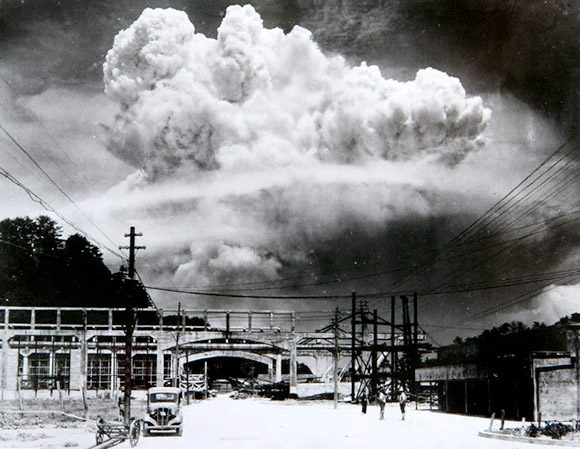
[Hiroshima and Nagasaki]


This month marked the 65th anniversary of the only nuclear weapons to be used in war, the atomic bombs dropped on Hiroshima and Nagasaki. These anniversaries passed without much notice, although for the first time there was an official American presence at the Hiroshima commemoration. This lack of attention is disquieting, not only to some in Japan, such as this prominent writer, but to others, such as this teacher whose students consider it "ancient history." The further we get from the reality of the damage caused by two atomic bombs of very modest yield by today's standards, the more complacent we seem to be, and therefore the more likely that nuclear weapons will be used again.

What follows is my piece published in the San Francisco Chronicle
Outlook section marking the 60th anniversary of Hiroshima in 2005.

On July 16, 1945, the cruiser Indianapolis sailed from Hunters Point Naval Shipyard in San Francisco, carrying one 15-foot crate. Inside were the components for the first atomic bomb destined to be dropped on a city. It was being shipped to Tinian Island in the western Pacific, and its final destination a few weeks later would be Hiroshima. It left San Francisco just four hours after the first successful atomic bomb test in history, in the New Mexico desert.

Sixty years is a long time to keep even such an immense memory alive, but several books published recently bring these events into sharper focus than ever before.

Several are biographies of key figures like Robert Oppenheimer and Edward Teller, but one is billed as a biography of the bomb itself. "The Bomb: A Life" by Gerard DeGroot (Harvard University Press), professor of modern history at the University of St. Andrews in Scotland, benefits from newly available records, especially concerning the Soviet nuclear program. But mostly it is a skillfully condensed narrative of the nuclear era, fascinating in the selection of details and riveting in its revelations of how possessing nuclear weapons changed those involved, and changed America.

On the day of that first test in July 1945, no one knew what would happen. About half the scientists didn't think the device would explode at all. Enrico Fermi was taking bets that it would burn off the Earth's atmosphere.

It did explode, with such brightness that a woman blind from birth traveling in a car some distance away saw it. "A colony on Mars, had such a thing existed, could have seen the flash," DeGroot writes. "All living things within a mile were killed, including all insects."

America was now in sole possession of the most powerful weapon in history. The first effect of the bomb was in Potsdam, Germany, where President Harry Truman was conferring with British Prime Minister Winston Churchill and Joseph Stalin, premier of the Soviet Union, then an ally in the war against Japan. After Truman received the news of the successful test, he was "a changed man" and "generally bossed the whole meeting," according to Churchill.

That the second bomb left San Francisco on the day the first was tested suggests the momentum to use it. Whether dropping the bomb was necessary to secure Japan's surrender before an invasion became necessary is still being debated. DeGroot believes that Japan was looking for a way to surrender in June and July. But there were other considerations, mostly to do with demonstrating American power, especially to the Soviet Union.

Using the bomb quickly became a test of patriotism. "For most Manhattan Project scientists the bomb was a deterrent, not a weapon," DeGroot writes. Physicist Leo Szilard had done as much as anyone to try to persuade FDR to develop the bomb because Germany was doing so. But on the day after that first test, he sent government officials a petition signed by 69 project scientists arguing that to use the bomb would ignite a dangerous arms race and damage America's postwar moral position, especially its ability to bring "the unloosed forces of destruction under control."

The petition was ignored, and Gen. Leslie Groves, the senior military official in charge of the project, began making a case that Szilard was a security risk. It's a pattern that would be repeated often.

DeGroot places the decision to drop the bomb on Japan in the context of the brutalization that occurred during the long years of World War II, with an unprecedented scope of savagery on both sides. The bombing of civilians and cities, morally unthinkable in the West before the war, became a major feature of it by its final years, long past the time many military targets were left. Gen. Groves, he writes, was worried that Japan might surrender before the bomb could be dropped.

Hiroshima was selected as the primary target because it had no allied POW camps. However, there were nearly 5,000 American children in the city -- "mainly children sent to Japan after their parents, U.S. citizens of Japanese origin, had been interred." It seems likely some of those children were from San Francisco.

The nuclear era began with the secrecy of the Manhattan Project, which is perhaps partly why it was accompanied throughout its history by lies and denial. It began with Hiroshima. As many as 75,000 people died in the first blast and fire. But in five years the death toll would reach 200,000 because of what the U.S. government denied existed: lethal radiation.

Even after the hydrogen bomb was developed in the 1950s (so powerful that the first test vaporized an island and created a mile wide crater 175 feet deep), the untruths continued. In 1954, Dr. David Bradley reported on 406 Pacific islanders exposed to H-bomb fallout: nine children were born retarded, 10 more with other abnormalities, and three were stillborn, including one reported to be "not recognizable as human." Such information was denied or routinely suppressed through all the years of testing, even on U.S. soil. Groves even told Congress that death from radiation was "very pleasant."

Even after the war, criticizing the bomb in any way became a threat to national security, an act of disloyalty that only helped the communist enemy. And so people were silent and compliant, and streamed into air-conditioned theatres to see movies about monsters created by atomic radiation.

This extreme weapon prompted extreme and contrary emotions, often within the same people. Some of the same Los Alamos scientists who cheered madly at the first news of Hiroshima were later shell-shocked with regret. Gen. Omar Bradley called his contemporaries "nuclear giants and ethical infants." Yet he pushed for developing the hydrogen bomb.

This peculiar combination of denial plus the immense power of thousands of bombs contributed to an era of deadly absurdities: the age of Dr. Strangelove. Yet reality was not so different, right down to the preposterously appropriate names: the head of the Strategic Air Command, Gen. Tommy Power, gave his philosophy of nuclear war in 1960: "At the end of the war, if there are two Americans and one Russian, we win!"

The warp in American political life created by the bomb might be summarized in two statements. "In order to make the country bear the burden," said President Dwight Eisenhower's secretary of state, John Foster Dulles, referring to the Cold War arms race, "we have to create an emotional atmosphere akin to a wartime psychology. We must create the idea of a threat from without."

The second is more famous, but perhaps its connection to the bomb and its effect on America has been forgotten: Eisenhower's farewell address. "We have been compelled to create a permanent arms industry of vast proportions," he said. "We must not fail to comprehend its vast implications. ... We must guard against the acquisition of unwarranted influence, whether sought or unsought, by the military-industrial complex. The potential for the disastrous rise of misplaced power exists and will persist."

Monday, March 08, 2010

What Gender Is Oscar?

This somewhat tongue in cheek piece was published as an oped in the Los Angeles Times on February 15, 2004.  This is a longer version, without the Times' cuts and one of my own.  I posted it here in 2010 after I read a similar piece asking the same questions, debunking the idea that the Oscar for best actress is sexist. 

It turns out this subject had been raised before, and since--as chronicled here by Daniel Radosh. Sorry, D.R., I wasn't aware of your prior piece when I wrote mine! Although it's such an obvious idea that he might not have been the first either. You might still be able to find the version the Times printed here.

Why is there a Best Actress Award?


(Los Angeles Times: February 15, 2004)

Sandra Bullock accepting the 2010 Academy
Award for Best Actress performance

As the Academy members mull over their choices among this year's nominees, I pause to ask one perhaps impertinent question about the Best Performance by an Actress categories. It's not about the fine female actors nominated this year---it concerns the categories themselves. My question is, why do they exist?

For after all, there is no award for the best screenplay by a woman writer. Sophia Coppola wasn't nominated as best female director. There will be no award for a Best Picture by a woman producer. Why are there separate acting awards divided by gender?

There doesn't appear to be anything about acting skill that is gender specific. In fact, many women insist on being called actors, and bristle at the designation of "actress" because it is implicitly demeaning, like the term "authoress." A writer is a writer, and an actor is an actor. Aren't these gender designated categories just relics of a less enlightened age?

All of the other Academy Award categories are based on the type of work or the type of film. These are the only categories that aren't. There are no separate categories based on race, ethnicity, religion, age, sexual preference or any other element of diversity. Why not best performance by a Latino in a leading role (apart from the extreme difficulty of coming up with five nominees)? Or best performance by a gay or Lesbian actor playing a character of the same gender and sexual preference, and another for playing a straight person?

It should be noted that women who might ordinarily lobby for equal treatment haven't exactly been burning their SAG cards to protest gender specific awards categories. The reasons aren't hard to figure out. Thanks in part to the prevalence of action pictures with a worldwide audience, fewer women get fewer starring roles, or even substantial supporting roles, than men (or, these days, than special effects creatures.) More male stars have more box office clout.

Kathyrn Bigelow, first woman awarded
Best Director Oscar, in 2010

So if there were only a single acting category, women might be in danger of getting a token nomination or two, but how often would they win? Having their own categories means that more women are more likely to get more attention, which helps all women actors. In the movie business and particularly in the businesses that own the movie business, there are fewer women decision-makers than men, and only a percentage of them will focus at all on making things better for other women.

Women actors need this category just to survive. So the inevitable conclusion is simply this: the best actress award is an affirmative action program. The award redresses contemporary imbalances and historically derived inequalities that otherwise would continue automatically.

Of course, that's not why these categories were created, or even why they are kept. Glamorous and sexy women attract audiences to movies, apart from their acting performances. Audience interest in watching the awards program is increased as well by beautiful women crossing the stage and tearfully thanking their parents and agents while dressed in daring designer clothes.

On the other hand, if there weren't special categories for women actors, the most popular women might need to be paid in ways other than prestige, like in equal money.

Other movie and television awards shows follow the gender pattern for acting. The Grammy awards however have categories for the music of specific ethnic groups (Native Americans, for instance) and for types of music that are associated with performers and audiences of one race or another. So instead of getting rid of these categories, should new ones be created to reflect other differences and redress imbalance? Separate categories for black actors and actresses, for instance?

But just as women aren't agitating for an end to their best performance categories, minorities are by and large not asking for their separate categories. Black actors have chosen to compete without reference to race. So Denzel Washington was not the best black actor, nor was Halle Berry the best black actress. They were the best, period.

Despite the fact that these two were very rare awards, and that black actors have historically faced long odds to even get on the screen at all, it may be that the greater legitimacy of winning an unrestricted award is worth it. Also, minority actors can support each other and work for better opportunities without feeling they are competing against just each other for a separate and probably unequal prize.

The Grammys reflect cultural roots of music, and how recorded music is marketed. Even though at various times there were movies made specifically for black audiences, movies have a very different history in most respects, and an entirely different marketing structure than the music business. These days however there is a marketing distinction between male-oriented action pictures, and movies about intimate relationships, widely known as "chick flicks." The actress categories may serve to recognize this market in particular.

The Oscars have gender specific acting awards today because they've always had them, the press and public like them, and nobody seems to want it any other way. Still, a new entry in the endless stream of awards shows might try something different and give a single genderless Best Performance award. Besides recognizing equality, and quality regardless of gender, it would have the additional advantage of an awards show that is just that much shorter.