Andy Warhol, Silver Screen
Article on the opening of the Andy Warhol Museum in Pittsburgh, solicited by and published by altelier Magazine of International Art, International Edition published in English and Japanese, September 1994.
I was living in Pittsburgh at the time, thirty miles or so from where I grew up. The museum took over a building that used to house a music store, where I first went as a high school student to help pick out sheet music for the marching band. I announced the half time shows, wrote the copy and eventually chose the music. The last time I'd gone there to find some music books was just a few years before the museum opened. Perhaps by now the Andy Warhol Museum has become as much a part of Pittsburgh as Volkwein's Music used to be.
Accompanied by mimes, jugglers, puppets and Buffo the Clown, attended by art world celebrities such as pop artist Roy Lichtenstein and Picasso biographer John Richardson, and graced by Hollywood stars like actor Dennis Hopper and director John Waters, the Andy Warhol Museum officially opened in Pittsburgh in May 1994. According to its director, Thomas Armstrong, "it is the most comprehensive single-artist museum in the world."
Andy Warhol was born into a immigrant working class family in the industrial city of Pittsburgh in 1928, and at the age of 21 left for New York City the week he graduated from college with a degree in design. He slowly became a successful commercial artist. By 1957 he had several assistants and incorporated himself as Andy Warhol Enterprises. Then suddenly in the 1960s, with his Pop Art paintings of mass-produced objects and silkscreen portraits of celebrities, Warhol exploded onto the international art scene. He became one of the most famous and most controversial artists of the 20th century, and changed the art world forever.
After Warhol's death in 1987, New York's Dia Center for the Arts (which had collected more than 200 Warhol works) and the Andy Warhol Foundation (which controls the Warhol estate) went looking for a major New York art institution to provide the financial backing for a museum dedicated to Warhol, but they found no takers.
Eventually they contacted Pittsburgh's Carnegie Museum of Art, which agreed to join as a partner in this joint venture. "It was an opportunity to bring a collection into Pittsburgh that had a reason to be here," Tom Armstrong explains. "In addition, Pittsburgh is a city that has decided that culture is a viable part of its future, and they were anxious to have a facility that would attract an international audience."
Armstrong, who had championed the work of new artists including Warhol during his 15 years as director of New York's Whitney Museum, was hired as the Warhol's director. "I realized this was a wonderful opportunity to be involved in the beginnings of an unprecedented type of museum," he says. " I thought it would be an extraordinary way to culminate my career in the museum field." His job now includes raising money for an endowment and an acquisitions budget.
Using all eight floors of a redesigned and refurbished 88,000 square-foot stone warehouse, the museum covers all aspects of Warhol's thirty year career, which involved film, publishing (several books and Interview magazine, which he founded) and rock music (he sponsored the classic band, the Velvet Underground, which featured Lou Reed and John Cale.)
One floor is devoted to the Archives Study Center, a point of pride for Tom Armstrong. "Andy never threw anything away," he says. "We have scrapbooks, notebooks, some 2,500 video and audio tapes, and over 600 of what he called his 'time capsules'--at the end of every day he shoved all the ephemera on his desk into a box and sealed it. We have an enormous collection of extraordinary source materials. It really is the combination of these archives and the more than 3,000 works of art we have in our permanent collection that makes this museum so special."
These works range from early commercial illustrations to collaborations with younger artists in the 1980s. They include environmental works, such as "Rain Machine," made for the Osaka World's Fair. But for this inaugural exhibit, the heart of the building is devoted to the period of Warhol's most famous work--the 1960s.
Here are his straightfaced paintings of brand name products and examples of the silkscreened photographs of celebrities enhanced with bright, day-glo colors that he began making in 1962. His portraits of Marilyn Monroe, Elvis Presley as a gunfighter, Elizabeth Taylor, Liza Minelli and finally his 1970s series of "Mao" (which at the Warhol Museum are hung against his purple Mao wallpaper) shook the art world and astounded the public.
In 1963 he made his first silkscreen portrait of a smiling Jackie Kennedy, surrounded by a robust red halo. In 1964 he constructed a multi-panelled portrait of her from photographs taken at President Kennedy's funeral. The Museum also shows not only the original array of photographs sent to be silkscreened, but the scissored magazine pages they came from. Curiously, Warhol did not use the most dramatic image--a full face photograph reminiscent of a Madonna or a grieving Mona Lisa.
By the mid-1960s Warhol was whirling through international exhibitions, accompanied by the Velvet Underground and his traveling light show, the Exploding Plastic Inevitable. With his New York assembly-line of artworks and films he called the Factory, Warhol was a focal point and a generating force. His parties mixing pop stars and pop artists with socialites and the "Superstars" he created, became intrinsic to his legend.
His statements in the catalogue of his first retrospective at the Modern Museet in Stockholm in 1968 became Warhol's manifesto: "I like boring things." "I'd like to be a machine, wouldn't you?" "I love Hollywood. Everybody's plastic, but I love plastic. I want to be plastic." "If you want to know all about Andy Warhol, just look at the surface of my paintings and films and me, and there I am. There's nothing behind it." "In the future everybody will be world famous for fifteen minutes."
Pop art, defined in England in the 1950s in reference to the collages of Richard Hamilton, uses popular culture as both form and content for "high" art works. By the mid 1960s Warhol was the most famous Pop Artist outside the art world--the one who popularized Pop. When he survived an attempted assassin's bullet in 1968, he became almost mythic. The general public was fascinated by Warhol's audaciously familiar images and repelled by his outrageous lifestyle, while elements of the art world found his work both a logical outgrowth of the pop art of Jasper Johns, Roy Lichtenstein, Claes Oldenburg and James Rosenquist, and a kind of nauseating apotheosis. "Before the Warhol canvases we are trapped in a ghastly embarrassment," wrote David Antin in a 1966 issue of Art News. "This sense of the arbitrary coloring, the nearly obliterated image and the persistently intrusive feeling. Somewhere in the image there is a proposition. It is unclear."
One potential problem of a one-artist museum is that it isolates the artist from his times and influences, which is a special danger in Warhol's case. He consciously absorbed the 1960s: a period of enormous energy, activity and change, when artists were experimenting with technology and borders were falling between various art forms, between high and popular art, and even between art and life. It was the era of happenings and the put on; of the Beatles, the Now Generation and Flower Power, John Cage and Marshall McLuhan (who said "The medium is the message" and "Art is anything you can get away with.")
Nevertheless, as critic Barbara Rose wrote of Warhol in 1971, "the images he leaves will be the permanent record of America in the sixties: mechanical, vulgar, violent, commercial, deadly." Though some would argue these images are deceptive because they are incomplete and skewed to the superficial, the existence of this museum seems to enforce Rose's observation.
Like John Cage, who released the music in ambient sound simply by calling it a song, Warhol found the charm in ordinary speech through transcribed interviews, and a different range of responses in watching a movie of a man sleeping. Among the Pop artists, Warhol was the most successful in suggesting that individuals need not be passively overwhelmed by the barrage of information and images--they could transform them into art. But many of Warhol's achievements appear somehow accidental. He confronted the culture with its own tawdry icons--celebrities and consumer products--but it's not clear he meant to do so.
Warhol led the Pop art parade basically by stepping out in front of it. After Johns painted a portrait of the American flag, Warhol took the next fatal step by painting the real icon to which the culture pledges its allegiance: the dollar bill.
But he approached the art world as he would a commercial client, asking essentially "What do they want?" He took the shrewd advice of a savvy art dealer who suggested that he paint dollar bills and "something like a can of Campbell's soup."
Normally a solo museum would seem to anoint a artist considered great by consensus, but the opening of the Warhol Museum was greeted in the local and national press with a cacophony of delight and anger, fulsome praise and utter derision. According to various views, Warhol was a social critic or social-climber, brilliant innovator or mindless imitator, a great artist or a con artist.
Was Warhol cynical or disingenuous? Did he mean to criticize or glorify consumer culture? Was he a serious artist or a lucky opportunist? According to Warhol biographer Bob Colacello he was all of this and more. "The ambiguity at the core of his work reflected the deep contradictions of his personality: Andy was innocent and decadent, primitive and sophisticated, shy and pushy, the eternal outsider at the center of a series of self-created in-crowds."
The Warhol Museum may encourage continuing evaluation of his legacy. At this point it seems clear that his pursuit of publicity and celebrity along with the mechanisms of a market that enhances the value of individual works through popular dissemination of their images was a watershed for contemporary artists, and helped create today's art world market and environment.
Cultural historians may see in his images the first evidence of a peculiarly working-class sensibility beginning to dominate a mass culture of the newly prosperous but uprooted, with mass produced objects and environments replaced the traditional, the hand-made and the local. The new consumers of culture found comfort not in the land of their ancestors or birth, but in the soup can label they remember from childhood. Their icons were no longer saints but celebrities, and the altar for the household gods was the television set.
Tom Armstrong hopes that scholars and others interested in the culture of the second half of the twentieth century will come to the Warhol museum. For the joint venture partners, it also keeps Warhol's work in the public eye and may enhance its financial value, which had shown signs of slipping. For Pittsburgh--now trying to find a new identity after losing its steel mills-it could attract tourists as well as scholars with its colorful celebrity faces (beginning with Warhol's self-portrait at the entrance ) and such crowd-pleasers as the "Silver Clouds" installation, a room of softly floating silver helium-filled balloons that gently bump and brush against visitors. Some locals have already begun calling it "Andyland." Visitors in the first few weeks appeared to include excited young artists and people unfamiliar with any art museum, who came to see what all this Andy Warhol fuss had been about. Some seemed equally interested in his paintings of celebrities and the magazine photographs that served as their sources.
The inaugural exhibition will be on view until May 1995. In 1996, the Museum plans to take a Warhol retrospective to Tokyo and two other cities in Japan.
Tuesday, June 03, 2003
Eugene O'Neill Center Playwrights Conference: The Summer of '91
Some twelve years ago I had one of the happiest summer experiences of my life, for two weeks at the Eugene O'Neill Theater Center in Waterford, Connecticut, during the National Playwrights Conference. I was there on assignment to the Smithsonian Magazine. My story ran in the March 1992 issue. This is a somewhat different version.
I was living in Pittsburgh then, and among other things I was writing plays. I'd been doing that since the third grade. Actually I more or less peaked in fourth grade, when I had my own rep company for a season: my Cub Scouts den. One month we couldn't think of anything else to do, so we put on a play I wrote for a pack meeting (each six-kid den met once a week, and the pack of dens once a month) and won the best-of-show. So we did it again the next month, won again (our competition being on the order of boys showing the knots they tied that month) and kept going, until we were spending all month making scenery, gathering props and rehearsing.
I wrote, acted and directed a bit in college, and though I wrote plays over the years, it wasn't until I got a reading at a theatre in Pittsburgh that I decided to pursue it more intently. I'd just left a "real job" and had severance pay and unemployment benefits to sustain me, so I wrote away. Several short pieces were produced, I won a small award with very modest production, and I began meeting and hanging out with theatre people.
So I heard about the O'Neill---it was legendary, and New York actors who came through for various local productions spoke about it with awe-and proposed a story to the Smithsonian, for which I'd been writing. It was easily the best assignment I got.
The conference began the day after my birthday, which I spent alone on the cloudy New London beach. It was the last day of anonymity I would have for the next month. The O'Neill advertised itself as a community, and it very much was. I hope that comes through in the article.
One of my first interviews was with August Wilson, a great talker and storyteller who was very generous with his time and comments. He is from Pittsburgh, and about my age, so as we kept talking, we had many points of reference (the 1960 Pittsburgh Pirates, for example), though sometimes from different points of view. We got on very well, and even had a few adventures that weren't appropriate to tell in the article.
Here's one, though: my day with the August Wilson Gang. Four of us left the O'Neill in a station wagon to perform various errands in Waterford and New London. Several of us---including me and August---needed to get cash, so we searched for cash machines. The few we found didn't work for our particular bank systems. We wound up at a small drive-in bank near closing time. There was no machine outside, but some banks had them inside so August and I rushed in, looking frantically around. I think we had the thought at the same time: we looked like we were casing the joint. August quickly tried to explain to a clerk, a woman in her 60s or so, who just smiled and called him "Mr. Wilson." Everybody at the O'Neill was required to wear a name tag all the time, and August had forgotten he was still wearing his.
Later when we talked about it, I thought it was all very funny, but he was not so amused. It was a little more consequential for a black man to be under suspicion, if the police were called.
Lloyd Richards was also fascinating and generous, with a precise imagination, a kindness that put up with no nonsense and insisted on discipline, and a modesty that was inflected with showmanship. O'Neill founder George White (who I'd met briefly at Carnegie Mellon, where he was receiving an award) was also very generous, and had loads of ideas and schemes for energizing theatre and the arts in America. But then, everyone I met there---from resident staff (even the guy who stepped in front of me to muff the volley I would have taken care of easily in one of the early conference volleyball games) to the actors and writers, to even the visitors who came for a day or two---were extremely kind to me, helpful and forthcoming.
I had such a great time at the O'Neill that I did exactly as August Wilson suggests in the piece: I sent in a play and a teleplay the next year, and the year after that. The second year I got a personal letter from Lloyd Richards, probably as much or more in recognition of my article as for my dramatic writing.
I never got back there as a playwright but I haven't stopped thinking about it. The 2003 conference starts in less than a month. Re-reading this piece is as close as I'll get this year.
This article also marked a watershed in my magazine and newspaper writing career. I hadn't bothered much over the editing of previous pieces for the Smithsonian, but I cared a lot about this one. When I got the edit I was upset by it, but I'd dealt with this stage of the process before. My editor wasn't accessible, so I set about trying to re-edit in such a way as to keep to the same number of words as her edit but to restore some of the parts I felt were important. To my shock and dismay, my work was entirely ignored---that is, it was refused. The piece was printed as first edited.
This was the first time I had no influence on the editing of my work. On "The Malling of America" for example, New Times magazine brought me to New York for several days-it turned out to be a week- just to work with the editor on editing. Even the New York Times Magazine, notorious for what one prominent novelist and essayist called an editing process of "brutality," at least participated in some give and take.
It turned out my editor had something like three or four articles coming out in the same issue and was greatly overextended. But this experience also turned out to be a precedent. Consulting with writers on the work that will be published under their name (not the editor's) has largely gone the way of fact-checking.
What follows is a longer version, based on my last draft. I added some material from surviving notes, mostly quotes from the playwrights, some of whom have become pretty prominent, in television especially. I've also attached a summary of what I've found of their subsequent history after the piece itself.
For awhile I crossed paths with people I'd met at the O'Neill, especially actors. I saw August Wilson several more times in Pittsburgh, at a premiere of a new production and once after he received an award (when he told me with justifiable pride that he'd quit smoking.) In every case there was an instant sort of familiarity, almost intimacy, that meant we'd shared a special experience at a special place, and that would link us forever.
We don't see a lot of outside theatre folk up here on the North Coast (though a couple of Jeff Hatcher's plays were done at a theatre in Eureka, but he didn't come for them) so I haven't seen any O'Neill people in awhile (though I have talked on the phone with Lori Robishaw, who was my press contact in '91 and later ran the O' Neill conference. She's with Americans for the Arts now.) But come July, I'll be wondering who's out on the seaporch, and what they're talking about.
In 1979, an unknown playwright received a brochure from a friend that described the National Playwrights Conference, a month-long summer residency at the Eugene O'Neill Theater Center in Waterford, Connecticut. Scrawled on the brochure was the friend's instruction: "Do this!"
So he sent in a stage play and a play for television (the two conference categories) before the annual December 1 deadline, along with his stamped self-addressed envelop. There were at least a thousand others trying to be one of perhaps fifteen playwrights selected to work on their plays with the help of some of the best actors, directors and other professionals in American theater. The envelope came back with bad news.
He sent another two scripts the next year. This time he got a form letter from Lloyd Richards, the conference Artistic Director, encouraging him to keep writing. So he wrote the best play he could and sent it the next year. When his self-addressed envelope came back again, he threw it across the room.
Later, when he thought to open it, he discovered that he was a finalist. Soon he got the telegram inviting him to spend July on a rambling farm caressed by the smell of the sea. "Nothing I've experienced in the theater quite matches the excitement of that," he said. "I guess what it said was, 'yes, you can be a playwright.'" It changed his life, and American theater.
The 1982 conference was such an inspiring experience for him that he immediately set out to repeat it. "The first thing I wanted to do was come back," he said. "I didn't have an idea for a play, but when I got home I said to myself I have to write a play by December first. I just have to write a play because I want to go back up there. And I did."
That play, which he worked on the next summer at the O'Neill, was eventually titled "Fences." It won August Wilson the 1987 Pulitzer Prize for Drama. That first play he took to the O'Neill was "Ma Rainey's Black Bottom," which made it to Broadway and was highly acclaimed. In subsequent years, August Wilson returned to the O'Neill to work on "Joe Turner's Come and Gone" and "The Piano Lesson," which won the 1990 Pulitzer.
This is one of the more recent playwright conference legends but hardly the only one: O'Neill Center plays and playwrights have energized international theater for more than a quarter century, winning several more Pulitzers as well as Oscars, Emmys, Tonys, Obies, and even a Nobel Prize for Literature.
Among the prominent playwrights the O'Neill has nourished are John Guare (author of Six Degrees of Separation), Wendy Wasserstein (The Heidi Chronicles), David Henry Hwang (M. Butterfly), Christopher Durang (Sister Mary Ignatius Explains It All For You), Lanford Wilson (Burn This), Charles Fuller (A Soldier's Tale), Lee Blessing (A Walk in the Woods) and John Patrick Shanley (who wrote the screenplay for Moonstruck.) Michael Douglas, Meryl Streep, Charles Dutton, Al Pacino, Jessica Tandy and Raul Julia are some of the actors who have participated in this protean enterprise.
Although many theater institutions now develop and showcase new plays (notably the Actors Theatre of Louisville), the O'Neill pioneered the practice, and in many ways it remains unique. For playwrights it is a trial by Paradise in a four week Eden, a working idyll demanding both openness and nerve, where they are privileged and condemned to creating in a state of grace under pressure. For all participants it is a necessary oasis, a temporary Utopia, where they can live out ideals of sincere community with hearts and talent joined, and commit to the real work of making theatre, protected from the pollution of other agendas.
How all this actually works is the O'Neill Center's mystique. Its history and prominence, its physical environment, its process, and something that might be called its ethic, are the elements that make it an indispensable asset to American theatre.
That's also what makes playwrights determined to come here, along with such legends as August Wilson's. "Coming to the O'Neill is something playwrights want to do," said P.J. Barry, one of the 1991 writers. "It's part of the experience of being an American playwright."
As a boy growing up in Waterford, George C. White had played in the barn on the Hammond estate, a 95 acre spread overlooking Long Island Sound. When White was a young story editor of the classic television series, "East Side, West Side" in the early 1960s, he learned that the estate's then abandoned buildings were about to be destroyed. At least one was scheduled to be burned as practice for the Waterford fire department.
He hit upon the idea of saving the estate by dedicating it to the theater and naming it after Eugene O'Neill, arguably American's first great playwright, who spent his boyhood in nearby New London, and had lived out his last years in a house a few miles away. (Called the Monte Cristo cottage, it is now owned by the O'Neill Center and open to the public.) O"Neill set one of his plays on the Hammond Estate itself, despite Edward Hammond's habit of chasing young Eugene away from the grounds with a shotgun.
With $1200 in cash raised from a life insurance policy and the housing provided by Waterford friends, White convened the first conference on the estate in 1965. Attending were eminent theater professionals and twenty-one young playwrights associated with the embryonic Off-Off Broadway movement, who were drawn in part by the presence of Edward Albee, then the only new voice in a generation to break Broadway's stranglehold on American theatre.
It was a tumultuous five days. "A lot of angry playwrights who wanted to be heard, who wanted in," recalls one of those young playwrights, Frank Gagliano, who drove a car up from Manhattan with unknowns Lanford Wilson and Sam Shepard as passengers. "The energy was extraordinary."
Decorous discussions under the trees among gentlemen and ladies in suits turned into shouting matches. The nineteen year old Shepard made an impassioned speech and stormed out of the conference, never to return. But some others (who included John Guare and Israel Horovitz) began talking about what they could do there, and giving new plays a start was the consensus.
The conference ended with the kind of connective---and predictive---symbolism that has become part of the O'Neill Center mystique: an act of "Moon for the Misbegotten" was performed in the old barn, directed by Jose Quintero, the champion of the then ongoing revival of Eugene O'Neill's plays. It would be only a few years later that his direction of this play would electrify New York.
The next two summers made the O'Neill Center's own reputation, and almost ended its existence. so many of those angry playwrights who returned had subsequent successes in new York that an article in the New York Times dubbed the O'Neill "Tryout Town USA." But the elaborate productions were exhausting participants and fostering rivalries. In 1968, George White convened another meeting. "It became obvious that the first task was to abolish the artistic anarchy that had set in," White recalls. "We needed a strong artistic director."
White turned to Lloyd Richards, the director of Lorraine Hansberry's 1959 Broadway hit, "A Raisin in the Sun." Although Richards had directed one of those elaborate productions at the O'Neill (complete with exploding bombs and rifle fire), he immediately stripped the conference down to essentials, "to focus on its original intent," as Richards says today, "which is to serve the playwright and serve the theatre by developing these playwrights." White and Richards have guided the O'Neill in that direction ever since.
Every day is a week...This is the repeated refrain, the conference mantra. Everyone uses it to describe not only the intense four-day rehearsal period for each play, but the O'Neill experience itself. Take for example the progress of "Dinosaur Dreams."
On a golden Monday morning, the first day of July, Tom Szentgyorgi rode in the blue O'Neill van down a curving two lane road through lush trees to the blue sign announcing the O'Neill Center in gold letters. Along with his fellow 1991 playwrights, a couple of whom were with him in the van, he would split his time for the next month between a room in a borrowed dormitory a few miles away where the living conditions were somewhere between collegiate and penal (one dorm has been known for years as "the Slammer"), and this quaint collection of frame buildings floating on 8.5 isolated acres, redolent of history and hopes, scattered with immanence. They'd left Manhattan's noisy insistence just a few hours earlier. Here they hear little but the calm commentary of birds.
There's time this first morning for a fast tour of the grounds. The indoor performance space is housed in the red barn, now refurbished, air-conditioned and named after two early O'Neill Center supporters, Rufus Rose (a pioneer puppeteer who created Howdy Doody, and was a mentor to the Muppet's Jim Henson) and his wife Margo. Next to the barn is the outdoor amphitheater, a shadeless suggestion of ancient Greece, though the ship's mast serving as a lighting tower gives it a nautical New England touch. A new wooden platform is under construction there, replacing the first one that Michael Douglas once augmented his actor's salary helping to build.
Some of their plays will also be performed at the Instant Theater, a small platform surrounded by bleachers nestled next to the signature copper beech tree. It was here that Lee Blessing's "A Walk in the Woods," the now famous play concerning conversations under the trees between a Soviet and an American arms negotiator was first performed, on July 4, 1984.
As soon as all the playwrights arrive, the work begins. Dressed in polo shirts, shorts and sandals; jeans, t-shirts and sneakers, they gather in a mostly bare room at one end of the Production Cottage, a long frame building of offices that inside as well as out suggests an elongated train caboose. In folding chairs or sprawled on the floor, they listen to each other read their plays. The first play they hear is "Dinosaur Dreams" by Tom Szentgyorgi.
Tom, whose last name (according to his program bio) is pronounced "szentgyorgi," but who tells everyone to say it as "St. George," has been an assistant director and literary manager, and after the conference will become the associate artistic director of the Denver Center Theater Company. He'd written a few short theatre pieces, but "Dinosaur Dreams", is his first full length play. Focusing on a young couple, it has a contemporary urban setting and theme, and a mood that mixes comedy and drama.
Many of his fellow playwrights in 1991 had also logged years in theatre, but half of them were here to work in a new form. Phil Bosakowski, Patricia Cobey and Peter Selgin had teleplays, while Gannon Kenney, Matthew Witten, Rick Cleveland, Jeffrey Hatcher, Paul Zimmerman, Charles Schulman, John Darago and P.J. Barry had stage plays. In age and experience the group ranged from Kenney, a Harvard graduate student, to Barry, a seasoned New York playwright and actor. Only two had been to the O'Neill before.
They would read to each other for the next three days. Besides gently starting the process of exposing a written script to scrutiny and transforming it into live theatre, this marathon introduces the playwrights to each other through their work, before they go their separate ways with their separate plays. They will need each other's support and understanding for the compressed rigors ahead, so the bonding this common experience creates is considered so important that this is one of the few events the O'Neill bars to outsiders.
But as he reads his own play, such purposes are lost on Tom. He is conscious only of the strange sound of his characters' words coming out of his mouth, and the salt deposits of sweat forming on his shirt.
At the sound of an old-fashioned school bell, the playwrights adjourn to cafeteria-style meals at the 19th century frame house known as the Mansion. They carry their trays into the added-on dining hall or through a warren of offices out to what is called the seaporch, with the Center's most dramatic view. From its red picnic tables under yellow and white striped awnings, they can gaze down the sloping meadow bordered on one side by woods, to the sand dunes and swirls of green and yellow marsh grass, and past the white beach to the steady blue of the Sound. Breakfast here is sometimes accompanied by rolling billows of fog, and at night this silent hill is the best vantage for viewing a sky crazed with stars: the kind you don't see in Manhattan.
Tom's first dinner is a working one. He confers with his dramaturg, August Wilson. Dramaturgs didn't exist in America before the O'Neill Center was searching for a way to get critics involved in the process, and borrowed the term from Brecht. Today in the many theatres that have them, their function is usually production-oriented. But the duty of O'Neill dramaturges is to assist the playwright in remaking the play. So in addition to critics like the New Yorker's Edith Oliver, O'Neill's dramaturges now include other playwrights: in 1991, Corrine Jacker and August Wilson.
"Initially, I was pretty nervous," Tom said of his first private meeting with August. "But right away we were talking the right language. Mostly we looked at places in the script where I can relate some of the peripheral action more strongly to the main story---a kind of rhyming."
August talked to Tom about the theme of his play as expressed in his synopsis---personal consequences of economic retrenchment in the 1990s (or as director Bill Partlan later described it, "adapting to a world that's gotten colder")---and questioned how this theme is carried out. "I think I can be helpful," he concludes. "There are mistakes that everyone makes. Having made those mistakes, I can point them out... You can stay up all night long and read your play over and over again and you won't see these things until someone points them out to you."
For the next few days Tom works on rewrites, first on his old Olivetti portable, but he soon finds he has to book time on the center's only computer, because he has to write faster. He has already talked to Lloyd Richards about the play (Richards is famous among playwrights for his concise analysis) and his director, William Partlan (who coincidentally was August Wilson's first O'Neill director.) "I've got to make my play more than a bag of scenes," Tom says at lunch on Tuesday. "How well does each scene advance the plot? Does it elucidate what the play is about? I'm going through and following the arc of each character, and rewriting that way. I have to think those things consciously, but at the same time I can't over-determine the play and kill it with theory. My task is to fire up my imagination and put it in the direction I want to go. To me that's the hard part."
After missing a few meals, Tom reappears in cutoffs and a sweater on a cool, rainy Wednesday afternoon to confer with August again. Together they spread old and new pages on a round table in the dining hall, and scissor and tape the script together. In particular Tom has rewritten one major scene. Still, there are two other scenes they agree still have problems.
But at week's end the first test of both solutions and problems is about to come, when the process moves from the page to the stage.
The first weekend is unusual. The playwrights' marathon reading normally occurs here during a pre-conference in May, but last-minute government funding cuts meant that those three days had to be made up within the conference itself in July. Besides shortening the rewriting time (resulting in what playwright and O'Neill veteran Jeff Hatcher called "paroxysms of typing") this meant that there would be no performances ready for the first weekend. This gap was filled by the visiting Royal Dramatic Theatre of Sweden company, with a new play by Swedish author Lars Noren about Eugene O'Neill's last days at the Monte Cristo cottage.
After two public readings of a new English translation, the company did one act in Swedish just for the O'Neill community with Max von Sydow in a dazzling tour de force as the playwright. The company's presence was another loop in the spirals of O'Neill history, not only for the Swedes, who were seeing the very landscape O'Neill wrote about (including a fortuitous fog) but for the conference, since owing to American indifference, several of Eugene O'Neill's last plays were first performed in Sweden.
This international input is also a conference tradition, dating back to 1969, when poet Derek Walcott brought his theatre company from Trinidad, and 1970, when West African writer Wole Soyinka came to work on "Madmen and Specialists," a play he had begun writing with ink he made from coffee grounds while a political prisoner in Nigeria. (George White got him into the country by inventing a sponsoring organization and faking its letterhead.) Soyinka won the 1986 Nobel Prize in Literature.
On Sunday, the quintessential fog swirls up into the big beech tree and forms wispy walls around the members of the 1991 Playwright Conference community assembled on the bleachers of the outdoor Instant Theatre to hear Lloyd Richards give his traditional welcoming speech. Until now, there were only the playwrights, directors, dramaturges and designers, and the O'Neill technical and administrative staff. But the crowd includes actors now, ready to begin in earnest the O'Neill process, with its high theatrical mood of anxiety, nobility and sweat.
Monday, July 7 is the first hot and humid day of the conference. (There would be many more.) Tom walks out of the midsummer sunlight and into the dark cavernous barn for his first day of rehearsal. He and the others involved in "Dinosaur Dreams" will have only four days to do what normally takes a month (Every day is a week, every week is a...) The names of his cast were posted on the Production Cottage bulletin board on Sunday, so Tom had only a short time to cope with the notion that he will be working with stage veterans Anne Pitoniak, Victor Raider-Wexler and Phyllis Somerville, as well as seasoned young actors Jane Adams, Joe Urla, Robert Knepper and Tony nominee J. Smith Cameron.
Tom sits in the shadows at one end of the last row of folding chairs, silently listening to the first read-through by the actors arrayed on the still blank stage. He scribbles on his script, and occasionally gets up and paces behind the raised platform of seats. At the other end of the row is August Wilson, dressed in the same khaki safari outfit he bought for his first conference in 1982, writing notes on a yellow pad. Bill Partlan watches from closer range in the front row, nodding his encouragement.
After lunch, the actors reassemble on the stage and ask questions about their characters. The action of "Dinosaur Dreams" concerns a young couple, Bob and Paula, deciding on marriage in a time of personal and societal uncertainty. Actor Joe Urla, who plays Bob, begins asking about his character in the play's first scene, set in a bar where Bob tells his friend Mark about Paula.
"Bob describes meeting Paula in very idyllic terms," Urla says. "Is that what really happened?"
"No, he's idealizing her," Tom replies. "He's bragging to his friend. But he's being sincere about his feelings for her."
Others talk about Bob's actions and reactions as the play progresses and as Paula drifts away from him. Does he understand what is happening around him?
"Bob is socially shallow," Tom says. "He's not aware of the world. But he's not emotionally shallow---he's ready to deal with relationships. That's why he fixates on Paula, and on marrying her as the solution."
The character of Bob's friend Mark, who works on Wall Street, is easier to summarize. "He's a shark," Bill Partlan suggests. But then the question becomes what kind of a shark-street-hardened or sophisticated? Throughout the rehearsals, actor Robert Knepper will experiment with Mark's accents and attitudes.
"How does she know these colors?" August Wilson asks, as Paul begins a scene reciting a list of arcane shades, to humorously illustrate all the choices for a wedding dress besides white. "Is she an artist?"
"She's a teacher," Tom says. "They're colors in a big crayon box."
"I've taught nursery school," says actor Jane Adams, who is playing Paula between her Broadway appearances in I Hate Hamlet, and a role in a movie directed by Barbet Schroeder. "These are the colors we remember from our crayon boxes, but they aren't the colors kids have now."
It is the actor's role in the process to see the play from the point of view of the character he or she is playing. They contribute by questioning motivations, the logic of actions, the journey of the character from beginning to end, the character's place in advancing the dramatic action, or even how the character talks. When one actor in the O'Neill production of "Ma Rainey's Black Bottom" told him his line didn't sound like a white Chicago cop, Wilson asked him what the cop would say. "He said, you know, things like, 'look, buddy, if you want it in a nutshell,'" August Wilson recalled. "That line's in the play to this day."
"The actors who come here are so willing to give," Wilson said. "They come up here without knowing what play they'll be working on---they don't come because they get to act in this cool play, they come for the conference. I know they helped me."
"To me, this is sanctuary," said John Seitz, an established stage and film actor who has been coming to the O'Neill for 19 years. "I'm not an actor up here---I'm a resource who acts. You work with a playwright in a more direct way than you're allowed to in the real world. It's like renewing your vows, reminding yourself why you became an actor." It's the same reason he does workshops and readings in New York without pay, he added. The money comes from television. "But what do I play? Cops."
The actors read through the play again, and Tom paces behind the seats, listening to the dialogue as it competes with the ringing phone in the box office, stopping to scratch out lines that the actors' gestures and intonations make unnecessary. He pays particular attention to the scene in which Paula introduces Bob to her parents, his major rewrite so far. He's inserted a new event: Paula's father has lost his job, and her mother is upset about it. This carries forward his theme while adding extra drama to the scene. The actors don't know this is a revision, but from now on new pages are color-coded.
As the actors leave, Tom huddles briefly with his director and dramaturg. They agree the new scene works, but the two other scenes that troubled them don't play well. At dinner, Tom ponders the day's lessons. "I have to sort out the questions that pertain to acting---questions that actors would act even if they were doing Shakespeare---from the questions that pertain to problems in the script. I've got a lot of work to do in the next three days. I'm getting tired just thinking about it." After dinner he returns to the dorm to work on changes, a jar of instant coffee stuffed in his backpack.
Tuesday turns out to be Tom's worst day. Bill Partlan begins instructing the actors on when and where to move on the stage, the process known as blocking. The actors are carrying their scripts, but like the minimal set and props now beginning to appear, this will not change for performances. Long gone are the elaborate sets and competitive acting of the first two years. "Productions are restricted to only what's essential to express the material," is the Lloyd Richards' rule, so there are only simple, modular units that stand in for the requisite sofas and park benches; only essential props, no special lighting and no costumes except for clothes the actors supply for themselves. (A designer also draws a rendering of an ideal set after meeting with the playwright. It's posted for the audience to see, but its basic function is to give the playwright a sense of design needs and possibilities.)
Similarly, actors don't memorize their lines but carry their scripts as they play their roles. Along with the easily altered sets, this allows the playwright to keep making changes up to the moment of performance (which August Wilson for one admits that he's done.) With only four days of rehearsal, Richards points out, the script-in-hand method ensures that "playwrights will hear the lines they wrote, not an approximation."
Today the playwright hears the lines he wrote last night, and doesn't like them. No one else does either, so a frantic night's work is negated. This only makes a long day longer. Tom escapes momentarily from this repeating concentration in the dark, to the sunlight and salt air outside. "O the excitement, the glamour of live theatre!" he proclaims to the oblivious gulls.
But on Wednesday his mood lifts. His stage manager plays the recorded song she's using as background for the first scene: Peter Gabriel's "Sledgehammer." Tom brightens. I haven't heard music is so long!" Today's work on the latter part of the play helps to focus his thoughts on what he needs to change in Paula's earlier monologue, a pivotal moment. He is relieved that this is his last major rewrite.
Thursday morning they work on a new scene. Instead of talking directly to the audience about her hitch-hiking flight from Bob, Paula now re-enacts it in cinematic swatches. The director, stage manager and lighting designer discuss the required sound and light changes. Ahead are compressed versions of dress and technical rehearsals. Friday night, "Dinosaur Dreams" will face its first audience.
Meanwhile the special life of the O'Neill Center has gone on. An ad hoc company of actors has rehearsed and read all three teleplays to the community audience. One of the writers, Peter Selgin, had already become a conference legend for feverishly rewriting his teleplay almost completely, much of it on a broken typewriter, in what seemed like one continuous stint, punctuated by frequent showers. During the Swedish play he was seen in Blue Genes, the on-site café, writing alone at a table amidst the intermission revelers, dressed entirely in black. He reminded August Wilson of the playwright of a past summer who stayed up for four successive nights rewriting his play, only to sleep through its first performance.
By the end of the second week, there are 130 or so people on the premises, including visitors, all wearing the requisite name tags, some of who are scouting new plays for their New York and regional theatres. But no business is permitted on the grounds, and to protect the playwright in a vulnerable time, the O'Neill keeps performance rights to every play for the length of the conference plus six weeks, after which (unlike many other development programs) the O'Neill takes no money from any subsequent production.
By this time there is the usual catalogue of summer camp injuries, including a few more exotic accidents, like the playwright who got a moth in his ear, and the television executive who was sprayed by a skunk.
And then there was the Soviet playwright who arrived unexpectedly, and was found wandering through Kennedy airport by a nun. All will become part of O'Neill Center lore.
At night there are group trips to local movies, and visits to the nearby tiny amusement park down on the beach which sometimes supplies unwanted polka music to outdoor performances. In Blue Genes, a playwright plays piano while a staff member sings show tunes, and director Clinton Turner Davis takes on all comers in Scrabble, while conversation continues on the patio into the night.
There is talk everywhere, invigorating and intoxicating: Evocations of theatre history by people who were there, by participants like teleplay director Jay Broad and story editor Max Wilk, and guests like Ben Shaktman (founder of the Pittsburgh Public Theatre), who recalled encounters with Carlotta O'Neill, the playwright's widow. The names of Odets, Miller, Williams and Albee are spoken, anecdotes told, legends continued in the oral myth of the American theatre.
August Wilson mesmerizes his dinner companions one evening with a description of his latest play, complete with dialogue. Patricia Cobey and Corrine Jacker trade first childhood memories of live theatre (Patricia's was sneaking off to matinees at New York's Theatre de Lys; Corrine's was watching Sylvia Sidney carry her curtain-call roses in Chicago.) As they lingered by the stone wall one evening, gazing at the ocean in the distance, their conversation underlined commitments to a life in the theatre that characterizes the O'Neill. "Whenever someone I know is having problems," Cobey said, "I tell them to take an acting class. It always straightens you out. That's where you learn that you can't lie."
And there are periods of stillness and quiet. The black and white lawn chairs on wheels, the faded red picnic table sloping down the foot-browned grass, are etched as objects in the landscape as surely as the elegant and solitary tree in the center of the meadow, or the stand of furry green trees bordering the sand, the metallic blue sea and the jagged line of blue woods across the sound. There is a nourishment of stillness and place to match the nourishment of motion, the blood flow of talk, laughter, smiles, bodies touching each other in the medium of air, of sight, of sympathy. The flowers, the stone wall. The damp, the smell of the sea. The high motion of faint dark clouds against the higher solid banks of lighter gray. The sense that humans do belong here after all.
And then there is work. ( Every day is a week.) Concentration makes every moment larger. "There are no distractions, it's just the work. That's what I like about it," said Brian Siberell, an advisor to the teleplay process here, but whose New York days in charge of developing movies for HBO are broken by telephones and faxes. Distant from the outside world and completed concentrated on the task at hand (the condition, Patricia Cobey notes, of a child at play), there is an analogous focus on every person and on every moment, even in non-working time.
And at rehearsals, meals and every performance, there is Edith Oliver, who after twenty summers as a dramaturg is such a beloved embodiment of the O'Neill that her oil portrait hangs in the Mansion living room. "The mysterious thing is the feeling we all seem to have for the O'Neill," she says. "The question here isn't, 'May I join you?' You're always welcome. This is the O'Neill!"
On Thursday night Tom tries to relax. After dinner he joins in the traditional volleyball game near the Instant Theater. But these games, which had begun with informal irony and mock heroics when the players were playwrights and staff, had become more seriously athletic as more actors arrived. Tonight the dust rises in the bright dusk, and when the players quit early as the Instant Theater is prepared for a performance, Tom is not sorry.
Everyone in the community attends every play, and so Tom puts aside concerns for his own to watch Gannon Kenney's "Weller," a short, two-character drama with Mason Adams (of "Lou Grant" and Smuckers' commercials fame) and Tom McGowan (fresh from his Tony-nominated role in La Bete.) It is a spectacular evening, the clouds packed in pink and reflecting purple in the sea. As the audience gathers in the deepening blue twilight, Gannon sits high in the corner of the top row of bleachers---"ready to jump" he shouts at someone. He has rewritten half his play, as Tom can see from the pink and yellow pages amongst the white in the scripts which the actors carry. But the play is well received, both comforting and daunting to the playwrights yet to be performed.
The gathering is repeated on Friday night, this time for "Dinosaur Dreams." Besides the Center community and visitors in theatre, there's a audience that comes from Waterford and New London. They're generally a savvy group, as George White describes them, knowledgeable and excited, expecting the script-in-hand acting and minimal O'Neill production but nonetheless interested in a good night of theatre. They are the play's first real audience-and, White suggests, they take their part in the process seriously. It's a public that has developed over the years, along with the O'Neill itself.
At the barn door most O'Neill people head to the balcony (formerly known as the hayloft), leaving the first floor folding chairs for paying customers. Tom escorts his visiting parents to seats in the back row center, but he will watch (or rather, listen) while pacing back and forth near the entrance.
Before the play, Lloyd Richards gives his ritual speech explaining the O'Neill process in its historical context, and what the audience should expect. "Without new playwrights," he says, "theatre is a museum. From the fifteen hundred plays submitted this year, we have chosen twelve---not because they are ready for Off Broadway, but because we spotted a unique voice."
In conversation, Richards reiterates that the purpose of the selection process is not to find the best new plays but potentially the best new playwrights. An initial group of readers performs the first screening. Then Richards and a smaller group reads the ones that are left. He says that the ten percent rule usually operates, a percentage breakdown he claims is uniform throughout every creative screening process he's encountered. Ninety percent of what is submitted is not worth considering. The plays selected come out of the remaining ten percent. (The total number submitted doesn't seem to matter, he said. What is clearly worthy of consideration is generally always ten percent.)
Richards took time to explain the various checks and balances in the process, but playwrights still often find it daunting. When one famous playwright with O'Neill productions in his past was asked why he doesn't work on his new plays there as August Wilson does, he intimated that he is intimidated by the screening process. He is afraid that his play won't get past the first layer of readers, and he would feel crushed.
Tonight Tom's play progresses without a hitch, although the actors are contending with the noise of the air conditioning for the first time. The audience laughs at some of the right places, and doesn't at others; they react with special favor to the kisses.
With Tom's new scenes the play now runs an hour and forty-five minutes, but there is no natural place for a break, so the audience as expected seems a little groggy at the end. Still it did not take long for the audience to forget that the stage is mostly bare and that the actors carry scripts. The alchemy of theatre works fast.
Afterwards Tom takes his parents and other family to Blue Jeans, where the program of his play is tacked up over the bar, honoring it along with the others performed so far. In a couple of days the community will gather again for a critique of his play, but over drinks in the paneled interior and out on the patio of Blue Genes, the talk has begun already, mixing discussion of dramatic points with resonances of personal experience. "I know what Bob was trying to do by marrying Paula---I tried it, and it doesn't work!" "I know that guy Mark-I've dated him!"
There is another performance the next afternoon. Playwrights have been known to make script changes at this point but Tom doesn't. There are two differences however: Robert Knepper's Mark seemed too aggressive Friday, so he plays him with a smoother slyness on Saturday. And at this performance Tom actually sits down to watch, at least part of the time. "I saw the wisdom of having two performances," he says afterwards. "I was totally at sea the first night. Going through it again I could actually listen to the audience."
The critique has its own rules and traditions. Only the play itself is to be discussed, not the performances or production. Summaries of these critiques are sent to the playwright, dramaturg and director, but sometimes not until months later.
For Tom the play development process is over, but the lessons of it aren't. "There are still problems," he concluded, "but I ended up with a much better play than I came here with."
"The performance is just one part of the process," Bill Partlan points out. "The playwrights might learn more from the actors' first reading." "The actors ask the playwright questions about their character," August Wilson said. "Long after the performance, when you're at home rewriting, you'll hear those questions in your head."
What Tom and other playwrights experience is a process unlike any other in the American theatre. All the usual theatrical roles are at least slightly different, as everyone and everything focuses on the playwright. "The role of the director in the commercial theatre is to make the play work," as Lloyd Richards explained. "Here the director tries to discover what doesn't work, and to work on that with the playwright."
The playwright is everyone's focus. "As a dramaturg, I'm an ombudsman for the playright, to see that what the playwright wants done, gets done," says Corrine Jacker, a two-time O'Neill playwright and seven-time dramaturg.
This emphasis is particularly telling in how teleplays are developed. "As a producer, I get what I want," said Philip Barry, a TV veteran serving as story editor (the equivalent of a dramaturg) at the O'Neill. "This is about what the author wants."
"In TV, writers lose control of their scripts very fast," says Jay Broad, who directed the teleplays. "Here the author listens to the director and story editors, but the author makes the decisions."
The actors also subsume themselves to the playwright's needs, to the extent underscored by the O'Neill tradition that at the end of the performance the actors do not take bows. Yet many actors, directors and dramaturges happily return to the O'Neill, year after year.
It all adds up to the O'Neill ethic and the O'Neill experience. "There is a wonderful feeling of good will," Patricia Cobey observed. "Down to the ground, solid, doing the work---no hype. That's kind of rare in theatre...The place feels authentic to me in that it says that it is committed to the exploration and development of plays in progress, and it turns out to be literally true."
Like Tom, Patricia had gone through the development process to final production and critique with her piece, "Eating Beige." "Now I'm in the second part of the experience-going to rehearsals of other plays, to performances and critiques, and talking to people. It's just as much a part of the process to me. Some writers feel a little bruised at this point, but Patricia didn't. Speaking of her director, dramaturg and actors she said, "we didn't have conflict but we had arguments, very good discussions. It was stimulating to have these different sensibilities concentrated on my work."
She described her response to her critique with a metaphor from painting. "When I'm painting in blue, I'm not interested in what people say who think I'm painting in green, or should be. But if they say something about the shades of blue I'm using, then I'm very interested."
Phil Bosokowski, whose credits include writing for the David Letterman show and Garrison Keillor's American Radio Company, was also taking a break after his teleplay production and critique of "How I Got My Apartment." He described his experience so far as "hard work, fast work, clear-headed comments from the audience. I knew coming in that this script had some weak links---I was close to the characters and the objective, but now I think this is a worthy project with a future life. Or if it doesn't, it makes a good 'calling card' script."
Gannon Kenney, as the youngest but not the least theatrically experienced of this year's playwrights, with one of the older and more experienced actors in Mason Adams, was fascinated by what the actors brought to the script. "I'd never had a production before. Just readings, and nothing like on this level. It was fascinating."
Gannon was surprised at how fast the writers bonded. "Literally, within hours. That shocked the heck out of me. People really pay attention to each other's work, not just their own."
As Tom, Patricia , Phil and Gannon reflect halfway through the 1991 conference, the work is still intense for those whose plays are still in progress. This Saturday afternoon, actors bathed in sunscreen and wearing towels on their heads are deep in rehearsals of "Washington Square Moves," Matthew Witten's play in the amphitheater.
Though Matt Witten has a TV movie under option, he is here to develop a play about a homeless character in Washington Square who is also a brilliant chess player. "My first draft was very lean and spare," he says. "I knew a lot more about the characters than I put down on paper. But my director and dramaturg told me I could tell the audience more. So the writing I've done here is mostly working at putting on paper what was in my mind. The characters are deepened, fuller and richer than they were. The plot and structure and style is the same."
While Witten added material, he also cut. "The actors show me the cuts it needs. That's what I'm doing now." In the middle of it, he was happy with the process. "If I could have a play started anywhere, it would be here."
Rick Cleveland was about to go into rehearsals with "Homegrown," about an Ohio farm family that gets involved with a pot grower. (Despite the Cleveland and Ohio connection, Rick is from Chicago.) "I wasn't sure what I had when I got here," he said. "When I read it out loud I began to see new possibilities. I was aware that the story and the characters needed to be fleshed out. This experience is overwhelming-- the caliber of people paying attention to your work."
P.J. Barry is a successful New York actor with television and commercial parts paying the bills, and grants to help support his extensive playwriting. His play is a comedy about a small town criminal's dying attempt to guarantee his daughter's happiness.
"My play's in pretty good shape. I'm waiting to get it to the actors on Friday. I've been talking to my dramaturg, Max Wilk, but my director has been working on other shows so we didn't talk much this week. I fixed the problem we identified. But right now I'm getting a little antsy. I want to get rolling." Barry had also dealt with some questions about his script by how he read it at the playwrights' reading. "Being an actor, I'm comfortable reading it. And they could hear what I mean."
Paul Zimmerman was looking forward to his first rehearsal on Monday as well. "So far I haven't made huge changes. I'm very anxious to hear the actors now. This is supposed to be a funny, angry play. It's about the paranoid author of children's books, a series called 'Cream Puff, the Friendly Cloud.' The rhythms are very important, so I want to work on the music of the piece. My director is Walter Dallas, and I feel very much on the same page with him. August [Wilson] is my dramaturg, and he's been very helpful. "
Paul had been a little concerned about the O'Neill lifestyle at first. "Summer camp made me miserable," he said. "But I got past that. I eased into this, and now it's really great to be here. This is at the top of what I could have hoped for."
Jeff Hatcher's play would be going into rehearsal on Thursday. Among the playwrights, he was one of the more experienced. "It's a 65 or 70 minute one act about vandalism at an art gallery, a locked room mystery, written as a high Tory cartoon," he said " I don't do major rewriting until I hear the actors begin to speak. Actors will get at the questions faster than the writer. The four day rehearsal period is tricky, though. Like Paul's play, mine needs to be done with a cracked naturalism. It's hard."
Although he loves returning to the O'Neill, he doesn't disapprove of the new O'Neill policy that no longer gives special priority to script submissions by past participants. "It's a level playing field. Every year there are one or two writers that come out of nowhere. The writers are especially young this year."
One of the writers more or less out of nowhere---that is, California, where he writes computer manuals for a living---is John Darago. Perhaps because he has the least theatrical experience, his play is scheduled to be last, giving him the most time to work on it. "This is the first play I've written in fifteen years," he says. "And this is the first one that's ever gotten this close to production. The structure of it was sound from the beginning, but I needed to work on character. My dramaturg is Corrine Jacker, and she has made all the difference. She really knows how to get me to work, and what I need to be doing. I'm going to have a much stronger play as a result. I don't think I ever could have done it without all this help. This process has met and exceeded my expectations."
With his production and critique of his teleplay "A God in the House" occurring on this day, Peter Selgin was at the exact center of the process. "I think this piece came a long way. I set high goals and I think we met them, but there's still work to be done-we did a lot but we only did it in a week. I want to see how much further I can take it. I believe in building something to last. We found the structure, and that's most important. I think I'm gong to bring back things I changed---on reflection I changed things I shouldn't have. We pulled some punches."
Sometimes writers worry about making changes they'll regret later, Lloyd Richards had mentioned, so now at the beginning of the conference he shows them a sealed envelope containing their play as it was when they arrived, so they know that they still have it no matter how much they change it later.
There were still two weeks left, but nearing the end of his most active phase, Selgin was already starting to feel elegiac. "I'll apply next year, and I'm sure it will be emotionally harder to deal with not getting in. Now that I've been here I feel these people are my friends. I'm curious now about other places that develop plays, but this place...being by the water makes it very special. And other places are not as haunted by people you know have been here. You feel you're part of a tradition here."
Meanwhile Charles Schulman, emerging from an all-night rewrite to fix a major problem on his play ("Angel of Death") that had emerged in his first rehearsals at the Instant Theater, was also feeling a tinge of gloominess about the summer's end. "What's so overwhelming about this process," he said, sprawling on a couch in the Mansion living room, "is that it's the exact opposite of being ignored. Too bad it's only a month. Too bad there's not some middle ground between being here and real life, where you are always ignored."
Rick Cleveland agreed. "I've been working in professional theatre for about 10 years now, and especially lately I've felt extremely burned out. I can't tell you how many times I've thought about quitting and going back and getting my degree in some totally unrelated area. But surrounded by these people paying this much attention to my play, it's a total cure for burnout. I feel like I want to be a playwright forever."
"That's what this place is about," Jeff Hatcher commented. "Great environment, good actors, good directors, people dedicated to your own work, which is something you don't find in most of the American theatre---very few places are you going to find writers having the power to do the things we have the power and responsibility to do here."
After two more weeks of plays, critiques, beach time and a crushing heat wave, the 1991 conference ends, but the Center's work continues. Under George White's continuing leadership and with a loyal staff, the Eugene O'Neill Center is a nonprofit instutution with year-round activities: the National Theater Institute for college students during the school year, and summer programs in puppetry, musical theater and cabaret. The National Drama Critics Association fellows program runs concurrent with the playwright's conference. The O'Neill also sponsors related activities ranging from arts programs for Connecticut school children to the American-Soviet Theater Initiative. "Fortunately, it's still evolving," George White says.
While White manages the O'Neill's external affairs, Lloyd Richards presides as the Zen Master of the playwright conference's internal workings. "My responsibility essentially is to create an environment where chances can be taken, where failure is not a stigma, but a step towards growth," he said. Richards recently retired as dean of Yale Drama School after 12 years, but intends to stay with the O'Neill. His commitment is perhaps suggested by the last play he directed at Yale: "Moon for the Misbegotten."
The O'Neill process has become an international model for developing new plays and playwrights, spread in part by the O'Neill itself or its alums: Frank Gagliano is artistic director of the Showcase of New Plays at Carnegie Mellon University; Jeff Hatcher of Minnesota's Midwest Playlabs. But the funding cuts that vanished a quarter of the conference budget also gave this summer a subtle smell of threat.
"There's been more of a garrison mentality this year because of that," said Phil Bosakowski, who also attended in 1990. "We feel more closely knit. Last year I was happy to be here. This year I'm relieved to be here."
"I hope places like this don't disappear," said Charles Schulman. "This is a possibility and it would be tragic, because writers don't have any status anywhere else."
"If the O'Neill isn't around, I don't know what's going to happen," said John Seitz. "Before there was any other concerted dedication to the voices of American theatre, the O'Neill was there."
Many of the participants were hoping to be back in 1992, including August Wilson-but this time as a playwright again. Meeting the O'Neill deadline has become part of his inspiration.
"I generally start in October or November," he said, sipping coffee on the Blue Genes patio. "I have this ritual of finishing the play on December first, going to the coffee shop and making copies, and making it to the mailbox at like eleven thirty, buying these one dollar Eugene O'Neill stamps and pasting them all over the envelope, and dropping it in the mailbox."
Many of the playwrights of summer 1991 have continued writing for theatre, some for film, and several have become pretty successful in television. Gannon Kenney's TV credits include the first episode of the 1998 series "Seven Days" and the notorious Seven of Nine mud-wrestling episode of "Star Trek: Voyager." Charlie Schulman's O'Neill play, "Angel of Death" was later produced by the American Jewish Theatre. He's had other plays produced at Circle Rep and Playwright's Horizon in Manhattan, writes for TV and film, and wrote a sketch comedy that ran for three years at the Apollo Theater. Peter Selgin has published three novels, a short story collection and travel books, in addition to winning several playwriting competitions, and making a name as an artist. Patricia Cobey is writer in residence at Washington University and has been produced by BBC radio.
Jeffrey Hatcher has continued to redefine the word "prolific." He's become known for his stage adaptation of "Tuesdays with Morrie." His plays are produced all over the U.S. and probably beyond;,he's written for television ("Columbo: Ashes to Ashes" in 1998, and the TV movie "Murder at the Cannes Film Festival" in 2000) and now he's breaking into the movies. He wrote the screenplay of his own play, "Three Viewings," which is announced for release this year (2003). His "Murder by Poe" adaptations are included in the 2003-04 season of the New York based touring group, the Acting Company. At the very moment I'm writing this, the premiere production of his play, "A Picasso" is running at the Philadelphia Theatre Company---during the same season as August Wilson's "King Hedley II."
Tom Szentgyorgyi, the playwright I followed for the piece, has continued writing plays ("Among the Thugs," adapted from a book by Buford, played at Chicago's Goodman Theatre in 2001) but is making a name---a long name---in television. He has worked with two TV originals: Aaron Sorkin (as a writer on "Sports Night") and Steven Bochco (on "NYPD Blue" and especially as writer and producer on the series, "Philly.")
Matthew Witten, now writing under the name of Matt Witten, is probably best known as a chief writer for the megahit series, "Law and Order." That New York-based series has featured several actors I met at the O'Neill (including John Seitz, playing a cop), as well as actor/playwright P.J. Barry. From there Witten has gone on to co-produce "CSI:Miami." He also wrote for the extraordinary "Homicide" series, and is the author of a series of Jacob Burns mystery novels.
The Summer of '91 group turns out to have included a future Emmy winner: Rick Cleveland won the writing Emmy for an episode of "The West Wing" along with Aaron Sorkin. The episode, "In Excelcis Deo," featured one character's attempt to memorialize a Korean War vet, which was Rick's tribute to his father. He involuntarily contributed to another episode when Sorkin logged onto a fan site and insulted him, which got Sorkin roundly criticized on the site and elsewhere, leading to a similar predicament for a West Wing character (Josh.) Rick went on to become a producer and writer for the much-praised cable series, "Six Feet Under." He also wrote the 1998 indie film "Jerry and Tom" (with Joe Mantegna and William H. Macy), adapted from his play presented at the American Theatre Company.
Unfortunately, several of the people in this story have since passed on, including grand dame and dramaturg Edith Oliver. O'Neill Center founder George White and artistic director Lloyd Richards have both retired. Most poignant perhaps was the fate of playwright Phil Bosakowski. He became resident playwright at Princeton in 1992, and returned to the O'Neill as dramaturg in 1993, where he got married in a ceremony on the O'Neill grounds that summer. But less than a year later he was diagnosed with pancreatic cancer, and he died in 1994 at the age of 48. There is now a Phil Bosakowski Theatre dedicated to him at Primary Stages in New York.
I had a great time at the O'Neill for a month that summer, and all the playwrights were friendly and collegial. But it was Phil Bosakowski who surprised me as we began one interview just before I left, by commenting that my presence had been a positive addition to the conference that year---not just the fact that I was writing about it, but me personally. I was very flattered and very grateful to hear him say that.
A quick check of the rosters since 1991 shows that several of these playwrights did return to the O'Neill. Jeff Hatcher and Patricia Cobey were back the very next summer, and Rick Cleveland the summer after that, in 1993. Charles Schulman returned in 1998, and Jeff Hatcher took "Tuesdays with Morrie" to the O'Neill in 2001.
And true to his word, August Wilson did return, though it took a little longer: in 1994, with "Seven Guitars," and again just last summer (2002) with "Gem of the Ocean."

Wednesday, January 29, 2003
The Man Who Loved Movies

This was before video cassettes of just about every movie ever made were lined up in concrete bunkers called video stores, available for rent at a dollar a night. Before that, if you wanted to see a particular movie you had to find a theater where it was playing. There were many more theaters playing many more movies in your major cities, of course. Occasionally, foreign films would be shown on television, especially in certain cities. But to see the life's work of a director-18 films in this case, to that date---was a rare opportunity. You had to be in the right city at the right time, or get there.
In 1979 I happened on an article in Variety (the show biz paper I did not make a habit of reading at the time) announcing a major Truffaut retrospective in Los Angeles, with Francois Truffaut in attendance for at least part of the festival. Formidable!
Unfortunately, at the time I was living some 3,000 miles away, in western Pennsylvania.
On the other hand...I had friends in the LA area, mostly from my years in Boston, and mostly associated somehow with the Orson Welles Cinema in Cambridge, which was my second home for several years. At times, let's face it, my first home.

People there, including me, breathed cinema. On a weekend there could be a couple of special screenings in the morning, then double features at each of the three screens for the rest of the day and night, with the choice of three midnight movies. One week I tried to see how many movies I actually could watch. I believe the number was 30, including a few on TV. I capped that week by seeing all of the Welles films in a weekend--11 or 12 movies. And then I was sick in bed for two weeks.
Anyway, the point is that several people from the Welles had moved out to LA to get into the other end of the movie business. Larry Jackson, the executive director of the complex and the cinema's creative programmer, was there. He would carve out a career as a studio exec and feature film producer for the next few decades. David Helpern, Jr. was there. He'd been at the Welles film school, a friend I spent a lot of time with at the Welles bar and cinema. I'd hung out with him and Nicholas Ray when that esteemed director came to town to help promote David's documentary on him, "I'm A Stranger Here Myself." I'd followed the making of David's second film, a documentary on the Hollywood Blacklist, "Hollywood On Trial" (not the recent version you may have seen on AMC or HBO, though) which was nominated for an Academy Award. More about that one elsewhere on this site.
But in 1979 David was putting the finishing touches on his first feature film, "Something Short of Paradise," written by our mutual friend, Fred Barron. I'm not sure if Fred was in L.A. yet. He did go there, I've heard, since he originated the Kate & Alley TV show, was executive producer of "Caroline in the City," and way too famous for any of his old friends to consider trying to get him on the phone. He got back into movies as a producer of something called "Moulin Rouge." (I went to a few movies at the Welles with Jon Landau, who soon hooked up with Bruce Springsteen as a producer then manager, and more recently co-produced some little art film called "Titanic." Don't think I'm on his speed dial either.)
Buffy Offner, one of the aforementioned waitresses, was there, working secretarial at William Morris. Later she became a sound editor; she worked on "The Woman in Red." And I know Terry Corey was there, because I stayed with him, at his second floor apartment on a corner facing the huge parking lot at the end of which was the Pacific Ocean in Santa Monica. Terry worked for Robert Altman and his company for awhile, and has since become one of the most sought after sound system designers in the country for large events---he's done the national party conventions, for instance.
So I had places to stay-even a former Boston Phoenix photographer, Michael Dobo, who also shot several of Bonnie Raitt's album covers, was living down in Venice then, trying to be a drummer, trying to write for TV, trying to get over falling for Bonnie... But I still needed the money to get there.
I'd had a couple of over the transom pieces published in Rolling Stone but never an assignment. I don't remember why or how I hooked up with them but I did. I do remember that the woman I talked to allowed me to represent myself as Rolling Stone and she was interested in a story, but the magazine wouldn't pay expenses, and wouldn't pay much of a guarantee. The upshot was that if I was lucky enough to have my article accepted, I would just about break even.
Sounded like a deal to me. I went.

My plane out of Pittsburgh was late getting into Chicago. I missed my first connection. So the flight I finally got on was late getting into LAX. I think it was my first time flying into that particular airport---on other west coast trips, I'd generally started out in San Francisco and taken the train from Oakland to that wonderful old station in LA. Because my plane was late, my rental car reservation had been voided. They had to start the whole process from scratch. In the meantime, my luggage had been lost.
I had to call the American Film Institute and tell them I was going to be late. I was supposed to meet somebody there and go to the screening. Instead I'd barely have time to make the screening itself, so I got directions for that. But by the time I finally got a car and headed out onto the freeways, I was probably going to be late even for that.
I'd driven these freeways before, but I hadn't been to where I was going before so I had to read my directions and carefully watch the signs as five lanes of traffic whizzed around me, not counting the high speed anarchy of my lane. That's when the storm hit.
It wasn't so bad on the freeway, except for seeing the signs. But I saw the right one, and just as I pulled onto the exit ramp, there was a tremendous crash of thunder, and I hit a wall of water that splashed off the hood. But that was all. Everything got very quiet, the rain stopped, but there was this eerie light for awhile.
I finally found where I was going, found the parking, reached for my wallet---and it wasn't there.
Here is where my traveling paranoia pays off. In those days, I never put all my eggs in one basket. I always kept the bulk of my cash plus at least one credit card in another pocket, secured somehow-buttoned, zipped tight-and I never touched it on the trip, except occasionally to make sure it was still there. I used my wallet for whatever transactions I did en route. Now my wallet, with cash and credit cards, but also driver's license etc., was gone, somewhere between the rental car counter and downtown Los Angeles. But I had the second stash. I used that credit card.
 |
| "Love on the Run" |
When my heartbeat slowed sufficiently, I noticed that standing in front of me was a man with dark hair, slightly shorter than me. It looked like---but could it be? And then I saw the tip-off. He was wearing a scarf. This was L.A. It had to be a Frenchman. It had to be Truffaut.
It was. The upshot of all of that grief was that I watched Truffaut's latest movie, while I watched Truffaut watching it.
I also breathed a sigh of relief that the day was almost over. I was there without the promise of an interview with Truffaut, without which, my editor at Rolling Stone made clear, there would be no story, and hence no money. But I wasn't worried. It had been my experience that a trip that started badly would soon turn out well. And a trip that started with a day like this would have to be bliss for the next two weeks. You know what? It was.
When I awoke in Santa Monica the next morning, the sun was shining. A van arrived from the airport with my lost suitcase. And when I went to get something out of my car, I spied my wallet hiding in a previously dark corner of the trunk. I went out on the front porch with my coffee to look at the ocean. A woman rode by on her bicycle. She looked up and waved. It was Jane Fonda. She lived on this street, in a big tumbled house with Tom Hayden and children.
 |
| Annette Insdorf |
Truffaut was present for the programs that week, as the article that follows will describe. At some point Annette told me my request was granted, basically because one of Truffaut's daughters subscribed to Rolling Stone.
The interview was in Truffaut's suite at the Beverly Hills Hotel. I had my tape recorder but through Annette he said I couldn't use it---Truffaut had turned down all other interview requests; apparently he'd agreed to do the press conference instead. This was to be a "conversation." I could take notes, though. I guess that was the distinction.
Actually it was a conversation. I know very little French. Truffaut liked to say he doesn't speak English but he understands it. So he spoke French, I spoke English, Annette translated. By the end of the conversation I swear I was understanding Truffaut's French, because we were talking back and forth before Annettee could translate. Then she gave up and just joined the conversation.
I remember that it got so informal that I told him about a scene in a play I wrote and directed in college, in which two gunslingers marched towards each other from opposite ends of the stage. "Truffaut!" said one. "Godard!" said the other. He thought that was pretty funny.
We had about an hour, because Truffaut was going to the American Film Institute banquet where Alfred Hitchcock would be presented with a lifetime achievement award. As we got close to the time he would need to leave, Truffaut didn't say anything or betray impatience. But with some subtlety he managed to pull his coat sleeve back and position his arm so I could see his wristwatch, as he continued to answer my question. I took it as a hint, and thanked him.
I stayed in LA for at least another week. Evenings I saw one or two Truffaut films as the festival went on. Daytimes I hung out with my friends. I went with David to meet the guy who was writing the music for his film. We watched a few scenes in a screening room as they talked. Buffy came by and she and I talked about writing a script together, based in part on something I'd written, and partly on her experience at the Orson Welles restaurant.
I'm not sure it was on this trip, but Buffy got me my first and only "lunch" with a Hollywood agent. A guy from William Morris took me to a Mexican restaurant and I pitched some ideas, which he seemed to like. Our waitress looked a lot like Gloria Swanson, only a good deal older. He said that she actually had been Gloria Swanson's stand-in. When she came back after the meal, I looked at her and smiled. She looked at my empty plate. "I guess you were hungry," she said. I went back to the Morris office with this agent and he gave me several agency envelopes to send him treatments and scripts. A few weeks after I got home, I talked to Buffy on the phone and she told me she showed up at work one Monday morning and he was gone.
I remember one night at a new bar and restaurant on the beach at Venice, a happening place. I was there with Terry and maybe Michael Dobo and friends of theirs, laughing it up at the bar. (Michael showed me the script he was trying to circulate, for an episode of the Jeffersons.) I looked over at the small dining area to see that one of the diners was distinctly annoyed. It was Lucille Ball.
I went to lunch with David and Larry and Terry (I'm pretty sure) at another happening bistro in west Los Angeles. We were sitting in our booth waiting for this chocolate dessert that was supposed to be amazing. In the booth behind us was Anthony Hopkins. He wasn't as well known then as now, but still a star. I still remembered a TV drama he'd done when he played a kind of Dylan Thomas poet. It's one of the few times I regret not interrupting somebody's privacy. He's a guy I would have liked to have a conversation with.
And then there was this early evening on Terry's porch. He had a few friends over. One was a cameraman on "Lou Grant," my favorite series at the time. It was a beautiful evening, sunset, and we were drinking wine. Then below us an ambulance appeared. An older man next door had a heart attack. As he was being put in the stretcher, an older woman waved frantically up at us from the street below. Terry was trying to explain with hand gestures that he was not the doctor who used to live there. Then a few minutes later she had a heart attack, and a second ambulance came. We watched all this in the Santa Monica sunset movie talk third glass of wine haze, like it was some bizarre TV program.
So I got back to Pennsylvania and I wrote the Rolling Stone piece. I sent it in, and I waited. And waited. When I had given up all hope, I finally heard from them. Well, the piece was too old now to run as an article about the festival, but maybe if I made it a more general piece about Truffaut.
So I rewrote the piece, though the changes didn't amount to much. The version that follows this typically longwinded introduction is a combination of the first version and the piece as it was published in Rolling Stone. They even used my title: "The Man Who Loves Movies."

I sent a copy of the piece to Truffaut in Paris, together with a letter recounting my adventures, and an article I'd published in Washington Newsworks when I was editor there and our film person was on vacation. It was on the aesthetics of the double feature, an even more arcane idea now.
I sent it to Truffaut because the last part of it was about a double feature of his two of his films. (It was at another Truffaut double feature in Washington, I believe at that same theatre, a year or so later, that in the lobby between the two films I ran into a young woman I'd met once when I was at Newsworks and she acted in a local experimental theatre company. We saw the second film together, had a few drinks and lots of laughs at the bar next door. I volunteered to walk her home, not realizing that she lived a couple of miles away, but by giving each other piggy back rides along the way, we completed the journey. The next time I saw her was also at the movies, although she was about ten feet high that time. She was in the movie. Her name was, and I guess still is, Karen Allen.)
To my surprise, I got a letter from Truffaut in response to mine. Most of it was in French, in large typed black letters on white paper, thanking me for "le clips" and saying that "undoubtedly we should meet again." There was a handwritten postscript referring to my comparison of "Day for Night" and "Adele H." It started out in French, but ended with the words in English: "is very accurate."
We never met again, and even more sadly, this was not to be the midpoint of his career as my article suggests. Truffaut made only three more films, including the classic, "The Last Metro." He died of a brain tumor in 1984.
In a film about Truffaut, one of his daughters says his public image was accurate but incomplete. That seems a fair and gallant way of saying it.
In that film, his boyhood friend, Robert Lauchenay recalled, "As the outside world was hostile to us, we used movies and books as a kind of shelter." We had that in common. Early in his career Truffaut proclaimed, "The film of the future will be shot by adventurers. The film of tomorrow will be an act of love."
rolling stone June 14, 1979
TRUFFAUT: THE MAN WHO LOVED MOVIES
Though probably better known to American audiences as Lacombe, the French UFO investigator in Close Encounters of the Third Kind, Francois Truffaut has twenty years of internationally acclaimed filmmaking to his credit, an opus honored recently in the first major domestic retrospective of his work in Los Angeles. It was a curious idea: appropriate for output and quality, but unusual for a director so comparatively young. As one critic recently wrote, "Francois Truffaut is 47 years old, has made eighteen feature films, and is probably no more than halfway through what adds up to one of the most fertile, impressive careers a director has ever had." In both formal question and answer sessions and informal conversation, Truffaut revealed that he feels his career is at a kind of midpoint---and what is ahead may be quite different from what we have seen so far.
 The retrospective (co-sponsored by the American Film Institute and the L.A. County Museum of Art) began at the Academy of Motion Pictures Arts and Sciences, a building rivaling Xanadu set amidst Rolls and Mercedes dealerships on Wilshire Boulevard. Truffaut, present for the first of the three week event, premiered his latest film, Love on the Run, to a packed crowd in the enormous Samuel Goldwyn Theater. (Truffaut's other unreleased film, The Green Door, a brooding drama based on a Henry James story, ended the retrospective.)
To my surprise, I got a letter from Truffaut in response to mine. Most of it was in French, in large typed black letters on white paper, thanking me for "le clips" and saying that "undoubtedly we should meet again." There was a handwritten postscript referring to my comparison of "Day for Night" and "Adele H." It started out in French, but ended with the words in English: "is very accurate."
We never met again, and even more sadly, this was not to be the midpoint of his career as my article suggests. Truffaut made only three more films, including the classic, "The Last Metro." He died of a brain tumor in 1984.
In a film about Truffaut, one of his daughters says his public image was accurate but incomplete. That seems a fair and gallant way of saying it.
In that film, his boyhood friend, Robert Lauchenay recalled, "As the outside world was hostile to us, we used movies and books as a kind of shelter." We had that in common. Early in his career Truffaut proclaimed, "The film of the future will be shot by adventurers. The film of tomorrow will be an act of love."
rolling stone June 14, 1979
TRUFFAUT: THE MAN WHO LOVED MOVIES
Though probably better known to American audiences as Lacombe, the French UFO investigator in Close Encounters of the Third Kind, Francois Truffaut has twenty years of internationally acclaimed filmmaking to his credit, an opus honored recently in the first major domestic retrospective of his work in Los Angeles. It was a curious idea: appropriate for output and quality, but unusual for a director so comparatively young. As one critic recently wrote, "Francois Truffaut is 47 years old, has made eighteen feature films, and is probably no more than halfway through what adds up to one of the most fertile, impressive careers a director has ever had." In both formal question and answer sessions and informal conversation, Truffaut revealed that he feels his career is at a kind of midpoint---and what is ahead may be quite different from what we have seen so far.

It was a fitting choice to lead the program, being the latest (and last) in Truffaut's series centering on Antoine Doinel, which began with his first feature, The 400 Blows (1959). Truffaut once described the character of Doinel as the synthesis of two people: himself and Jean-Pierre Leaud, the actor who plays Doinel in all five films and who has aged with the character from adolescence, something unprecedented in moviemaking.
In the new entry Doinel is 35, a divorced first novelist looking back on his relationships, and beginning a new romance. The film is built around clips from previous Doinels and replete with playful quotes and references to other Truffaut movies such as Day for Night, Soft Skin and The Man Who Loved Women, so it is a kind of retrospective in itself.
Truffaut told the audience that the clips in Love on the Run were first selected by one of its stars, Marie-France Pisier (co-star of Cousin, Cousine), working with an assistant director. They also wrote the first draft screenplay. Truffaut added Doinel's new love interest, "so the ending would not be so sad."
Truffaut felt a prisoner of the Doinel character in doing this film ("Because of things he'd done before I felt I didn't have a lot of choices") which perhaps is why he announced it will be the last in the series. Still, Antoine is a much beloved character. Speculating on the reasons, Truffaut said, "He has a certain sincerity even when he lies...He has valor. It's the word I used most often in directing Leaud in the role---'this scene needs more valor.'"
In their combination of comedy and seriousness, their elevation of ordinary humanity and their cinematic energy, the Doinel films are often considered Truffaut's most characteristic, rivaling the fame of Jules and Jim and the more recent Day for Night, which won the Academy Award for Best Foreign Film in 1973. The middle three ( Antoine and Collette (1962),a 23 minute contribution to an anthology called Love at Twenty; the classic Stolen Kisses (1968) and possibly the best of the series, Bed and Board (1970)) were shown together later in the program and proved a highlight of the retrospective. The audience especially appreciated the unity of the latter two, down to the same foreboding music accompanying a mysterious character, though in both cases he turned out to be benign.
After the first screening, Truffaut was asked why many of his male characters are romantic while his women are independent--a reversal of Hollywood stereotypes. "In love, women are professionals, men are amateurs," he said. "Women live their love stories doubly---they live love and reflect upon it at the same time. I show men who live their love stories not at a conscious level, and this is perhaps why I show women stronger than men."
As to the charge that Antoine Doinel and other characteristic Truffaut males are perennial adolescents, shy but childishly demanding, Truffaut responded, "I am reproached because my men are not adults. But in my life I have not met many men who are adults." The audience applauded.

Truffaut's concern with human relationships (including children, family and society) has been his trademark among the directors who began the French New Wave movement in the 1950s, as an attempt to bring sincerity back to a stultified commercial cinema. His many films about men and women range from the playful Doinel films to the truly fiery love stories of Mississippi Mermaid (with Catherine Deneuve and Jean-Paul Belmondo) and The Story of Adele H (which won an Oscar nomination for Isabelle Adjani.) Truffaut's secret in telling these more serious love stories is the tension between a character who sees love as temporary or accidental, and the other to whom love is definitive. The latter characters, Truffaut said, "are like mad people, but mad people who we like because we recognize their purity."
Truffaut's definitive passion for film itself is a long-standing one. He wrote in his recent book, The Films in My Life, "I saw my first two hundred films on the sly, playing hooky and slipping into the movie house without paying...I felt a tremendous need to enter into the films. I sat closer and closer to the screen so I could shut out the theatre. I passed up period films, war movies and westerns because they were more difficult to identify with. That left mysteries and love stories."
Later as a filmmaker, his natural mentors were the geniuses of these two genres, Alfred Hitchcock and Jean Renoir. he states bluntly that his work is an attempted reconciliation of these two apparently opposite directors: the master of murder and the cinematic humanist.
Truffaut was in Los Angeles partly to participate in the American Film Institute presentation of its Life Achievement Award to Hitchcock. In the televised ceremony Truffaut observed, "In America you respect Hitchcock because he makes scenes of love as if they were scenes of murder. In France we respect him for the scenes of murder that are like scenes of love."
 Hitchcock's influence is weighted toward cinematic technique; Renoir's contribution is focused on the feeling that informs the film. Coincidentally, Renoir's death came just before the retrospective began; Truffaut spoke at a memorial program at USC. Renoir used "something like a trade secret---sympathy," Truffaut once wrote, which enabled him to make "the most alive films in the history of the cinema." Truffaut often quotes Renoir's words in The Rules of the Game: " You see, in this world, there is one terrible thing, and this that everyone has his reasons."
As part of his own retrospective, Truffaut screened Hitchcock's Shadow of a Doubt. Characteristically his discussion afterwards was the longest and best of his three appearances. Truffaut clearly and enthusiastically acknowledges his debt to other filmmakers---his acceptance of the rules of the cinema makes him a classicist among the New Wave directors like Godard and Bresson, who attempt to reinvent film every time they start a camera.
"Godard is more of a romanticist and I am more of a classicist," Truffaut said. "The idea of being the first to do something doesn't interest me at all. I used to explain it this way: if Godard and I came upon a card game we didn't know, he would say, 'That's stupid! Let's play it another way.' But I would say, 'What are the rules? Teach me.'"
But it is this passionate scholarship and empathy with the filmmakers of the past that fuels Truffaut's own inventiveness---his knowledge of styles is so exact that he can effectively mix several within a single picture.
In person, Truffaut's affable seriousness and intelligent passion for how movies are made illuminated the post-screening sessions. As anyone who has been there can attest, it is impossible to have coffee in this part of L.A. without hearing a movie deal discussed. But in these hours something strangely rare occurred: the romance and reality of movies met as art, craft and experience.
Yet with all the technical fascination, Truffaut never lost sight of the people and emotion involved. Speaking about Hitchcock's uniqueness as a director he added, "I don't think Hitchcock feels comfortable in normal society." When the audience laughed Truffaut commented, "That isn't funny." It is this quality of caring that inspires the feeling often mentioned by his admirers---trust. Like the professor he portrays in The Wild Child, Truffaut plays shell games---but he doesn't cheat.
The retrospective went on after Truffaut returned to Paris. Ray Bradbury was on hand at the L.A. Museum (where all screenings but Love on the Run were held) to introduce a mint-condition Technicolor print of Fahrenheit 451, and told how he wrote the novel on which it is based by feeding dimes into a metered typewriter in the typing room of the UCLA Library. He praised the movie, especially the ending. "It's one of the greatest endings of any film ever. I've seen it twelve times and cried every time---and not because it's mine. Because it's Truffaut's."
Annette Insdorf, a Yale film professor and author of a new book, Francois Truffaut, who had also served as Truffaut's translator for his public appearances, introduced a quartet of films including Shoot the Piano Player and Jules and Jim with an apt interpretation of Truffaut's thematic and technical message: "Life repeats itself and there's nothing you can do about it." A later audience was mesmerized by the start and classical narrative of The Wild Child combined with the vibrantly colorful picaresque Small Change--a combination of films about childhood that Truffaut himself devised. He in fact selected all the pairings and groupings of his films for the retrospective.
Although he granted no formal interviews in Los Angeles, Truffaut agreed to a conversation in his Beverly Hills Hotel suite at the end of his stay (partly because one of his daughters is a Rolling Stone subscriber.) Annette Insdorf was also present to translate. Although he speaks considerable English and understands more, Truffaut takes pains to be precise. Once when Insdorf translated his description of the protagonist of The Man Who Loved Women as a "playboy," Truffaut corrected her in French, and she amended it to "skirt-chaser."
While rumors were rife that Truffaut is being wooed by Hollywood producers---and despite the phone calls and the open copy of Howard Hughes: The Hidden Years---there appears to be no American period for Truffaut in the near future. "Presently I am in a lull," he said. "but there are four or five projects in preparation in France." The Hollywood star system and its attendant problems do not seem to encourage him. He pointed out that if he had made The 400 Blows in the traditional way even in France, he would have had to use a star to play Antoine's father, and because of that the part of the father would have to be expanded, distorting the whole idea of the film.
In America the star system is the economic underpinning of the industry. "They needed Brando to get the money to make Superman," he said, "but when Brando was on the screen you just waited for him to get off so you could see the man who flies."
Truffaut has used stars (including Jeanne Moreau, Julie Christie and Jacqueline Bisset) but it was a matter of choice. "If a director here can get Nicholson or Pacino and doesn't want him, he's considered an idiot. In France, Small Change was released in the normal way but here it would have been a "B" film unless I used big stars." You have to have stars to get bookings, I suggested. "Booking!" Truffaut boomed, breaking into precise Hollywood English. "Booking is King!"
Truffaut's own filmmaking career is at a juncture. He feels Love on the Run represents doors that have closed. He spoke of writers who do five or six novels and then move on to other kinds of books (books and writing are major themes in his work---Truffaut is the movies' most conspicuous champion of literature and its enterprise.) "As one gets older one loses the sense of fiction," he said. "Fiction is something linked to youth."
But Truffaut is hardly at the end of his career. "Films made by old people are generally misunderstood," he mused. "They're more theoretical, less physical." But it also takes time for audiences to accept the style of a young filmmaker, he added. "The best contact with audiences is made when the filmmaker is around 45 or 50." Annette and I both laughed. Truffaut smiled. "I should take advantage of this period," he said.
We discussed his appearance in Close Encounters, his first as an actor outside his own pictures. ("I tried to be the most cooperative actor on the set. Every director does.") The role was ironic, considering a statement I'd heard attributed to him to the effect that he was interested only in film, children and the relationships between men and women; if a flying saucer landed he wouldn't cross the street to investigate.
I asked him if this was true. "Yes," he smiled. "When people talk about UFOs, I tune out. It's the same when they discuss food---I think about something else...my work."
Despite his own lack of interest in the subject, those who know Truffaut's work attach a special significance to his presence at the end of Close Encounters. There are few people we would rather have representing humanity to an alien culture than Francois Truffaut.
*
Here also is my article on double features I sent to Truffaut, published in Washington Newsworks weekly in 1976. The irony of it now, of course, is that both the double feature and the "big city revival and sub-run houses" mentioned in the lead are virtually obsolete. But this was before the VCR, let alone the DVD. Read this, and program your own double feature today!
The Aesthetics of the Double Feature
 Like the weekly serials and the Saturday afternoon cartoon shows, the double feature has become a relic of a bygone era. As shopping center cinemettes showing the latest first-run films in separate pre-fab compartments all over the country replace the old movie palaces, the double bill remains a staple only in big city revival and sub-run houses. But there it has also found a new kind of life---the double feature has become, in the hands of creative programmers, a kind of art form in itself.
Seen in a certain way, double features have unique effects. Besides feeling less ripped-off by the admission price, the moviegoer feels somehow more adventuresome at the prospect of seeing more than one film. Two films seen together naturally feed back on one another. The first film colors the experience of the second, and the second, since it was seen more recently, colors the memory of the first. If the films are matched particularly well, each may draw out aspects of the other that the view might not ordinarily catch.
Few double bills are paired randomly; putting two films together is frequently the only creative thing a programmer gets to do. Some are paired rather obviously by subject and style, as with several upcoming twin bills: animal nastiness in Rattlers and The Frogs at the Senator; violent steel and posturing in Super Weapons and Lightning Sword of Death at the Trivoli; classic Fred Astaire foot-tapping sweetness in Top Hat and Swingtime at the Inner Circle. Some are combined for an actor (the Key's recent Bogart festival) or director (two Truffauts at the Biograph.)
But there are more subtle pairings, too. The Capitol Hill II puts together two films with a common theme---politics and corruption---but with very different approaches emanating from different areas: Advise and Consent, a pot-boiling anti-heroic drama from the 60s, and Born Yesterday, a comedy-romance with a heroic message from the 40s. A similar approach---common theme and different style---but using two films from the same era of disaffection occurs in the Circle's twinning of The Graduate and Paper Chase.
Some double bills seem to make very little sense, but suddenly each film illuminates the other in a new way. A few years ago I saw two movies that seemed to have little in common except they were both ostensibly minor British films of the trendy 60s: Karl Reisz's Morgan! and Charlie Bubbles, Albert Finney's first and so far only film as a director as well as star. Though I'd seen them both separately before (sometimes that makes seeing films together even better) I hadn't noticed, nor felt, the depth to which each dealt with an artist who came from a working class family and politics, into upper-class situations and money---and the confusing effects the artists had on the people in their lives who were quite comfortable in their class niche, or at least were unable to transcend it.
Each main character struggles to join together these aspects of their lives---Morgan in a more fantastic, yet more political way (he was perhaps the world's first back-to-nature Trotskyite, who revered Marx and gorillas equally)---Charlie Bubbles in a more mundane and identifiably real context. Both characters achieved some sort of half-tragic transcendence---Morgan through madness and Charlie in such a pure sense of transcendence that I hesitate to give the ending away even now, it so moved me the first time I saw it.
Each of these films yielded new insights into the other not likely to occur if each is seen alone. If one views films, cares about films, beyond the surface gore and giggles allowed by the canons of 70s apocalyptic hedonism, the experience can be enlightening and exciting.
Another pleasure of discovery occurs when a double bill gives you a new feeling for the common themes that link disparate films by the same director. For example, the Biograph's recent pairing of Francois Truffaut's two most recent American releases, The Story of Adele H. and Day for Night.
Seeing them separately with months between, they seem entirely dissimilar: the tragedy of a young 19th century woman whose obsessive love for a shallow soldier drives her mad; and a comedy about the making of a not especially good contemporary movie. But together it becomes clear that they are not dissimilar---they are opposite sides of the same theme; the same guiding obsession of the same director.
Adele H's obsession isn't simply with a resistant lover but with her own identity, her passionate need to separate herself from over-identification with her famous father (Victor Hugo) and older sister. To do this she must perform some extraordinary, heroic act--to, in her words, "walk across the sea to join her lover in a new world---this I will accomplish."
Adele's obsessions only refer to the outside world but don't respond to it---primarily they are responses to her inner world, her anguish, her courage, her struggle---above all, her gamble: the romantic gamble of self-realization, of making something new of one's life and another's through vision and love.
Adele H. ends with Victor Hugo's dying words, "I see a black light," and a repetition of Adele's vow. Her failure to accomplish it-the gamble lost---is her tragedy.
What can this have to do with Day for Night? Simply that Adele's obsessions have been applied to a generally more successful way of dealing with the dark, helpless interior struggles. The solution is classic: the inner struggle is externalized, the emotions of the inner darkness are acted out in the light through the making of art, in this case the social art of films---and so the exchange is literally day for night.
Clearly, the world of film is what allows the characters in Day for Night, including the director Truffaut himself plays, to deal with themselves in the given world. Truffaut says as much to the character played by (and very much based on) Jean-Pierre Leaud: "We are no good at life, we are only happy in our work."
Adele spends much of her time feverishly writing in her diary; in dark rooms, she constructs her inner-directed dramas alone. There will be no audience until she is dead. The moviemakers are shown in constant relationship to each other, and the most private moments are transformed (in one case, literally overnight) into the acted out, public form of film.
There are other common threads between these two movies; seen together, they form a unique presentation of Truffaut's wisdom and compassion. It is a pairing of films as subtle and wonderful as an ideal marriage between two people, sensitively, wisely and lovingly attuned. But like such a marriage, the wonder is only potential until the two are brought together, in the right place, at the right time.
In the new entry Doinel is 35, a divorced first novelist looking back on his relationships, and beginning a new romance. The film is built around clips from previous Doinels and replete with playful quotes and references to other Truffaut movies such as Day for Night, Soft Skin and The Man Who Loved Women, so it is a kind of retrospective in itself.
Truffaut told the audience that the clips in Love on the Run were first selected by one of its stars, Marie-France Pisier (co-star of Cousin, Cousine), working with an assistant director. They also wrote the first draft screenplay. Truffaut added Doinel's new love interest, "so the ending would not be so sad."
Truffaut felt a prisoner of the Doinel character in doing this film ("Because of things he'd done before I felt I didn't have a lot of choices") which perhaps is why he announced it will be the last in the series. Still, Antoine is a much beloved character. Speculating on the reasons, Truffaut said, "He has a certain sincerity even when he lies...He has valor. It's the word I used most often in directing Leaud in the role---'this scene needs more valor.'"
 |
| "Bed and Board" |
In their combination of comedy and seriousness, their elevation of ordinary humanity and their cinematic energy, the Doinel films are often considered Truffaut's most characteristic, rivaling the fame of Jules and Jim and the more recent Day for Night, which won the Academy Award for Best Foreign Film in 1973. The middle three ( Antoine and Collette (1962),a 23 minute contribution to an anthology called Love at Twenty; the classic Stolen Kisses (1968) and possibly the best of the series, Bed and Board (1970)) were shown together later in the program and proved a highlight of the retrospective. The audience especially appreciated the unity of the latter two, down to the same foreboding music accompanying a mysterious character, though in both cases he turned out to be benign.
After the first screening, Truffaut was asked why many of his male characters are romantic while his women are independent--a reversal of Hollywood stereotypes. "In love, women are professionals, men are amateurs," he said. "Women live their love stories doubly---they live love and reflect upon it at the same time. I show men who live their love stories not at a conscious level, and this is perhaps why I show women stronger than men."
As to the charge that Antoine Doinel and other characteristic Truffaut males are perennial adolescents, shy but childishly demanding, Truffaut responded, "I am reproached because my men are not adults. But in my life I have not met many men who are adults." The audience applauded.

Truffaut's concern with human relationships (including children, family and society) has been his trademark among the directors who began the French New Wave movement in the 1950s, as an attempt to bring sincerity back to a stultified commercial cinema. His many films about men and women range from the playful Doinel films to the truly fiery love stories of Mississippi Mermaid (with Catherine Deneuve and Jean-Paul Belmondo) and The Story of Adele H (which won an Oscar nomination for Isabelle Adjani.) Truffaut's secret in telling these more serious love stories is the tension between a character who sees love as temporary or accidental, and the other to whom love is definitive. The latter characters, Truffaut said, "are like mad people, but mad people who we like because we recognize their purity."
Truffaut's definitive passion for film itself is a long-standing one. He wrote in his recent book, The Films in My Life, "I saw my first two hundred films on the sly, playing hooky and slipping into the movie house without paying...I felt a tremendous need to enter into the films. I sat closer and closer to the screen so I could shut out the theatre. I passed up period films, war movies and westerns because they were more difficult to identify with. That left mysteries and love stories."
Later as a filmmaker, his natural mentors were the geniuses of these two genres, Alfred Hitchcock and Jean Renoir. he states bluntly that his work is an attempted reconciliation of these two apparently opposite directors: the master of murder and the cinematic humanist.
Truffaut was in Los Angeles partly to participate in the American Film Institute presentation of its Life Achievement Award to Hitchcock. In the televised ceremony Truffaut observed, "In America you respect Hitchcock because he makes scenes of love as if they were scenes of murder. In France we respect him for the scenes of murder that are like scenes of love."
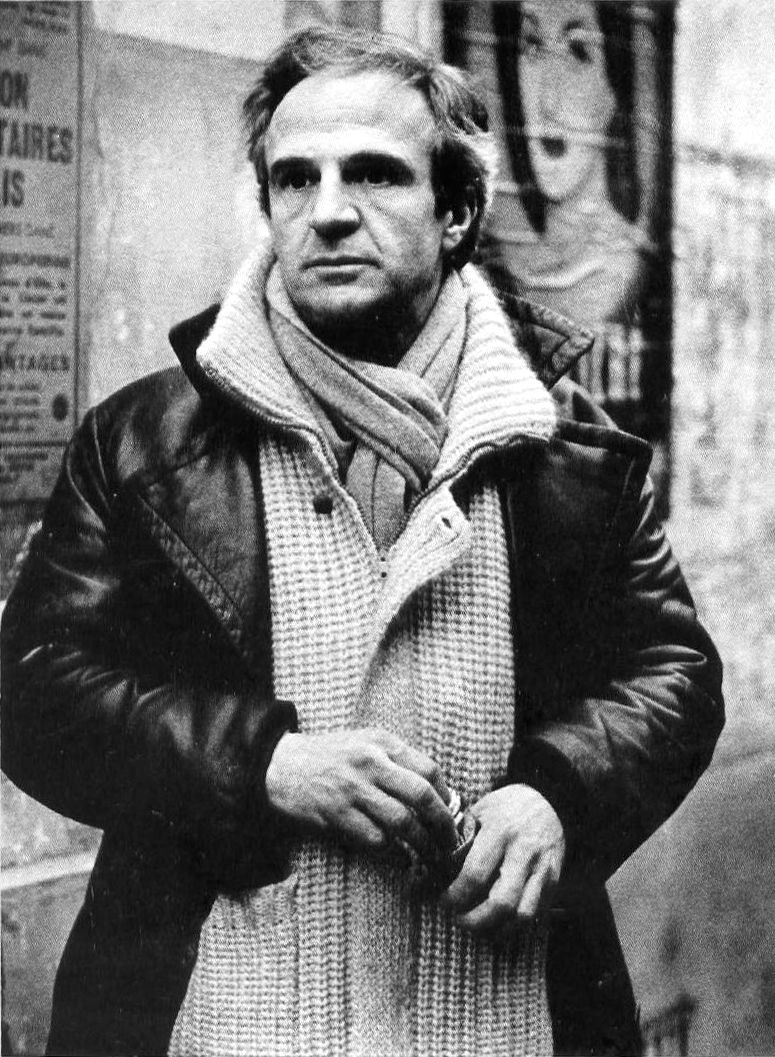
As part of his own retrospective, Truffaut screened Hitchcock's Shadow of a Doubt. Characteristically his discussion afterwards was the longest and best of his three appearances. Truffaut clearly and enthusiastically acknowledges his debt to other filmmakers---his acceptance of the rules of the cinema makes him a classicist among the New Wave directors like Godard and Bresson, who attempt to reinvent film every time they start a camera.
"Godard is more of a romanticist and I am more of a classicist," Truffaut said. "The idea of being the first to do something doesn't interest me at all. I used to explain it this way: if Godard and I came upon a card game we didn't know, he would say, 'That's stupid! Let's play it another way.' But I would say, 'What are the rules? Teach me.'"
But it is this passionate scholarship and empathy with the filmmakers of the past that fuels Truffaut's own inventiveness---his knowledge of styles is so exact that he can effectively mix several within a single picture.
In person, Truffaut's affable seriousness and intelligent passion for how movies are made illuminated the post-screening sessions. As anyone who has been there can attest, it is impossible to have coffee in this part of L.A. without hearing a movie deal discussed. But in these hours something strangely rare occurred: the romance and reality of movies met as art, craft and experience.
Yet with all the technical fascination, Truffaut never lost sight of the people and emotion involved. Speaking about Hitchcock's uniqueness as a director he added, "I don't think Hitchcock feels comfortable in normal society." When the audience laughed Truffaut commented, "That isn't funny." It is this quality of caring that inspires the feeling often mentioned by his admirers---trust. Like the professor he portrays in The Wild Child, Truffaut plays shell games---but he doesn't cheat.
 |
| "Fahrenheit 451" |
The retrospective went on after Truffaut returned to Paris. Ray Bradbury was on hand at the L.A. Museum (where all screenings but Love on the Run were held) to introduce a mint-condition Technicolor print of Fahrenheit 451, and told how he wrote the novel on which it is based by feeding dimes into a metered typewriter in the typing room of the UCLA Library. He praised the movie, especially the ending. "It's one of the greatest endings of any film ever. I've seen it twelve times and cried every time---and not because it's mine. Because it's Truffaut's."
Annette Insdorf, a Yale film professor and author of a new book, Francois Truffaut, who had also served as Truffaut's translator for his public appearances, introduced a quartet of films including Shoot the Piano Player and Jules and Jim with an apt interpretation of Truffaut's thematic and technical message: "Life repeats itself and there's nothing you can do about it." A later audience was mesmerized by the start and classical narrative of The Wild Child combined with the vibrantly colorful picaresque Small Change--a combination of films about childhood that Truffaut himself devised. He in fact selected all the pairings and groupings of his films for the retrospective.
Although he granted no formal interviews in Los Angeles, Truffaut agreed to a conversation in his Beverly Hills Hotel suite at the end of his stay (partly because one of his daughters is a Rolling Stone subscriber.) Annette Insdorf was also present to translate. Although he speaks considerable English and understands more, Truffaut takes pains to be precise. Once when Insdorf translated his description of the protagonist of The Man Who Loved Women as a "playboy," Truffaut corrected her in French, and she amended it to "skirt-chaser."
While rumors were rife that Truffaut is being wooed by Hollywood producers---and despite the phone calls and the open copy of Howard Hughes: The Hidden Years---there appears to be no American period for Truffaut in the near future. "Presently I am in a lull," he said. "but there are four or five projects in preparation in France." The Hollywood star system and its attendant problems do not seem to encourage him. He pointed out that if he had made The 400 Blows in the traditional way even in France, he would have had to use a star to play Antoine's father, and because of that the part of the father would have to be expanded, distorting the whole idea of the film.
In America the star system is the economic underpinning of the industry. "They needed Brando to get the money to make Superman," he said, "but when Brando was on the screen you just waited for him to get off so you could see the man who flies."
 |
| Truffaut on set of "Small Change" |
Truffaut has used stars (including Jeanne Moreau, Julie Christie and Jacqueline Bisset) but it was a matter of choice. "If a director here can get Nicholson or Pacino and doesn't want him, he's considered an idiot. In France, Small Change was released in the normal way but here it would have been a "B" film unless I used big stars." You have to have stars to get bookings, I suggested. "Booking!" Truffaut boomed, breaking into precise Hollywood English. "Booking is King!"
Truffaut's own filmmaking career is at a juncture. He feels Love on the Run represents doors that have closed. He spoke of writers who do five or six novels and then move on to other kinds of books (books and writing are major themes in his work---Truffaut is the movies' most conspicuous champion of literature and its enterprise.) "As one gets older one loses the sense of fiction," he said. "Fiction is something linked to youth."
But Truffaut is hardly at the end of his career. "Films made by old people are generally misunderstood," he mused. "They're more theoretical, less physical." But it also takes time for audiences to accept the style of a young filmmaker, he added. "The best contact with audiences is made when the filmmaker is around 45 or 50." Annette and I both laughed. Truffaut smiled. "I should take advantage of this period," he said.
We discussed his appearance in Close Encounters, his first as an actor outside his own pictures. ("I tried to be the most cooperative actor on the set. Every director does.") The role was ironic, considering a statement I'd heard attributed to him to the effect that he was interested only in film, children and the relationships between men and women; if a flying saucer landed he wouldn't cross the street to investigate.
I asked him if this was true. "Yes," he smiled. "When people talk about UFOs, I tune out. It's the same when they discuss food---I think about something else...my work."
Despite his own lack of interest in the subject, those who know Truffaut's work attach a special significance to his presence at the end of Close Encounters. There are few people we would rather have representing humanity to an alien culture than Francois Truffaut.
*
Here also is my article on double features I sent to Truffaut, published in Washington Newsworks weekly in 1976. The irony of it now, of course, is that both the double feature and the "big city revival and sub-run houses" mentioned in the lead are virtually obsolete. But this was before the VCR, let alone the DVD. Read this, and program your own double feature today!
The Aesthetics of the Double Feature

Seen in a certain way, double features have unique effects. Besides feeling less ripped-off by the admission price, the moviegoer feels somehow more adventuresome at the prospect of seeing more than one film. Two films seen together naturally feed back on one another. The first film colors the experience of the second, and the second, since it was seen more recently, colors the memory of the first. If the films are matched particularly well, each may draw out aspects of the other that the view might not ordinarily catch.
Few double bills are paired randomly; putting two films together is frequently the only creative thing a programmer gets to do. Some are paired rather obviously by subject and style, as with several upcoming twin bills: animal nastiness in Rattlers and The Frogs at the Senator; violent steel and posturing in Super Weapons and Lightning Sword of Death at the Trivoli; classic Fred Astaire foot-tapping sweetness in Top Hat and Swingtime at the Inner Circle. Some are combined for an actor (the Key's recent Bogart festival) or director (two Truffauts at the Biograph.)
But there are more subtle pairings, too. The Capitol Hill II puts together two films with a common theme---politics and corruption---but with very different approaches emanating from different areas: Advise and Consent, a pot-boiling anti-heroic drama from the 60s, and Born Yesterday, a comedy-romance with a heroic message from the 40s. A similar approach---common theme and different style---but using two films from the same era of disaffection occurs in the Circle's twinning of The Graduate and Paper Chase.
 |
| "Charlie Bubbles" |
Some double bills seem to make very little sense, but suddenly each film illuminates the other in a new way. A few years ago I saw two movies that seemed to have little in common except they were both ostensibly minor British films of the trendy 60s: Karl Reisz's Morgan! and Charlie Bubbles, Albert Finney's first and so far only film as a director as well as star. Though I'd seen them both separately before (sometimes that makes seeing films together even better) I hadn't noticed, nor felt, the depth to which each dealt with an artist who came from a working class family and politics, into upper-class situations and money---and the confusing effects the artists had on the people in their lives who were quite comfortable in their class niche, or at least were unable to transcend it.
 |
| "Morgan" |
Each main character struggles to join together these aspects of their lives---Morgan in a more fantastic, yet more political way (he was perhaps the world's first back-to-nature Trotskyite, who revered Marx and gorillas equally)---Charlie Bubbles in a more mundane and identifiably real context. Both characters achieved some sort of half-tragic transcendence---Morgan through madness and Charlie in such a pure sense of transcendence that I hesitate to give the ending away even now, it so moved me the first time I saw it.
Each of these films yielded new insights into the other not likely to occur if each is seen alone. If one views films, cares about films, beyond the surface gore and giggles allowed by the canons of 70s apocalyptic hedonism, the experience can be enlightening and exciting.
Another pleasure of discovery occurs when a double bill gives you a new feeling for the common themes that link disparate films by the same director. For example, the Biograph's recent pairing of Francois Truffaut's two most recent American releases, The Story of Adele H. and Day for Night.
Seeing them separately with months between, they seem entirely dissimilar: the tragedy of a young 19th century woman whose obsessive love for a shallow soldier drives her mad; and a comedy about the making of a not especially good contemporary movie. But together it becomes clear that they are not dissimilar---they are opposite sides of the same theme; the same guiding obsession of the same director.
 |
| "Story of Adele H" |
Adele H's obsession isn't simply with a resistant lover but with her own identity, her passionate need to separate herself from over-identification with her famous father (Victor Hugo) and older sister. To do this she must perform some extraordinary, heroic act--to, in her words, "walk across the sea to join her lover in a new world---this I will accomplish."
Adele's obsessions only refer to the outside world but don't respond to it---primarily they are responses to her inner world, her anguish, her courage, her struggle---above all, her gamble: the romantic gamble of self-realization, of making something new of one's life and another's through vision and love.
Adele H. ends with Victor Hugo's dying words, "I see a black light," and a repetition of Adele's vow. Her failure to accomplish it-the gamble lost---is her tragedy.
What can this have to do with Day for Night? Simply that Adele's obsessions have been applied to a generally more successful way of dealing with the dark, helpless interior struggles. The solution is classic: the inner struggle is externalized, the emotions of the inner darkness are acted out in the light through the making of art, in this case the social art of films---and so the exchange is literally day for night.
 |
| "Day for Night" |
Clearly, the world of film is what allows the characters in Day for Night, including the director Truffaut himself plays, to deal with themselves in the given world. Truffaut says as much to the character played by (and very much based on) Jean-Pierre Leaud: "We are no good at life, we are only happy in our work."
Adele spends much of her time feverishly writing in her diary; in dark rooms, she constructs her inner-directed dramas alone. There will be no audience until she is dead. The moviemakers are shown in constant relationship to each other, and the most private moments are transformed (in one case, literally overnight) into the acted out, public form of film.
There are other common threads between these two movies; seen together, they form a unique presentation of Truffaut's wisdom and compassion. It is a pairing of films as subtle and wonderful as an ideal marriage between two people, sensitively, wisely and lovingly attuned. But like such a marriage, the wonder is only potential until the two are brought together, in the right place, at the right time.
Subscribe to:
Posts (Atom)