by William Severini Kowinski
Backstory
Between the time that my book, THE MALLING OF AMERICA, had been accepted for publication and the time it actually was published, I worked on a story assigned by the New York Times Magazine. I'd done three pieces for my editor there, two of them covers. He talked to me about doing a story that concerned the difficulties young people were having when they came to New York to start their careers. The cost of living had shot up during the inflation of the late 1970s and afterwards. The city seemed more dangerous and more frenetic, and the 1980s brought a Darwinian mood of succeed or die. It was the dress for success era, when the heroes of the Reagan decade were entrepreneurs, Wall Street brokers and business people in general.
I suggested that the scope of the article be narrowed to young people coming to New York from elsewhere for a career in the arts. He agreed, and I started on the assignment.
The New York Times is a magic phrase for getting access, especially in New York, so I was able to interview some stellar names in the arts. I talked on the phone with Joe Papp of the Public Theatre, and movie actors Mary Steenburgen and JoBeth Williams, to get their sense of how things had changed.
I interviewed Jason Robards, Jr., backstage after a matinee performance of the revival of "You Can't Take It With You" in which he starred. Robards seldom gave interviews, but it turned out he was very interested in this subject, partly because his two sons were beginning their professional careers as actors: Sam Robards, and Jason III, who was also in the cast and who was present for part of the interview. Since Jason Jr.'s father had also been a New York actor, I was hearing about the experiences of three generations. I also spent a delightful hour with the rest of the cast, which included Elizabeth Wilson, who I remembered from her role in one of my favorite TV shows as a teenager, "East Side, West Side" starring George C. Scott. I also saw a performance of Peter Nichol's play, "Passion" and interviewed several cast members, and then went off with them to dinner. I enjoy the company of actors.
When I was doing the Times story I had already resolved to make the arts in America the subject of my next book. At that moment in my life, many things seemed possible. My agent was predicting great success for the mall book, and a person who advised movie studios on books about to be published also predicted a bright future for my book. I even had a screenplay mostly done, concerning two rival shopping malls in suburban Minnesota, an old small one, and the new super-mall, the biggest in the country. The screenplay never went anywhere, but not too many years later, the Mall of America appeared in the Twin City suburbs, just down the road from the first enclosed mall.
I spent a couple of weeks in New York reporting this story, and I had masses of good material. By the end of my time there I was afraid I had too much. So when a press agent called to say he had a client I should talk to, a young actress back in town from Hollywood, I had to say I was leaving and couldn't do it. That's how I missed meeting Kim Bassinger.
I did several drafts of the story back in Pennsylvania, but ultimately the Times Magazine decided not to publish it (my editor was apparently the only one on the staff that thought they should.) Eventually a shorter version was published in the rival New York Daily News Sunday Magazine. When my mall book was abandoned by my publisher, interest in my second book dwindled. I'm still waiting for it to reignite.
What follows is a combination of two versions I did for the Times, the Daily News version, and some later revisions for book proposals. Since at this point, decades years later, the value of this story is in the material and not as a magazine piece per se, I'm opting for completeness rather than economy.
So what is the significance of this story, and the companion piece I'll describe and present later, on young artists in Pittsburgh? That many of these stories mirror what's happening today is not only a matter of the perennial struggles of young and not so young in the arts in America. In many important ways, we are still in the 1980s. What began in that decade continues to dominate today, culturally, politically and economically. Here we get a glimpse of how it began, when people could still recall when it was different.

In 1972, a young woman of nineteen arrived in New York City from a small town in Arkansas, in love with the theatre and crazy to become an actress. She had little experience, and no theatre connections in New York, so she took a room in a hotel for women at $42 a week, began attending acting classes and auditions, and supported herself by waitressing. She did this for six years, and in that time she never had an acting job that paid her more than $10 a week.
One hot summer day she was stuck in the city, getting ready to go to her waitress job at the Magic Pan. "I was pressing my apron for the millionth time," she recalled. "I felt a flood of discouragement, because it had been so long without substantial feedback, except just getting close to things. At that moment I knew I had to decide whether I was willing to be an aspiring actress, even if I was just aspiring for the rest of my life, or be a success back home in Arkansas as a teacher. And I knew I wanted to be an actress. That's as close as I came to giving up."
Not long after that, this unknown actress got her big break, an audition that led to a major role in a Hollywood movie---co-starring with Jack Nicholson, who personally chose her. The movie was "Goin' South," not a big hit at the time, but it led to other major roles for her, including one in "Melvin and Howard." So a few years after that moment of truth at the ironing board, Mary Steenburgen won the Academy Award as Best Actress.
Standard story. Inspiring. Happy ending. We love it.
In 1983, another young woman from a small town in Arkansas (Beebe: population 2500) arrived in Manhattan determined to become an actress. Beebe didn't have even a movie theatre, but Suzanne Doss grew up wanting to act. "My Barbie dolls did Shakespeare," she said. Several times in her teens she slept by the side of the road leading out of town, intending to catch the bus to Hollywood in the morning, but her parents always found her first and took her back home.
But after convincing her high school principal to start a drama class, and then to stage a senior class play, and then stealing the script from his desk the night before auditions so she would be prepared to try out for the lead; and after starring in two plays at the University of Arkansas and treading the boards at Murray's Dinner Theatre in Little Rock, and spending a summer at the Jacob's Pillow dance theater workshop, Suzanne took her dreams and talent, her pure good looks and intelligence and determination (plus $1500 in cash) to the Big Apple, where she got a room in a hotel for women, a job as a waitress, and began her acting classes and auditions. She was 22.
It's the standard beginning of a tale like Mary Steenburgen's, or of something out of "A Chorus Line" (and when the movie version auditioned, Suzanne was there among the 2,000 hopefuls.) From "Stage Door" to "Stayin Alive," the portrait of the starving young artist has fascinated audiences. But in the New York of the 1980s, the nature of that struggle has changed, and the chance of survival has lessened---some say dramatically.
Though the aspiring Brandos (Libertyville, Illinois), Rauschenburgs (Port Arthur, Texas) and Styrons (Newport News, Virginia) still stream in from small towns and cities all over America, the likelihood of someone like Suzanne making it has greatly diminished. Talent is still a major factor, and luck and timing, especially when there are more aspirants chasing fewer opportunities . But other factors have assumed greater significance than ever before.
It is now more important than ever to come from an upper middle class home with artistically-aware parents who will support you, and who have the right connections. It is also increasingly important to be educated in the right prestige universities and specialized institutions.
In other words, it's more like succeeding in business. While the images of Bohemian free-spirits and the myths of innocents conquering and redeeming the city with honest vitality and homegrown talent are still cherished, they are fading further into make-believe.
With declining opportunities for new actors, playwrights and fiction writers, and a hot art market emphasizing star power and art-as-investment, there is overwhelming pressure for quick commercial success that more and more defines the characteristics necessary for survival. Talent, creativity, sensitivity and artistic commitment are not only insufficient, they may be counter-productive. Today the necessary qualities include shrewd business sense, relentless and refined social skills, an eye for hype and media, management and marketing savvy, and the ability to suppress and mask emotions and manipulate others: in other words, all of the 1980s qualities promoted in best-selling success manuals for aspiring high tech managers and fast-track junior executives.
Such attitudes are now part of the air a new artist breathes. Newcomers like Suzanne Doss learn it from other young artists who've been in New York a little longer. "The actors who make it aren't necessarily the most talented," said Lauren Cloud, a 24 year old actress who arrived three years ago. "They're the best businessmen. That's what you learn."
Part of the new struggle is due to changes in the city itself. Because housing is so scarce and so much more expensive, especially in areas which traditionally have been home to young artists, fewer aspirants can afford to live in the city, and those who do must devote more time than their artistic predecessors to making a living rather than pursuing their careers. So they feel pressured to make it sooner, and bigger. And with the Village and SoHo thoroughly gentrified, young artists are isolated in cheap apartments all over the city and even well beyond its borders, cut off from the energy and sustenance of an arts community. As a result, their struggle is also lonelier.
 |
| JoBeth Williams |
"It has definitely gotten harder---even harder than it was five or six years ago," says actress JoBeth Williams, who labored in Off-Broadway theater and did soap operas until her movie career began in Hollywood. Even the steely Bette Davis confessed to a student audience that if she were starting out today, she would not even try to be an actress---it's just too difficult.
There are common problems felt by young aspirants in all the arts, and there are special pressures of specific art forms emerging from particular and differing circumstances. For example, the art market is hot, but the theatre is not. And while New York remains the center of publishing, it is no longer the literary community of legend.
These are conclusions drawn from stories told by veterans and aspirants in the New York arts. They are the realities that real people must face, though few are prepared for them. Moreover, many question whether the arts can fulfill their social and cultural functions, or even survive, if such conditions persist.
SPACE CADETS

Suzanne Doss began her New York acting career by tearfully talking her way into a rented room in a Manhattan hotel for women, past a substantial waiting list.
Of all the factors that have changed the experience of starting out in New York, the most extreme is the high cost and scarcity of space. It affects every part of a young artist's life, creating a web of complication and effort.
The average rent for all of New York City is almost four times what it was in 1960, and more than double the 1970 average. This rise has contributed to a near doubling of the consumer price index for New York from 1978 to 1983. But even more meaningful are the current rentals in areas of Manhattan where young artists have traditionally lived and worked.
Because of the complexities of rent control and rent stabilization laws, arriving at an indicative overall figure is difficult, but knowledgeable real estate sources say that rents three and four times higher now than just ten years ago in Manhattan are common. Moreover, finding a decent apartment at any price in these areas is increasingly difficult, especially for newcomers without contacts to get unadvertised sublets or private deals on rent-controlled apartments.
Most people with experience in recent Manhattan apartment hunting agree that the rental situation began getting much worse in 1978, when the coop and condo booms began, attracting more affluent residents and real estate speculators. "Where I live, people who have been here for five years pay $500 for a real apartment," Lauren Cloud observes. She lives in the east Village. "You can't get a studio for that now, even if you could find one."
Rents are even more of a problem for those artists who need space for more than a place to live. Two years ago, when she was 22, Rene Lynch lived in Richmond, Virginia, where she painted and directed a gallery performance space. But even though she was part of a vibrant arts community, she felt isolated there. "If you're an artist," she said, "New York is still the Mecca of the world."
In Richmond, Rene paid $25 a month for a studio, and her share of the rent of a large house was $30 a month. But when she came to New York in 1981 she found herself living and painting in a small apartment on an addict-riven street on the Lower East Side of Manhattan, which she shared for $424 a month.
"I couldn't find a studio I could afford, or that I could even work in," she said. Then last year Rene got a break---she was one of 32 artists to be allocated a studio for one year in P.S. 1, a foundation-run arts complex in Long Island City, in Queens. The rent is $70 a month, which is still not easy for her to pay.
So this year Rene works a waitress job in SoHo from 10:30 a.m. until 7 p.m. at least four days a week, and then commutes to Long Island City to paint. If she paints past midnight she doesn't risk riding the subway or walking through her neighborhood alone, so she sleeps in her studio.
"You hear stories about Rauchenberg renting a loft for $15 a month," Rene said, her gaze drifting over some of her recent canvases. "I sense that even five years ago I could have gotten a loft in Tribeca. It's impossible now. Things have changed a lot." And then she made an observation that sums up the difference for young artists of all kinds now. " Before, you painted and grabbed a job when you needed it. But now you work a job, and paint when you can."
There in one sentence is a major shift in the experience of aspiring artists, with ramifications still unknown.
 |
| Bill McCutcheon |
"In the past you could get a little apartment for $50 or $100, and get a little job to pay for it," said veteran actor Bill McCutcheon, appearing in the Broadway revival of You Can't Take it With You. But today a walk-up in the Village lists for $745. Studio apartments list from $250 in one of the worst neighborhoods in Manhattan to $1050 for a large studio in Chelsea. Lower East Side apartments start at $500, and a one bedroom for $750 on the Upper West Side is considered a steal. Meanwhile, SoHo lofts which were obtainable for next to nothing even a decade ago (although sometimes illegally, as "storage space") now rent as living lofts for from $900 to $2500 a month. A Tribeca co-op loft lists for $1200.
Rents are so high that many aspiring artists find that even with a part time job they cannot make ends meet, so they must turn to others for help. "I don't know anyone who gets by without some form of patronage," a young book editor said, referring to aspiring artists in all fields. Many newcomers agree, and they uniformly estimate that more than three quarters of young artists they know are being substantially supported by parents or spouse.
The housing situation also means that nearly every young artist must share living space, and often that means sharing one bedroom among three or four people, or three bedrooms among eight. Space is at such a premium that it is a factor in relationships. A young painter who once shared a loft with her boyfriend and had to move when the relationship soured, confirms that because of the horrors of finding and renting space, "...people are very reluctant to split up. Friends would say to me, 'Can't you patch this up? You need the space.'"
The high costs radiate out from Manhattan to areas of the other boroughs, so while many find affordable space in Brooklyn, Queens and Staten Island neighborhoods, some find themselves living in Hoboken, Jersey City and other places in New Jersey and Long Island. Living there can be practical and pleasant, but commuting significant distances to galleries or auditions or even to see shows or friends add extra elements of time, difficulty and discouragement.
 |
| Bob Gunton in Star Trek later in 1980s |
The idea of living outside Manhattan frankly baffles the veteran actor Richard Woods, who came from Buffalo a generation ago. "My niece is just getting started now, and she's living in Jackson Heights. Jackson Heights! It seems like Buffalo to me."
The crisis of space is felt most acutely by artists and dancers who need studios, and their migration outward has led to a dispersal of artistic activity. This is good for those places and in some sense for those artists (a visual arts group on Staten Island, a dance group in Brooklyn, for instance) but it does raise the question of what their relationship is to the New York that drew them here.
The effects of the higher cost of living are common to aspirants in all the arts. But each art has its particular demands and particular situation in the culture and economy of New York.
ACTING OUT
Suzanne Doss arrived in Manhattan from Little Rock in the gray slush of February, with $1500 in savings. At the Christian-run hotel for women she emoted her way into, she paid $80 a week for a room with breakfast and dinner included---not the same as the $14 a week actress Elizabeth Wilson paid for similar digs when she arrived from Grand Rapids in 1942, but something of a bargain in today's Manhattan. She got a waitress job, having trained for it in Little Rock specifically because she knew that actresses work as waitresses in New York. But even though she once waited on actor Malcolm McDowell, married at the time to her role model, Mary Steenburgen ("I got all excited and tried to explain it to him," she said, "but he didn't know what I was talking about") she wasn't able to keep up with the pace of a Manhattan restaurant, and she was fired.
She talked her way into a gofer job in an office , and started acting classes, but couldn't resist trying her wings at auditions. On her first day in the city she had been chosen as one of four dancers for a commercial, but the producers were so disconcerted that she had no agent, photos or resume, that they dropped her. When she did get pictures and a resume and took them to agents' offices, she was usually told to slip them under locked doors.
The office job didn't last long and by summer she was working at a women's clothing shop six or seven days a week, where she "sold shorts for women to wear in the park that cost more than I made in a week." She practiced her voice and dance in the mornings, and the rest of her time she spent meeting with acting partners and attending acting, dance and voice classes.
By the end of her first year, finding the time and energy to study, rehearse and audition became impossible. So Suzanne began taking another class, in word processing, so she could get a better paying job that might allow her more time to pursue the career that brought her to New York in the first place.
Lauren was one of a group of San Francisco actors who felt they'd outgrown the work they were doing there, and left to seek their fortunes and careers. About half left for Los Angeles, and the other half headed to New York.
Lauren chose New York because "I studied the situation and saw that the actors who make it are New York trained." But her first adjustment was the difference in what it took to support herself. In San Francisco she lived well on $200 a month. In New York it took her a year to find a Manhattan apartment, a one-bedroom in the East Village which she shares for $575 a month.
"And this is a toy apartment," she said. "It's as big as a dollhouse. "
But making the rent is only part of the necessary expenses. While stealing lunch between a few hours sleep after her waitress shift and an afternoon acting lesson, Lauren described some of what starting an acting career involves. In an increasingly competitive market, actors must have professional looking resumes and especially expensive photographs ("head shots") taken by photographers who specialize in them. ("You have to know which photographers are "in" for your 8x10s," Lauren explained, "and which ones are better with women or men.") The minimum cost she estimates at $200 for the 8 x 10s plus another $50 for 100 reprints on postcards. Then more to have the resume printed and the photo glued onto it.
She uses the resumes and photos not only for auditions but to send to agents and theatres. She sends out at least 15 postcard photos as reminders.
Acting classes, she estimates, cost around $175 for an 8-week course, and private study is $45 an hour minimum. She takes dance classes ($5 a session, just to keep trim) and voice lessons (the most expensive of all). She looks for parts in "showcase" productions (usually a handful of actors on a small stage or in a living room, with no one getting paid), and then makes sure that the director invites agents and producers. There must be a guest book for them to sign, she said, so she can follow up with a postcard and a phone call.
All of that takes money and time. There must be time as well for auditions, even though they are often "cattle calls" for hundreds at a time. These auditions can end in summary rejection on the basis of shoe size (as happened to Suzanne Doss, when she discovered she was expected to literally fill the shoes of a dancer departing a Broadway musical if she had any hope of getting the part.)
Above all it takes making constant decisions. How many auditions can you schedule in one day, so you won't be late for any or all of them? Should you go after a part and risk making a lasting bad impression, or go to class more? Do you devote time trying to get scarce work in commercials for more money and exposure, or do you use the flexibility of waitressing hours to audition for parts you really want? And of course there is the constant rejection, and even the deflating daily experience of showing up for auditions with hundreds of others who look just as right for the part as you do.
 |
| Roxanne Hart |
The process is all the more difficult the farther from Manhattan theatres the aspirant lives. "It's very debilitating to live outside Manhattan when you're beginning,," said Roxanne Hart, a young actress establishing herself with a critically acclaimed performance in Peter Nichol's play, "Passion," on Broadway. "What you're basically doing is not a creative exercise---it's selling yourself. When you have to travel into the city for auditions and so on, it's a lot easier to just say to yourself, 'not today."
Even within each decision there are new pitfalls. Lauren chose to earn her living waitressing, but just finding a decent job was itself a struggle. "Even in the worst restaurants they demand NEW YORK waitressing experience---nowhere else will do. There are just so many attractive, intelligent people who work as waiters and waitresses that restaurants can pick and choose, and then they can treat you badly, make outrageous demands and fire you for no reason, because there will always be somebody to replace you."
Finally Lauren got a good situation working at Googies on Sullivan Street, but after the struggle to find a good job she discovered she had to struggle against it. "The problem with a good restaurant situation is that it becomes like a womb. It's safe. Going out there day after day with your pictures and your resume, going to auditions at nine in the morning when you went to bed at six after your shift---you know you probably won't get the part because you look terrible---it's all so scary. So you go to fewer auditions and stop for awhile, and pretty soon you've stopped for a long time. It happened to me. I came here to be an actress and I was becoming a waitress. I had to go to a shrink to get it all straightened out."
Yet in three years, Lauren had acted in only two shows, both part of a marathon of all Shakespeare's plays (a "Shakespearathon") at the No Smoking Playhouse, which was virtually cast out of her restaurant---the cook, a bartender and several waitresses. Lauren appeared in "Pericles", which was directed by a man in his fifties, who works as a waiter at her restaurant five days a week. The show that began at 3:30 a.m., and was seen by fifteen people.
After just one year, Suzanne is starting to get worried. "Every day I meet waitresses who are 28, 29, and basically they're just waitressing," she said. "They aren't aspiring---they just say it. I don't want to wake up 30 years old and be a waitress."
It is a temptation, which Lauren Cloud knows well. The restaurant business in New York is booming, especially the fancier places catering to a monied clientele. The skills of an attractive, charming, efficient, personable waiter or waitress or bartender are qualities that actors bring, especially as these new restaurants with fantasy themes themselves become a branch of show business. It's especially seductive for outgoing people and women, Lauren said, because there are more women chasing fewer acting jobs than men, but more restaurant jobs for women. People get involved in their roles, and often get interested in the business. If it's a pleasant and secure situation with growing financial rewards, it can be a lot more tempting than sweating auditions and dealing with rejection.
Beyond economic imbalances, a number of factors that make making it in the New York arts more difficult now are part of the pressures Lauren and Suzanne feel. Thanks in part to the baby boom, and its effect on expanding higher education and arts training all over America, there are more and better trained aspirants coming to New York. At the same time, the opportunities are shrinking. Together they create intense competition, which seems to be changing what people must do to succeed, and even the kind of the people who do make it.
 |
| Jason Robards, Jr. |
But why are opportunities in New York theatre shrinking? In the middle of three generations of New York actors, Jason Robards, Jr. is well placed to observe the change. We talked backstage after a matinee of the Broadway revival of the Moss Hart and George S. Kaufman comedy, "You Can't Take It With You." Robards, the celebrated star of stage, screen and television, has two sons pursuing acting careers, Sam Robards, and Jason Robards III, who was an understudy in this production, and joined us for part of the conversation. (After his father's departure from the cast, Jason III took on a featured role.)
"When I was starting out just after World War II," Jason Robards, Jr. said, "my father came to see me and he told me---'this is terrible! When I was an actor, there were 700 road shows out, and two hundred some-odd theatres on Broadway!'
"Even when I was starting out we still had 134 theatres in New York, and many road shows and stock jobs and resident theatre jobs...Now I think theatre in New York is going to become like the opera, if it isn't already becoming that: a small, specialized thing."
Robards believes that one major reason for theatre's decline is the postwar move to the suburbs, and the loss of the middle class New York audience this exodus implies.
Whatever the reasons, the decline is palpable. Theatre was once synonymous with New York. But although it is still important to the legend, it is less of a presence in reality. "Pick up VARIETY by the theatre pages and let it hang," suggests Richard Frankel, managing director of the Circle Repertory. "Legitimate theatre is on seven pages north of the obituaries."
 |
| Jason Robards, Sr. |
There are only 38 Broadway theatres left, about as many as a decade ago. However, Off Broadway theatres (with 100 to 499 seats) have declined by half (from about 30 to 15) in that time. But perhaps the most important decline for younger theatre artists is in Off Off Broadway, which has nurtured new actors and new plays since the 1960s. The number of Off-Off houses continued to grow every year through the 1970s, but the Alliance of Residence Theatres (ART/New York) reported its first decline in theatres, from 98 in 1980 to 87 in 1983. As leases signed when rents were cheaper run out, more theatres are likely to close.
For experienced actors like Robards, Jr., this decline means that movies, TV movies and commercials become their major sources of income. Established playwrights like Neil Simon, possibly the last in a long line of playwrights whose fortunes and reputations were made in New York theatre, now also must depend on Hollywood. The same is true for established directors (according to one estimate, no more than four or five directors make a living primarily from New York theatre.)
 |
| Jason Robards III |
For newcomers like Jason III, the squeeze begins before they can become established. With theatre stagnating if not shrinking, those who depend on its marginal incomes find their expenses outrunning their means. "A lot of Off Off Broadway theatres were started in the 1970s by people in their twenties," said Gary Steur, Director of Programs for ARTS/New York. "They were content to make $6,000 a year, and they could live on that then. But the money hasn't gotten better in theatre, so they're in their thirties now and still making $6,000---and that doesn't even buy subsistence anymore."
The disappearance of small theatres in particular also hurts young playwrights. Sam Shepard, Pulitzer playwright and Oscar nominated actor, acknowledges that without the Off Off Broadway scene of the 1960s he would never have become a writer or an actor.
Even for the theatres that survive, the economics demands are reshaping what and who are seen. Theatres need established acting stars to attract audience, and they shy away from unpopular plays. "Now they have to do plays that are safe and likeable," commented playwright Kevin Heelan, who had productions in all types of New York houses, including Broadway. "But these little places where people talk to the kids who come off the bus with their plays---when that kind of place disappears, all those kids are really going to have a tough row to hoe."
Who has the best shot at survival? To simply get by during the years of struggle and apprenticeship, it has become almost mandatory to have an independent source of income or support: a trust fund, or a spouse or parents willing to subsidize them for several years.
Then to get noticed, it helps to have connections. As difficult as things are for the younger Robards, prospects are worse for beginning actors with less familiar names. But in some ways even better is some entrée into the "old artist network" which largely emanates from the right schools. If you're an actor it helps a great deal if you've gone to the Julliard School's Theatre Center (as did Kevin Kline, William Hurt and Patti LuPone) or the Yale Drama School (graduates include Sigourney Weaver, Mark Linn-Baker and Meryl Streep, who admitted she attended Yale partly because it would give her a competitive edge.)
 |
| Daniel Hugh Kelly |
Absent pedigree, it may become a matter of guile and luck, as well as talent and attitude. Daniel Hugh Kelly came from an urban New Jersey neighborhood, where he was often in trouble as a teenager. He wound up studying theatre at an obscure college in western Pennsylvania. He knew he wanted to act in New York. But "you can't just come to New York," he said. "You have to be smart about it. You have to treat it like a business."
When I talked to him one afternoon at a West Side restaurant, Kelly was just about to become a star, though not in New York theatre. He'd just played the lead in a Stephen King movie (Cujo), and in the fall he would co-star in a series that would become a hit, "Hardcastle and McCormick." But to that point, he had managed a fairly long apprenticeship, starting with his decision not to go directly to New York from college. "Kids come straight to New York and spend the first five years just trying to get in doors---that's ridiculous," he said. His plan was to be patient, and to act as much as he could in the growing network of regional theatres throughout the country, gaining experience and working with directors and other actors on the way up.
He built up his resume for four years before coming to New York, and even then it wasn't easy. He took a considerable risk from the start by deciding he would not get a day job. "I always swore that if I couldn't work in acting, I wouldn't work," he said. "I'm an actor, not a waiter."
He had some luck with housing: the City of New York had just opened an apartment complex called Manhattan Plaza, which mandated 70% of its apartments for performing artists on a sliding rent scale based on income. Kelly was its first tenant. But that left the problem of eating, and at times he didn't.
Once when he hadn't eaten for days, he cadged a meal from a stockbroker who was also a buddy from his old neighborhood, but he was so weak that after a pre-dinner beer, he passed out.
The next day was Christmas Eve, and Kelly attended the annual party of his New Jersey friends. "That was always hard, going to see the guys I grew up with---there was a lot of pity in their eyes," he recalled. "These guys had gone on to become bankers and stuff, they'd become real respectable. It was always weird trying to explain what I was doing." But during this party he got a phone call. His agent had tracked him down with the news that he'd been offered an important part on the TV soap opera, "Ryan's Hope." "I got off the phone and said,'you guys are not going to believe this.' It was the best Christmas present I ever had."
But as Kelly also observed, another actor didn't have such a great Christmas---the one he replaced, who was also called on Christmas Eve with the news that he was fired.
Yet his good fortune became a new challenge. Acting in New York based soap operas has many advantages beyond the regular pay check: exposure, maybe even fame, and experience. But it is also a place where the ambitions and careers of some actors die: they call it the Velvet Coffin.
Soap operas favor quick and conventional acting, and only the patina of realism. After a few years, some actors get stale and restless, but they are locked into contracts and the daily grind. JoBeth Williams remembers feeling like climbing the walls in frustration. She was terrified that she would be stuck in soap operas forever.
Kelly thought he could outsmart the process. He played Senator Frank Ryan on "Ryan's Hope" for four years, and negotiated contracts that allowed him the freedom to do New York plays and Hollywood films and television. But when he felt the lazy habits he acquired as a soap actor affecting his other work ---the stock mannerisms, reading lines off a teleprompter---he quit. "Every little thing is an important decision in this business," he said. "And they never stop."
 |
| Elizabeth Wilson in "The Graduate" 1967 |
To actors of Jason Robards Jr.'s generation, the present situation is so different as to represent a different world. Several cast members of You Cant Take It With You gathered in the homey basement of the Plymouth Theatre to consider the changes. They talked about their early days, not in terms of looking for work, but of working almost constantly, in one kind of production or another, in New York or any of many road show circuits. Between jobs they made the rounds of agents and producers, most of whom they knew on sight. Then they hung out with other actors, directors, playwrights and journalists in the Times Square drugstores.
"In a strange way, there wasn't any pressure, really," said Elizabeth Wilson, who came from Grand Rapids, Michigan in the 1950s. "It was more fun when we were starting out," said Richard Woods, who came from Buffalo. "I think being poor was not so awful as it must be these days."
Part of what makes it awful is that it seems like it never ends. Even what used to be clear indications of success don't necessary mean as much today. The Big Break may not be enough.
At first, Kevin Hellan' s story was a fairy tale of New York. Born and raised in Nebraska, he attended Smith College where he met Kim Davis. They went to New York together: he was going to be a playwright, and she was going to be an actress. They got married in Manhattan.

Their living situation was uncomfortable but almost immediately they each tasted success. Kim was acting regularly on a TV soap opera and waiting tables at a midtown hotel. Kevin picked up odd jobs and was churning out plays. When they returned from their honeymoon, Kevin got a call from an interested producer. Soon after that another of his plays, called "Heartland," was mounted on Broadway---almost unheard of for a new playwright.
But then suddenly the fairy tale ended. Kim lost both of her jobs simultaneously. "They got a new set on the soap, and a new dining room at the Sheraton," Kevin said. "Meanwhile, I just had a play on Broadway, I had three other plays produced in New York, and I'd written a short film that was nominated for an Academy Award---and I was still photocopying at Lincoln Center for a living."
. "We were living in this kind of dungeon apartment when things had stopped, "he said. "But everything in New York is tolerable as long as something is going on: even a reading in a living room, with four or five really good actors---that's phenomenal. When the bottom falls out-when the pressures get to you and you can't work---then the city overwhelms you."
"At first it was exciting to be in New York and living on the edge, but finally I found it stifled creativity. Basically it came down to money, and the shocking revelation that you could have plays produced and you still don't have anything."
THE ART OF LIVING
In apparent contrast to theatre, the art market is booming. But there is little evidence that the greater amount of money is being spread among a significantly larger number of artists.
But the notoriety and high prices attained by artists in their 20s and 30s such as Julian Schnabel and David Salle seem to have increased the pressure on young artists to succeed quickly or become permanently overlooked. The competition is fierce. New York City Cultural Affairs department conservatively estimates the number of gallery artists in the city at 50,000, and more are applying for artist certification (which qualifies them for artist-zone housing) every week.

The hot art market combined with the overall increase in real estate values to turn the old warehouse districts where artists of the 50s through the 70s bought cheap lofts into fashionable and expensive areas. High building values either forced artists out (and certainly kept struggling young artists from moving in) or turned their heads with the prospect of instant riches, when their property was more valuable than their art would ever be. For a long time, said a woman art photographer who has lived in SoHo for eight years, artists in SoHo talked more about real estate deals than art. "I've seen more artists destroyed by real estate than by cocaine," she said.
Another difference may be that an artist didn't have to become a big name to survive in New York. "I have a friend, a painter who is about Robert Rauchenberg's age," the photographer said. "He saw Rauchenberg at one of his openings, wearing his gold shoes and charming the crowd around him. He told me that's still his goal---he still wants to be like Rauchenberg. But he's been here a long time. He paints, he works as a carpenter, he has a family and friends. He has a life."
She mentioned Louise Bourgeois, the painter who had her first show at the Museum of Modern Art when she was in her eighties. "It was touch and go whether Louise Bourgeois would die before the Modern discovered her. But she had a life."
Today however there are those in them art world, young artists among them, who worry that it is no longer possible to just have a life as a New York artist. The expenses and the pressures (such as the growing role of media attention, publicity and marketing) mandate either major and early success, or giving up.
"We are dealing with a different art world now," says Barbara Haskell, a curator at the Whitney museum, "and the pressures are felt very early. There is more concentration on the externals of success. It is not as important whether you've made a good painting as whether you're in the right gallery. Someone who isn't successful finds it difficult to make a go of it at all."
But while places like Long Island City may be the new SoHo, the old romance seems to be lacking. Perhaps it is that poverty is not so genteel, and a good deal more dangerous and debilitating. Or perhaps, as some suggest, children of the middle class have middle class expectations.
"It's really ironic," says Rita Sirignano, a young painter who is also on the administrative staff of P.S. 1. "My parents escaped Brooklyn for the suburbs of New Jersey, and now a generation later I'm back there, in a worse dive than they ever had to live in." She counts herself among the disillusioned. "When you get out of school, the world is in front of you---you think you can do anything if you're young. But it isn't like that."
There are also the urges towards family and settling into a life that become more urgent as time goes on. Rita talks about a couple she knows, both artists, who live in a cheap but awful apartment in lower Manhattan. "She waitresses, he works construction. She doesn't show her work, he sells a little. They want a child but they don't want to raise one in such a bad neighborhood."
For Rita, the sacrifice is becoming too great. She wants a life as well as art. "I don't want to live like this anymore," she says. " It isn't romantic anymore."
THE LITERARY UN-COMMUNITY
Everyone knows that the publishing capital of America, if not the world, is in New York City. Everyone knows that to make it, a writer has to live in New York. But at least on the second premise, everyone would be wrong.
"Most of the major younger writers who come to mind---Sam Shepard, Tom McGuane, Hunter Thompson, Tom Robbins---they all stay as far away from New York as possible," a literary book editor observed. "With a few exceptions, you have to go back to when Mailer and Styron were young to find writers who live here and identify with New York."
(New York, Sam Shepard recently insisted to an interviewer, "is not the cultural center of America. New York's about as provincial as the smallest town in east Texas." )
But young fiction writers, steeped in legends of Fitzgerald and Mailer, come to New York looking for the watering holes and delis where literary types conduct their impassioned intellectual discourse. They don't find them. Writers are alone almost everywhere, but nowhere so much as New York.
"I expected to find a semblance of a literary community," said Lee Phillips, a young fiction writer from Cleveland. "But that hasn't turned out to be the case at all. People find a sympathetic group of friends, some of whom might happen to be writers, but the literary community is mostly a romantic notion."
Chip McGrath, fiction editor of the New Yorker, agrees. "I suspect that the literary life of New York is still a draw, but the irony is that it doesn't exist."
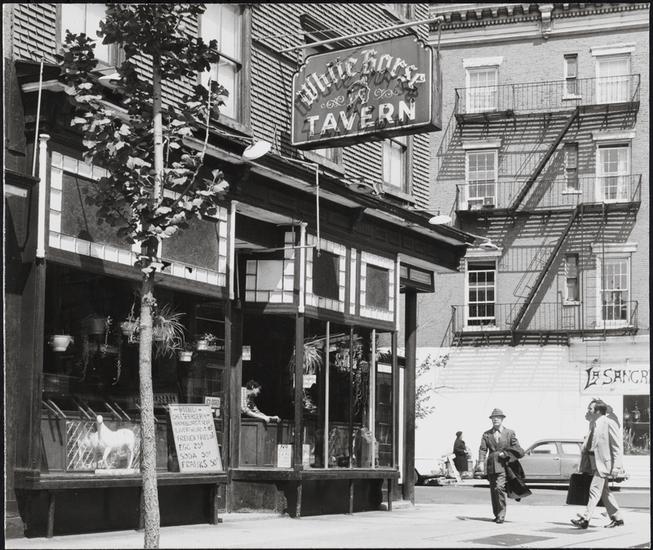
The lack of community is common, but perhaps felt most acutely by writers, whose work is done alone in private. The reasons are complex, but the dispersion caused by real estate prices is part of it, which has also erased the kind of low cost places artists used to gather. Nothing seems to have replaced the old drugstore meeting places around Times Square for theatre people, nor do there seem to be new writers and artists bars as important as the Lion's Head, the White Horse or the Cedar Tavern in the Village. The effect is not only fewer places for young writers to meet each other as writers, but nowhere to see older writers, outside of university classes and television interviews.
Writers also don't usually have rehearsals and classes to share, though writing and publishing workshops are becoming more common. For writers of book length fiction in particular, the path is lonely.
"You have to have a lot of confidence in yourself, "says fiction writer Jay Liebold. "You don';t have a lot of money and you have to put at least two or three years into your work before publishing. During that time you're basically living on faith. You don't have any badges of success and you aren't going up any ladders. You're going out on a limb. And the fear is that in five years, you'll realize you're on the wrong limb."
There are additional pressures that reflect a changing publishing industry, as small literary houses are absorbed into conglomerates with commitment only to profit margins higher than publishing has ever yielded. There are more books being published, but there are fewer names on the best seller lists, and among them, even fewer writers.
"You don't just write anymore," said Paul Stark, a young writer from Seattle. "You're supposed to design what you write for a target market. Newcomers I know feel embattled by the large forces acting against them. It's very difficult to find people in this city doing creative work that they don't feel is compromised."
Again, business values and conformity are more important than artistic intent or even quality. "People here decide what books are going to be published and which aren't, but they don't really know what they are doing," said a young editor at a major Manhattan publishing house, who refused to be named for obvious reasons. "They base decisions on all kinds of things, and if an author is charming and cooperative and understands the business, that's going to be important in those decisions. From what I've seen it's unfortunately true in other arts, too---those artists without social skills are a lot less likely to succeed, or even be heard."
Although many newcomers arrive with the motivation of dreams, they also come thinking they have few illusions: they know they won't make it overnight, but they count on their energy, optimism and persistence to carry them through. But they often find it's much worse than they imagined, if only because it gets harder every year. There are changes they haven't foreseen, because of the gap between the old expectations and the new realities in the New York arts and entertainment world, and the city's relationship to it.
ART AND THE ECONOMY OF THE CITY
"The economy has no place for you really," said Douglas McDonald, a young theatre director. "You have a vague outlaw status."

New York City does have the most elaborate system of government and private support for the arts. The New York State Council on the Arts distributes about $20 million a year to arts organization in New York City, including groups such as Young Concert Artists which have as their primary purpose the support of new talent. New York's department of Cultural Affairs devotes $3.3 million of its $52 million budget to programs for artists, which include supplying funds to 100 local arts organizations.
Manhattan Plaza , funded under a federal program to provide 70% of its 1689 apartment units to performing artists on a sliding scale, has been a conspicuous success. According to a Plaza administrator, turnover has been very low and there is a waiting list of thousands. "But that's an indication of the need," he said," and that this one place is not much of a solution."
However, compared to the one time in American history that individual New York artists received meaningful and sustained support---during the Great Depression---today's programs are feeble (the last such program was C.E.T.A. during the Carter administration, and it was quite small.)

But arts observers point out that the 1930s was a particularly vibrant time for the arts in New York. Jackson Pollock painted under the aegis of the Federal Arts Project from its inception in 1935 until its demise in 1943. He was one of several subsequently famous artists whose work was chiefly responsible for making New York the art capital of the world, and therefore of creating the multi-billion dollar art market of today. Projects in theatre, writing and music also materially aided the development of major figures as well as directly supporting innovative work (such as New York's "Living Newspaper") that remain influential in those fields.
In a survey of visual, literary and performing artists, Columbia University found that 77% work other jobs to support themselves. 75% earn less than $12,000 a year from their art, and more than half earn less than $3,000. Consider that in virtually no other field is it expected and accepted that after years of formal education and specific training, and then unpaid or barely paid apprenticeships, professionals are very likely to need employment outside their profession to survive.
Engraved on the Kennedy Center terrace in Washington are these words of President John F. Kennedy: "I look forward to an America which will reward achievement in the arts as we reward achievement in business or statecraft." Certainly those few who achieve greatly are grandly rewarded. But for most whose achievements are the backbone of the arts and entertainment of a nation, President Kennedy's vision is yet to be fulfilled.
THE ORGANIZATION ARTIST
Some would argue that many of the challenges young artists face are a natural part of the winnowing process, however Darwinian that might be. But while many of the pressures enumerated here will soon become standard, they are at this moment new enough in kind or degree to call forth the question of what kind of art will emerge from these changes.
 |
| Barbara Rose |
"Around the end of the 1970s, there was a shift in attitude among college students," said fiction writer Jay Liebold. "At Williams, where I went, it was palpable. They began worrying about earning power. There was a sense you had to start early or others will get ahead of you. It's different than in the 60s or 70s when there was a lot more encouragement to do something creative. That makes it harder: when the values of people around you are less encouraging."
This attitude of calculation and playing it safe based on the pressure to succeed fast before failure overwhelms you, merges with the psychology of the 80s, which makes financial success. There is little cultural patience for poverty and struggle even in New York, where such support or at least indulgence was part of the cultural scene for decades. Today the starving artist is out of style, except as a slogan to sell mass-produced paintings in motel lobbies. Bohemianism in whatever guise, from pre-Beatnik to post-hippie, is all but gone: shabby-genteel has yielded to dress for success. As the famous actress Elizabeth Ashley memorably said, "Money is the long hair of the 80s."
It is very difficult as youth slips by not to notice the difference with your similarly educated contemporaries. "You see people your own age making 50 or 75 thousand a year," said Lee Phillips. "All you can do is screw up your courage and realize you're not in it for the money, but for the beauty."
But the effect isn't just on morals and motivation, but on the art itself. "There is a real schzophrenia that happens," says Roxanne Hart. "The things that we need in a business sense are to a certain extent opposed to the openness, the willingness to reveal oneself that is important to the work. And a lot of people who are immensely talented do not survive personally...Sometimes it's amazing to me the kind of gall I had walking through closed doors in agent's offices or just ignoring signs that said, 'don't come in.' I don't think I have as much of that now, but I think I'm a better actress. I am more willing to be vulnerable."
"If you're a system that takes in knowledge and experience," Bob Gunton said, "sifts it through yourself and produces something---which is what an artist basically is and does---and you live in a very insular world of small ideas, and you start regurgitating the same stuff all the time, it becomes very inbred and pallid and, after awhile, lifeless."
"Talent is the bottom line," Jason Robards, Jr. said. "It takes talent to play the great parts. But a lot of talented people fade away---they leave. They don't want the mediocrity. We're trying to say something about the human condition, and nobody's listening. They don't buy what we're saying."
There may be cumulative effects on the arts themselves. "I think acting students tend to be more superficial today," legendary acting teacher Sanford Meisner told writer Jennifer Dunning in the New York Times Magazine. In that same article, actor and acting teacher Austin Pendelton remarked, "It's notr a really juicy generation coming up...But the structure of the industry supports such literalness. The shocking way we audition, stressing the processed and homogenous, for instance, encourages mechanical acting. It would kill the soul of anyone."
 |
| Joseph Papp |
The personal and commercial pressures, and the system they breed, all interact with the peculiar ethos of the 80s. Producer Joseph Papp agrees that for the young artist in New York, "It is more difficult in every way," but the causes and effects are more complex than simple economics. "There's a kind of furtive caution now, a sluggishness," he said. "What theatre needs is the driving force of people aching to say something. Moribund ideas are deadly for the arts." But new ideas are not good gambles for organization artists, for show business survivalists in gray flannel suits.
The old notion was that artists aren't supposed to be like other people, especially not business types. While others 'take charge", artists are receptive, observant, sensitive. While others suppress and falsify emotions, artists express them. While others improvise a social identity, artists work to refine a private vision. While others follow established procedures, artists explore and create. While others adapt quickly to prevailing circumstances and fashions, artists apply themselves deliberately, with great concentration, to originality and craft. And when others are serious and businesslike, artists are instinctive, open and free. Their allegiance is not to money and expediency, but timeless beauty and the truth of the moment.
But those images seem to have gone the way of the abacus and the epic poem. In the 80s, the image of creativity has been appropriated by entrepreneurs and manipulators of financial instruments. There are legends of misbehaving artists like Jackson Pollock. But in today's art world, observers agree, it is artists who must be well-behaved and compliant to be successful, while self-indulgence, impulsiveness and flamboyance have become the privilege of managers, agents, gallery owners and producers.
So people in the arts in New York do ask themselves, could Al Pacino or Dustin Hoffman make it today? Or Jackson Pollock? Or Sam Shepard?
There are some who do survive, or at least develop value from the experience. "You have to think of your life as a picaresque novel---think of yourself as Tom Jones," advised Douglas McDonald, a young theatre director. "He's broke and in the ditch and everyone despairs of him, but the reader still likes him and reads on...When you decide to be a playwright or an actor or any artist you're essentially admitting yourself to an elite, and there's a cost. I know any number of people who lived for the theatre in college but got scared, and now they're in law school and they're unhappy."
Bob Gunton is an actor who has earned the right to speak about the costs and value of what he's done. He has harrowing tales of surviving on nothing but a cookie and an apple a day, both of which he had to tie in a bundle and hang from the bare light bulb in the center of his room, to keep it from the rats he heard scurrying in the night.
"If someone comes here saying I want to be rich, or I want to be a star, it's all out of their hands really," said Bob Gunton. "It's fate, it's chance. But if someone comes here and says I want to do better work each time I go out, I want to work with the best people I can, I want to challenge myself to grow as a human being as well as an artist---making those kinds of decisions and sticking with them in the face of the absurdities of the business part---if you can do that, then you'll survive. Whether you become a celebrity or rich, that's in somebody else's hands. But you can accomplish or work towards the goals you set for yourself, if they are worthwhile goals. And that's the hardest thing for us to do."
"The healthiest people I know are those who think that success is only being able to work at what you want to do," says Douglas Hughes, a young theatre director who believes that good theatre can exist outside New York. "The toil is what sustain you---the joy in the craft itself."
NEW YORK OR NOT NEW YORK, THAT IS THE QUESTION

On a hot summer night, thousands of young people stream down Sixth Avenue and into the Village, past the meditative eyes of a bearded wino crouched in a doorway. Suddenly he raises his arms and says in a clear, thoughtful voice ringing with finality, "A few of you will make it. A FEW."
Part of what haunts Lauren and Suzanne is all around them: the death of dreams. The wait staff and bartenders at Upper West Side bars with movie-set decors are replete with half-familiar faces from commercials or one part in a memorable play or movie. Some of them may be actors who are still trying, but others have given up.
"I worked with an actress who had a major role on a soap for awhile," Daniel Hugh Kelly recalled. "But she took a job at an Upper West Side in-spot bar, and she hasn't acted in three years. She got caught up in her restaurant job and just sort of faded away. That happens a lot."
There are of course many advantages to living and learning in New York. For one thing, being an aspiring artist is not as unusual or potentially weird as it might be in other places. "In New York you're expected to learn your craft," Mary Steenburgen observed. "I didn't feel ashamed to be learning for five or six years."
"Those I knew who didn't stay that I saw later recall that time as having been generous to them,:" she added. "None of them regret having tried. It also gave a richness of life they took home with them. Not many people I know who came to New York felt it was a bad choice in their lives."
Some thrive on the hardships, and if they succeed, it becomes part of their New York cred. Dancer and choreographer D. J. McDonald said, "My reaction is to get more determined. No one wishes for more struggle, but there's a value in it. You get stronger and faster." Actor Thomas Waits remembers living in what he describes as a "Dostoevsky dive." "That's where I began to cement my desire," he said," and to realize the task ahead."
 |
| E. Katherine Kerr with playwright Chris Durang |
But others are wary of the costs. "This business is like dancing on the edge of a black hole," said established actress and playwright E. Katherine Kerr. "You are endangered if you fall out, or if you fall in. You can get sucked in and disappear. I've seen people whose whole personalities disappear in the theatre and they come out the other end bitter and in pain, with no lives other than the theatre."
So some newcomers try to manage a balance, as they assess the costs against their own dreams. Nancy Demechek and her roommate, Tracy Eula, came to New York last spring from the Indiana University drama department (which also graduated Kevin Kline). Both are actresses and both are now working full time at skilled and relatively well paying jobs. They live above their means in a $1050 apartment with a third roommate, because they want to feel safe and have a pleasant home to return to. Tracy has done some children's theatre, but Nancy especially casts a cautious eye on all the people she sees who are "one step below almost making it."
"I could probably give up everything and get some parts," Nancy said, "but I've been here six months and I can afford to see Broadway shows. I know actors who have been here ten years and can't afford to see Broadway." She, too, is haunted by those who have been in New York longer and have given up, like a young woman who came from Chicago and worked as an intern at the Circle in the Square theatre, but after awhile went back home. "She told me she just couldn't live that way any longer," Nancy said. "She wanted to be able to afford makeup, she wanted to have clothes, she wanted to be able to go out."
Penniless and spent, Kevin and Kim Heelan left New York. They moved to Northampton, Massachusetts, where Kevin teaches, and where he advises young writers heading for New York to learn a trade: "something that will pay you $8 an hour instead of $3.50." He also told them to "be prepared for things to take a long time. There are no laws, no rules of conduct, no steps that if you follow them, you will get specific rewards. That's a hard thing to accept, especially for middle-class kids."
" I left because there wasn't any need to stay there," Heelan said on the phone from Massachusetts, where he began writing again. "The most important thing is to get the work done. You can have all the business acumen, all the get-up-and-go, but if you don't have anything to show, it's useless. I had to get back a little of the innocence I started with."
Lauren Cloud is not sure she can continue with her New York life either, so she is going back to San Francisco to evaluate things. "I don't know if I have the drive to make it big this way," she said. "Maybe I'll travel the world, and act in smaller theatres somewhere." The escape from New York isn't uncommon, even for those who in fact do return. Roxanne Hart quit the business and hid out in Paris, but came back when she realized that changing her career to journalism was going to be about as hard as being an actress. More than one actor has been on their way out the door, when the phone call they'd been waiting for finally came. Yet others who finally got that call disappeared anyway.
"I've seen many who had talent but didn't get the lucky break being undermined and eaten away by frustration," said Jobeth Williams, whose lucky break was a nude stroll down a hallway in Kramer v. Kramer. "I wouldn't wish that on anyone. But there are people who are driven to do it, and you aren't going to stop them."
"You've got to really want to do it now," concludes painter Rene Lynch. "It can't be because it's fashionable. You either really want to make art, or you do something easier."
But the stories of individuals also accumulate, and though individuals make their decisions, experience their fates and perhaps seek their balance, there are effects in the trends of what they face that have consequences beyond them.
"The theatre is lucky that so many artists are impelled by their passion to create, rather than guided by realistic assessment of the situation," writes Mindy Levine in the Theater Times. "But at some point, there must be a reckoning...In several years when we wonder, 'Where are all our theater artists, both young and old?' we may have to turn to businessmen, lawyers and doctors and ask them what their dreams were when they were young."
But something else has changed: in many art forms, New York is no longer the only alternative. Cities throughout the U.S. are showing more interest in the arts, and providing more financial support than ever before. In fact, many visual arts based in New York get their most lucrative work showing or holding master classes in other cities and states, as well as in Canada and Europe. Actors have been going to Hollywood for a long time, as well as on the road with touring Broadway shows, but added to that mix are new opportunities in regional and university associated theatres.
"...it is our local bad luck," wrote Brendan Gill in the New Yorker, "that at the moment there are probably more plays worth going to see in Seattle than in the tinselly reaches of Times Square. So much the better for Seattle (and for the country), so much the worse for us!"
But even beyond the growing emphasis on tourist spectacle in Times Square, it is more than bad luck. Theatre artists agree that new plays are seldom produced in New York, except in a few venues like Playwright's Horizon and the Ensemble Playhouse, which are committed to this process. Even established serious playwrights like Edward Albee and Arthur Miller find New York productions scarcer.

At the same time opportunities are increasing for artists to leave New York altogether, frequently finding not only better living situations, but more exciting artistic opportunities. Adventurous, high quality theatre is flourishing in such cities as Seattle, Chicago and Dallas. Long established theatre, music and art scenes in cities like San Francisco, San Diego, Los Angeles, and Minneapolis-St. Paul are being joined by ambitious new commitments in Denver, Portland, Oregon and even smaller, more isolated cities like Wichita, Kansas. Or Pittsburgh, Pennsylvania.
Judith Leifer was born in New York, and attended the New York High School of Performing Arts before becoming a young member of the Martha Graham dance company. Several years ago she was invited to go down to Pittsburgh to perform with the Pittsburgh Ballet Theatre, then in residence at Point Park College. She went, and liked the dancers and the environment so much that she stayed.
She found that her quality of life was immediately better. "In New York I had to search for a cubicle," she said. "Here I have a huge house to myself." But the effect on her work was just as significant. "In New York I knew of performances that went on with only two or three rehearsals at ungodly hours" because dancers had full time jobs. But in Pittsburgh, the dancers she works with all have part-time jobs in the evenings, so they can rehearse nearly every day.
Leifer formed a new company, the Extension, with dancer Douglas Bentz, a Pittsburgh native who had moved to New York. But his career there had reached an impasse. He had begun to choreograph, and his dream was to start a company. But studio rents were too high, and the time for dancers to rehearse too difficult to find. On visits home he realized that Pittsburgh was more enthusiastic about the arts, and more dancers were staying.
"Five years ago there wasn't as much variety here," Bentz said. "But Pittsburgh is the third largest corporate capital in the country, and people from Los Angeles and Chicago and New York work for those companies. They expect cultural variety. And the people of Pittsburgh support us...It's also easier to survive here. Dancers can afford a nice place to live on a waitress salary, and still have time to dance and do other things."
Bentz found he could devote 25 to 30 hours a week to his company and still make enough money teaching to support himself. He got a large rehearsal and performance space in a good neighborhood for $200 a month. He found that the corporate community was willing to help fund a new and somewhat experimental company.
"New York may be the dance capital of the world," Bentz said. "But that doesn't mean it's the only place with a good supply of quality dancers. And a lot of New York dancers are too jaded to try something new."
The Extension performs beyond Pittsburgh as well, including engagements in New York City.
POSTSCRIPT 2005
Although it seems to me that the changes for aspiring artists in the 80s have continued in pretty much the same direction since, the world has changed in other ways in the 20 plus years since this article was written (and rewritten and rewritten.) Namely, there's the Internet, and the search engine, which allows us to ask the question, Where are they now? And even come up with some answers.
I'm pretty sure it's the same Rene Lynch I met at PS 1 who is co-founder of Metaphor Contemporary Art in Brooklyn, an organization for "emerging and mid-career artists." She's had a career as a painter, and perhaps an illustrator. I know the Rita Sirignano I met there now lives in Calgary, where she is again painting (and selling) and is an often published writer and community arts activist, as well as a mother. I know because we've exchanged emails since I started assembling this (the article is so old that it preceded my first computer.) Rita left New York in 1991 with her husband to be, and is now a Canadian citizen.
Sticking with certainties, I wrote about two dancers who left New York to start a dance company in Pittsburgh. They are still there. Douglas Bentz and Judith Leifer-Bentz (how about that) are both associate professors of dance at Point Park University, which used to be Point Park junior college.
Suzanne Doss is a puzzle so far. I kept in touch with her for a few years---she was married (to an actor) and living in Long Island City for awhile, but I think the last time I heard from her she was pregnant, and I believe they were living in upstate New York. But now the Internet shows me a Suzanne Doss in Los Angeles who is an assistant director for a production at West Coast Ensemble in LA. And there is a Suzanne Doss who belongs to the Cable and Telecom Association for Marketing in Alexandria, Virginia. When I think about it she could be either one, or, of course, neither. (Who knows, she could even be both.)
Lauren Cloud shows up in the acting credits of a low-budget movie in 1989, and was a production manager or assistant director on several more in the 90s. This year there's a Lauren Cloud directing a play for Theatre Neo in LA.
I can't find anything new on playwright Kevin Hellan---his Broadway play, "Heartland" is now famous for introducing the world to Sean Penn, who played the lead in his first major role.
The only novels listed for a Lee Phillips are genre westerns. Jay Liebold has published several children's books. I can't find anything by Paul Stark.
Suzanne Opton (who did the photos for the original "Malling of America") had an established career as an art photographer in New York, and still does. Her website is www.suzanneopton.com.
It's funny how once you interview somebody, you follow their careers as if they were friends, and cheer them on from afar. I last saw Daniel Hugh Kelly in "Star Trek: Insurrection," which makes him an immortal in my eyes. Sweet Roxanne Hart was a regular on the TV series, "Chicago Hope," and has done a number of films and TV shows, including a TV movie filming now. Bob Gunton works pretty regularly in film and TV, usually as a heavy. E. Katherine Kerr had a nice part in a movie I liked a lot, called "Reuben, Reuben," and she's been on several episodes of "Law & Order" (along with just about every other New York actor I've known, including Hart and Gunton.)
The great Jason Robards, Jr. died in 2000. His children, Jason III, Jake Shannon and especially Sam Robards have acted professionally in film, TV and on the stage. JoBeth Williams has worked steadily as a film actor (with two movies to be released in 2005) as well as a producer and director. Mary Steenburgen has also had a constant film and TV career since her Oscar in 1980, followed in the business by her two children with Malcolm McDowell, Lilly McDowell (actress) and Charlie McDowell (producer.) Mary also was executive producer of a film and a TV series in the 90s. All this reminds me what a kick it was to talk with people whose very voices I love, like Mary Steenburgen and Jason Robards.
This article was supposed to be the start of a book project about the arts in America. While I was bouncing around North America for speaking engagements for "The Malling of America," I often scheduled extra time to look into the arts in various places, like Seattle, Denver, both Portlands, and Wichita, which was a real eye opener. There I saw one of the largest collections of quality outdoor sculptures in the country, including several Henry Moore's (donated by an eccentric Wichita millionaire who carries a Henry Moore on his private jet); a university with a fine writing program and a composer who wrote the first piece ever performed for percussion and professional wrestlers, and several art galleries---a cooperative of feisty young painters, called Ball Park, and Gallery XIII, created and staff by middle-aged, middle class women artists, whose work was shown at the National Museum of Women in the Arts in Washington. Their motto, displayed on bumper stickers, was "Support Your Local Louvre."
I then got a sublet in Manhattan for several months to do more New York research. The art world was suddenly centered in the area of the alphabet avenues of the East Village. I vividly recall that area of the city then, looking more forlorn and destroyed than pictures of London during the Blitz, or Berlin after World War II. In particular I remember walking on a street, Avenue D maybe, and passing one gutted abandoned building after another, until I came to small one that seemed intact but otherwise not very different from the others. However, in the street in front of it, amidst broken glass and scattered garbage, a Rolls Royce was parked. It was an unmarked art gallery.
I was also in New York to meet with agents and editors to get some interest in this book project. It never happened. I'll conclude with a portion of a letter I received from an agent---a hot young agent then, a very distinguished one now---whose response was atypical only in being so forthright. "I think you've got a fresh approach...As far as I know, no one's written about what this world [of the arts] is like today, and as you point out and as I know from friends' experience, it's completely different, in a tragic way..."
The agent's letter continued: "One of the writers you quote complains, justly, that' You don't just write anymore. You're supposed to write for a target market.' I find that as depressing a thought as anyone else does, but since I make a living from this game, I've become one of the world's leading exponents of this kind of thinking. You have to, if you're writing or selling books for a living, and not just for self-fulfillment."
He went on to say that except for people in the arts---who can't afford to buy hardback books anyway---there would be no market for the book I wanted to write. So he (along with every other agent and editor I talked to) declined to do it.


