Wednesday, January 29, 2003

The Man Who Loved Movies


It started sometime in the seventies on a visit to Minnesota. I seem to remember making my impetuous pledge there. I had worked myself up to such a state extolling the cinema of Francois Truffaut that I vowed that wherever and whenever the next Truffaut retrospective was held, I would be there.

This was before video cassettes of just about every movie ever made were lined up in concrete bunkers called video stores, available for rent at a dollar a night. Before that, if you wanted to see a particular movie you had to find a theater where it was playing. There were many more theaters playing many more movies in your major cities, of course. Occasionally, foreign films would be shown on television, especially in certain cities. But to see the life's work of a director-18 films in this case, to that date---was a rare opportunity. You had to be in the right city at the right time, or get there.

In 1979 I happened on an article in Variety (the show biz paper I did not make a habit of reading at the time) announcing a major Truffaut retrospective in Los Angeles, with Francois Truffaut in attendance for at least part of the festival. Formidable!

Unfortunately, at the time I was living some 3,000 miles away, in western Pennsylvania.

On the other hand...I had friends in the LA area, mostly from my years in Boston, and mostly associated somehow with the Orson Welles Cinema in Cambridge, which was my second home for several years. At times, let's face it, my first home.

The Orson Welles was a unique kind of place. It started out as a one-screen cinema and a film school. The film school closed, and a restaurant-bar opened. Within a few years it was the Orson Welles Complex: three screen cinema, large café style restaurant with a smaller more intimate bar attached, and downstairs a real restaurant, serving dinners. I went there as a writer for the Boston Phoenix---among other things I wrote film features and the occasional movie review, when Janet Maslin (my boss) would let me. Later I went there as Managing Editor of the Arts half of the paper (when I was Janet Maslin's boss.) Still later, I went there as a refugee. For several years, I lived on movies,coffee, popcorn, licorice, brandy and the smiles of the most beautiful waitresses the world has ever seen.

People there, including me, breathed cinema. On a weekend there could be a couple of special screenings in the morning, then double features at each of the three screens for the rest of the day and night, with the choice of three midnight movies. One week I tried to see how many movies I actually could watch. I believe the number was 30, including a few on TV. I capped that week by seeing all of the Welles films in a weekend--11 or 12 movies. And then I was sick in bed for two weeks.

Anyway, the point is that several people from the Welles had moved out to LA to get into the other end of the movie business. Larry Jackson, the executive director of the complex and the cinema's creative programmer, was there. He would carve out a career as a studio exec and feature film producer for the next few decades. David Helpern, Jr. was there. He'd been at the Welles film school, a friend I spent a lot of time with at the Welles bar and cinema. I'd hung out with him and Nicholas Ray when that esteemed director came to town to help promote David's documentary on him, "I'm A Stranger Here Myself." I'd followed the making of David's second film, a documentary on the Hollywood Blacklist, "Hollywood On Trial" (not the recent version you may have seen on AMC or HBO, though) which was nominated for an Academy Award. More about that one elsewhere on this site.

But in 1979 David was putting the finishing touches on his first feature film, "Something Short of Paradise," written by our mutual friend, Fred Barron. I'm not sure if Fred was in L.A. yet. He did go there, I've heard, since he originated the Kate & Alley TV show, was executive producer of "Caroline in the City," and way too famous for any of his old friends to consider trying to get him on the phone. He got back into movies as a producer of something called "Moulin Rouge." (I went to a few movies at the Welles with Jon Landau, who soon hooked up with Bruce Springsteen as a producer then manager, and more recently co-produced some little art film called "Titanic." Don't think I'm on his speed dial either.)

Buffy Offner, one of the aforementioned waitresses, was there, working secretarial at William Morris. Later she became a sound editor; she worked on "The Woman in Red." And I know Terry Corey was there, because I stayed with him, at his second floor apartment on a corner facing the huge parking lot at the end of which was the Pacific Ocean in Santa Monica. Terry worked for Robert Altman and his company for awhile, and has since become one of the most sought after sound system designers in the country for large events---he's done the national party conventions, for instance.

So I had places to stay-even a former Boston Phoenix photographer, Michael Dobo, who also shot several of Bonnie Raitt's album covers, was living down in Venice then, trying to be a drummer, trying to write for TV, trying to get over falling for Bonnie... But I still needed the money to get there.

I'd had a couple of over the transom pieces published in Rolling Stone but never an assignment. I don't remember why or how I hooked up with them but I did. I do remember that the woman I talked to allowed me to represent myself as Rolling Stone and she was interested in a story, but the magazine wouldn't pay expenses, and wouldn't pay much of a guarantee. The upshot was that if I was lucky enough to have my article accepted, I would just about break even.

Sounded like a deal to me. I went.

The negotiation however took so long that I barely had time to make reservations and arrangements. (It was in the course of making arrangements with the American Film Institute, co-sponsor of the festival, that I learned they'd already done the whole thing in Washington, D.C., which Variety neglected to mention. Washington was a four hour drive from where I was living in Pa.) The only flight to LA I could get arrived with just enough time for me to get to the Institute and then to the opening screening of the festival. No sooner had I made the final arrangements that I was on my way. To one disaster after another.

My plane out of Pittsburgh was late getting into Chicago. I missed my first connection. So the flight I finally got on was late getting into LAX. I think it was my first time flying into that particular airport---on other west coast trips, I'd generally started out in San Francisco and taken the train from Oakland to that wonderful old station in LA. Because my plane was late, my rental car reservation had been voided. They had to start the whole process from scratch. In the meantime, my luggage had been lost.

I had to call the American Film Institute and tell them I was going to be late. I was supposed to meet somebody there and go to the screening. Instead I'd barely have time to make the screening itself, so I got directions for that. But by the time I finally got a car and headed out onto the freeways, I was probably going to be late even for that.

I'd driven these freeways before, but I hadn't been to where I was going before so I had to read my directions and carefully watch the signs as five lanes of traffic whizzed around me, not counting the high speed anarchy of my lane. That's when the storm hit.

It wasn't so bad on the freeway, except for seeing the signs. But I saw the right one, and just as I pulled onto the exit ramp, there was a tremendous crash of thunder, and I hit a wall of water that splashed off the hood. But that was all. Everything got very quiet, the rain stopped, but there was this eerie light for awhile.

I finally found where I was going, found the parking, reached for my wallet---and it wasn't there.

Here is where my traveling paranoia pays off. In those days, I never put all my eggs in one basket. I always kept the bulk of my cash plus at least one credit card in another pocket, secured somehow-buttoned, zipped tight-and I never touched it on the trip, except occasionally to make sure it was still there. I used my wallet for whatever transactions I did en route. Now my wallet, with cash and credit cards, but also driver's license etc., was gone, somewhere between the rental car counter and downtown Los Angeles. But I had the second stash. I used that credit card.

"Love on the Run"
I got to the screening twenty minutes into the movie. It was Truffaut's most recent film "Love on the Run", one of the few in the festival I hadn't actually seen once. I was too late to get a seat and the theatre was packed, so I stood in the back, and quivered with delayed shock.

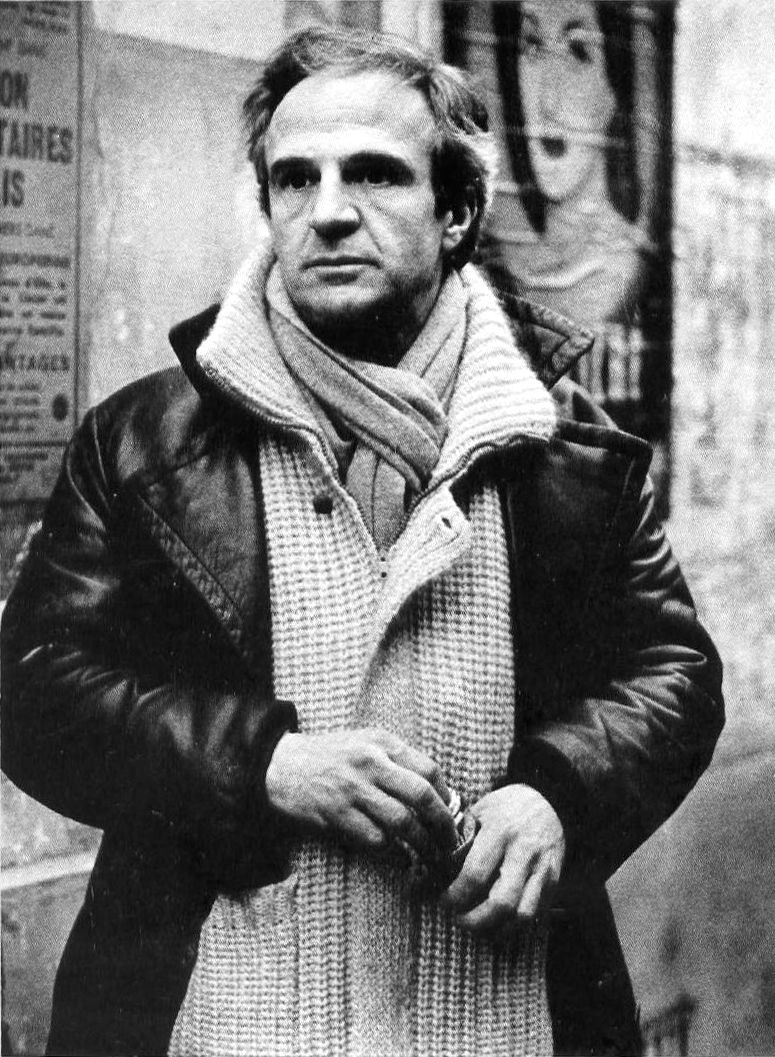
When my heartbeat slowed sufficiently, I noticed that standing in front of me was a man with dark hair, slightly shorter than me. It looked like---but could it be? And then I saw the tip-off. He was wearing a scarf. This was L.A. It had to be a Frenchman. It had to be Truffaut.

It was. The upshot of all of that grief was that I watched Truffaut's latest movie, while I watched Truffaut watching it.

I also breathed a sigh of relief that the day was almost over. I was there without the promise of an interview with Truffaut, without which, my editor at Rolling Stone made clear, there would be no story, and hence no money. But I wasn't worried. It had been my experience that a trip that started badly would soon turn out well. And a trip that started with a day like this would have to be bliss for the next two weeks. You know what? It was.

When I awoke in Santa Monica the next morning, the sun was shining. A van arrived from the airport with my lost suitcase. And when I went to get something out of my car, I spied my wallet hiding in a previously dark corner of the trunk. I went out on the front porch with my coffee to look at the ocean. A woman rode by on her bicycle. She looked up and waved. It was Jane Fonda. She lived on this street, in a big tumbled house with Tom Hayden and children.

Annette Insdorf
After a press conference with Truffaut I met Annette Insdorf, an American from New York who was then teaching film at Yale and was later the director of the film program at Columbia. She was finishing a book on Truffaut, and was serving as his translator. She agreed to ask Truffaut if he would give me an interview.

Truffaut was present for the programs that week, as the article that follows will describe. At some point Annette told me my request was granted, basically because one of Truffaut's daughters subscribed to Rolling Stone.

The interview was in Truffaut's suite at the Beverly Hills Hotel. I had my tape recorder but through Annette he said I couldn't use it---Truffaut had turned down all other interview requests; apparently he'd agreed to do the press conference instead. This was to be a "conversation." I could take notes, though. I guess that was the distinction.

Actually it was a conversation. I know very little French. Truffaut liked to say he doesn't speak English but he understands it. So he spoke French, I spoke English, Annette translated. By the end of the conversation I swear I was understanding Truffaut's French, because we were talking back and forth before Annettee could translate. Then she gave up and just joined the conversation.

I remember that it got so informal that I told him about a scene in a play I wrote and directed in college, in which two gunslingers marched towards each other from opposite ends of the stage. "Truffaut!" said one. "Godard!" said the other. He thought that was pretty funny.

We had about an hour, because Truffaut was going to the American Film Institute banquet where Alfred Hitchcock would be presented with a lifetime achievement award. As we got close to the time he would need to leave, Truffaut didn't say anything or betray impatience. But with some subtlety he managed to pull his coat sleeve back and position his arm so I could see his wristwatch, as he continued to answer my question. I took it as a hint, and thanked him.

I stayed in LA for at least another week. Evenings I saw one or two Truffaut films as the festival went on. Daytimes I hung out with my friends. I went with David to meet the guy who was writing the music for his film. We watched a few scenes in a screening room as they talked. Buffy came by and she and I talked about writing a script together, based in part on something I'd written, and partly on her experience at the Orson Welles restaurant.

I'm not sure it was on this trip, but Buffy got me my first and only "lunch" with a Hollywood agent. A guy from William Morris took me to a Mexican restaurant and I pitched some ideas, which he seemed to like. Our waitress looked a lot like Gloria Swanson, only a good deal older. He said that she actually had been Gloria Swanson's stand-in. When she came back after the meal, I looked at her and smiled. She looked at my empty plate. "I guess you were hungry," she said. I went back to the Morris office with this agent and he gave me several agency envelopes to send him treatments and scripts. A few weeks after I got home, I talked to Buffy on the phone and she told me she showed up at work one Monday morning and he was gone.

I remember one night at a new bar and restaurant on the beach at Venice, a happening place. I was there with Terry and maybe Michael Dobo and friends of theirs, laughing it up at the bar. (Michael showed me the script he was trying to circulate, for an episode of the Jeffersons.) I looked over at the small dining area to see that one of the diners was distinctly annoyed. It was Lucille Ball.

I went to lunch with David and Larry and Terry (I'm pretty sure) at another happening bistro in west Los Angeles. We were sitting in our booth waiting for this chocolate dessert that was supposed to be amazing. In the booth behind us was Anthony Hopkins. He wasn't as well known then as now, but still a star. I still remembered a TV drama he'd done when he played a kind of Dylan Thomas poet. It's one of the few times I regret not interrupting somebody's privacy. He's a guy I would have liked to have a conversation with.

And then there was this early evening on Terry's porch. He had a few friends over. One was a cameraman on "Lou Grant," my favorite series at the time. It was a beautiful evening, sunset, and we were drinking wine. Then below us an ambulance appeared. An older man next door had a heart attack. As he was being put in the stretcher, an older woman waved frantically up at us from the street below. Terry was trying to explain with hand gestures that he was not the doctor who used to live there. Then a few minutes later she had a heart attack, and a second ambulance came. We watched all this in the Santa Monica sunset movie talk third glass of wine haze, like it was some bizarre TV program.

So I got back to Pennsylvania and I wrote the Rolling Stone piece. I sent it in, and I waited. And waited. When I had given up all hope, I finally heard from them. Well, the piece was too old now to run as an article about the festival, but maybe if I made it a more general piece about Truffaut.

So I rewrote the piece, though the changes didn't amount to much. The version that follows this typically longwinded introduction is a combination of the first version and the piece as it was published in Rolling Stone.  They even used my title: "The Man Who Loves Movies."

The Hitchcock banquet wasn't broadcast until many weeks later, so I watched it back in Pennsylvania, watched Truffaut make his little speech, realizing that barely an hour before this moment was taped, he and I had been in "conversation" in the Beverly Hills Hotel.

I sent a copy of the piece to Truffaut in Paris, together with a letter recounting my adventures, and an article I'd published in Washington Newsworks when I was editor there and our film person was on vacation. It was on the aesthetics of the double feature, an even more arcane idea now.

 I sent it to Truffaut because the last part of it was about a double feature of his two of his films. (It was at another Truffaut double feature in Washington, I believe at that same theatre, a year or so later, that in the lobby between the two films I ran into a young woman I'd met once when I was at Newsworks and she acted in a local experimental theatre company. We saw the second film together, had a few drinks and lots of laughs at the bar next door. I volunteered to walk her home, not realizing that she lived a couple of miles away, but by giving each other piggy back rides along the way, we completed the journey. The next time I saw her was also at the movies, although she was about ten feet high that time. She was in the movie. Her name was, and I guess still is, Karen Allen.)

To my surprise, I got a letter from Truffaut in response to mine. Most of it was in French, in large typed black letters on white paper, thanking me for "le clips" and saying that "undoubtedly we should meet again."   There was a handwritten postscript referring to my comparison of "Day for Night" and "Adele H." It started out in French, but ended with the words in English: "is very accurate."

We never met again, and even more sadly, this was not to be the midpoint of his career as my article suggests. Truffaut made only three more films, including the classic, "The Last Metro." He died of a brain tumor in 1984.

In a film about Truffaut, one of his daughters says his public image was accurate but incomplete. That seems a fair and gallant way of saying it.

In that film, his boyhood friend, Robert Lauchenay recalled, "As the outside world was hostile to us, we used movies and books as a kind of shelter." We had that in common. Early in his career Truffaut proclaimed, "The film of the future will be shot by adventurers. The film of tomorrow will be an act of love."


rolling stone June 14, 1979


TRUFFAUT: THE MAN WHO LOVED MOVIES

Though probably better known to American audiences as Lacombe, the French UFO investigator in Close Encounters of the Third Kind, Francois Truffaut has twenty years of internationally acclaimed filmmaking to his credit, an opus honored recently in the first major domestic retrospective of his work in Los Angeles. It was a curious idea: appropriate for output and quality, but unusual for a director so comparatively young. As one critic recently wrote, "Francois Truffaut is 47 years old, has made eighteen feature films, and is probably no more than halfway through what adds up to one of the most fertile, impressive careers a director has ever had." In both formal question and answer sessions and informal conversation, Truffaut revealed that he feels his career is at a kind of midpoint---and what is ahead may be quite different from what we have seen so far.

The retrospective (co-sponsored by the American Film Institute and the L.A. County Museum of Art) began at the Academy of Motion Pictures Arts and Sciences, a building rivaling Xanadu set amidst Rolls and Mercedes dealerships on Wilshire Boulevard. Truffaut, present for the first of the three week event, premiered his latest film, Love on the Run, to a packed crowd in the enormous Samuel Goldwyn Theater. (Truffaut's other unreleased film, The Green Door, a brooding drama based on a Henry James story, ended the retrospective.)

 It was a fitting choice to lead the program, being the latest (and last) in Truffaut's series centering on Antoine Doinel, which began with his first feature, The 400 Blows (1959). Truffaut once described the character of Doinel as the synthesis of two people: himself and Jean-Pierre Leaud, the actor who plays Doinel in all five films and who has aged with the character from adolescence, something unprecedented in moviemaking.

In the new entry Doinel is 35, a divorced first novelist looking back on his relationships, and beginning a new romance. The film is built around clips from previous Doinels and replete with playful quotes and references to other Truffaut movies such as Day for Night, Soft Skin and The Man Who Loved Women, so it is a kind of retrospective in itself.

Truffaut told the audience that the clips in Love on the Run were first selected by one of its stars, Marie-France Pisier (co-star of Cousin, Cousine), working with an assistant director. They also wrote the first draft screenplay. Truffaut added Doinel's new love interest, "so the ending would not be so sad."

Truffaut felt a prisoner of the Doinel character in doing this film ("Because of things he'd done before I felt I didn't have a lot of choices") which perhaps is why he announced it will be the last in the series. Still, Antoine is a much beloved character. Speculating on the reasons, Truffaut said, "He has a certain sincerity even when he lies...He has valor. It's the word I used most often in directing Leaud in the role---'this scene needs more valor.'"

"Bed and Board"

In their combination of comedy and seriousness, their elevation of ordinary humanity and their cinematic energy, the Doinel films are often considered Truffaut's most characteristic, rivaling the fame of Jules and Jim and the more recent Day for Night, which won the Academy Award for Best Foreign Film in 1973. The middle three ( Antoine and Collette (1962),a 23 minute contribution to an anthology called Love at Twenty; the classic Stolen Kisses (1968) and possibly the best of the series, Bed and Board (1970)) were shown together later in the program and proved a highlight of the retrospective. The audience especially appreciated the unity of the latter two, down to the same foreboding music accompanying a mysterious character, though in both cases he turned out to be benign.

After the first screening, Truffaut was asked why many of his male characters are romantic while his women are independent--a reversal of Hollywood stereotypes. "In love, women are professionals, men are amateurs," he said. "Women live their love stories doubly---they live love and reflect upon it at the same time. I show men who live their love stories not at a conscious level, and this is perhaps why I show women stronger than men."

As to the charge that Antoine Doinel and other characteristic Truffaut males are perennial adolescents, shy but childishly demanding, Truffaut responded, "I am reproached because my men are not adults. But in my life I have not met many men who are adults." The audience applauded.


Truffaut's concern with human relationships (including children, family and society) has been his trademark among the directors who began the French New Wave movement in the 1950s, as an attempt to bring sincerity back to a stultified commercial cinema. His many films about men and women range from the playful Doinel films to the truly fiery love stories of Mississippi Mermaid (with Catherine Deneuve and Jean-Paul Belmondo) and The Story of Adele H (which won an Oscar nomination for Isabelle Adjani.) Truffaut's secret in telling these more serious love stories is the tension between a character who sees love as temporary or accidental, and the other to whom love is definitive. The latter characters, Truffaut said, "are like mad people, but mad people who we like because we recognize their purity."

Truffaut's definitive passion for film itself is a long-standing one. He wrote in his recent book, The Films in My Life, "I saw my first two hundred films on the sly, playing hooky and slipping into the movie house without paying...I felt a tremendous need to enter into the films. I sat closer and closer to the screen so I could shut out the theatre. I passed up period films, war movies and westerns because they were more difficult to identify with. That left mysteries and love stories."

Later as a filmmaker, his natural mentors were the geniuses of these two genres, Alfred Hitchcock and Jean Renoir. he states bluntly that his work is an attempted reconciliation of these two apparently opposite directors: the master of murder and the cinematic humanist.

Truffaut was in Los Angeles partly to participate in the American Film Institute presentation of its Life Achievement Award to Hitchcock. In the televised ceremony Truffaut observed, "In America you respect Hitchcock because he makes scenes of love as if they were scenes of murder. In France we respect him for the scenes of murder that are like scenes of love."

Hitchcock's influence is weighted toward cinematic technique; Renoir's contribution is focused on the feeling that informs the film. Coincidentally, Renoir's death came just before the retrospective began; Truffaut spoke at a memorial program at USC. Renoir used "something like a trade secret---sympathy," Truffaut once wrote, which enabled him to make "the most alive films in the history of the cinema." Truffaut often quotes Renoir's words in The Rules of the Game: " You see, in this world, there is one terrible thing, and this that everyone has his reasons."

As part of his own retrospective, Truffaut screened Hitchcock's Shadow of a Doubt. Characteristically his discussion afterwards was the longest and best of his three appearances. Truffaut clearly and enthusiastically acknowledges his debt to other filmmakers---his acceptance of the rules of the cinema makes him a classicist among the New Wave directors like Godard and Bresson, who attempt to reinvent film every time they start a camera.

"Godard is more of a romanticist and I am more of a classicist," Truffaut said. "The idea of being the first to do something doesn't interest me at all. I used to explain it this way: if Godard and I came upon a card game we didn't know, he would say, 'That's stupid! Let's play it another way.' But I would say, 'What are the rules? Teach me.'"

But it is this passionate scholarship and empathy with the filmmakers of the past that fuels Truffaut's own inventiveness---his knowledge of styles is so exact that he can effectively mix several within a single picture.

In person, Truffaut's affable seriousness and intelligent passion for how movies are made illuminated the post-screening sessions. As anyone who has been there can attest, it is impossible to have coffee in this part of L.A. without hearing a movie deal discussed. But in these hours something strangely rare occurred: the romance and reality of movies met as art, craft and experience.

Yet with all the technical fascination, Truffaut never lost sight of the people and emotion involved. Speaking about Hitchcock's uniqueness as a director he added, "I don't think Hitchcock feels comfortable in normal society." When the audience laughed Truffaut commented, "That isn't funny." It is this quality of caring that inspires the feeling often mentioned by his admirers---trust. Like the professor he portrays in The Wild Child, Truffaut plays shell games---but he doesn't cheat.

"Fahrenheit 451"

The retrospective went on after Truffaut returned to Paris. Ray Bradbury was on hand at the L.A. Museum (where all screenings but Love on the Run were held) to introduce a mint-condition Technicolor print of Fahrenheit 451, and told how he wrote the novel on which it is based by feeding dimes into a metered typewriter in the typing room of the UCLA Library. He praised the movie, especially the ending. "It's one of the greatest endings of any film ever. I've seen it twelve times and cried every time---and not because it's mine. Because it's Truffaut's."

Annette Insdorf, a Yale film professor and author of a new book, Francois Truffaut, who had also served as Truffaut's translator for his public appearances, introduced a quartet of films including Shoot the Piano Player and Jules and Jim with an apt interpretation of Truffaut's thematic and technical message: "Life repeats itself and there's nothing you can do about it." A later audience was mesmerized by the start and classical narrative of The Wild Child combined with the vibrantly colorful picaresque Small Change--a combination of films about childhood that Truffaut himself devised. He in fact selected all the pairings and groupings of his films for the retrospective.

Although he granted no formal interviews in Los Angeles, Truffaut agreed to a conversation in his Beverly Hills Hotel suite at the end of his stay (partly because one of his daughters is a Rolling Stone subscriber.) Annette Insdorf was also present to translate. Although he speaks considerable English and understands more, Truffaut takes pains to be precise. Once when Insdorf translated his description of the protagonist of The Man Who Loved Women as a "playboy," Truffaut corrected her in French, and she amended it to "skirt-chaser."

While rumors were rife that Truffaut is being wooed by Hollywood producers---and despite the phone calls and the open copy of Howard Hughes: The Hidden Years---there appears to be no American period for Truffaut in the near future. "Presently I am in a lull," he said. "but there are four or five projects in preparation in France." The Hollywood star system and its attendant problems do not seem to encourage him. He pointed out that if he had made The 400 Blows in the traditional way even in France, he would have had to use a star to play Antoine's father, and because of that the part of the father would have to be expanded, distorting the whole idea of the film.

In America the star system is the economic underpinning of the industry. "They needed Brando to get the money to make Superman," he said, "but when Brando was on the screen you just waited for him to get off so you could see the man who flies."

Truffaut on set of "Small Change"

Truffaut has used stars (including Jeanne Moreau, Julie Christie and Jacqueline Bisset) but it was a matter of choice. "If a director here can get Nicholson or Pacino and doesn't want him, he's considered an idiot. In France, Small Change was released in the normal way but here it would have been a "B" film unless I used big stars." You have to have stars to get bookings, I suggested. "Booking!" Truffaut boomed, breaking into precise Hollywood English. "Booking is King!"

Truffaut's own filmmaking career is at a juncture. He feels Love on the Run represents doors that have closed. He spoke of writers who do five or six novels and then move on to other kinds of books (books and writing are major themes in his work---Truffaut is the movies' most conspicuous champion of literature and its enterprise.) "As one gets older one loses the sense of fiction," he said. "Fiction is something linked to youth."

But Truffaut is hardly at the end of his career. "Films made by old people are generally misunderstood," he mused. "They're more theoretical, less physical." But it also takes time for audiences to accept the style of a young filmmaker, he added. "The best contact with audiences is made when the filmmaker is around 45 or 50." Annette and I both laughed. Truffaut smiled. "I should take advantage of this period," he said.

We discussed his appearance in Close Encounters, his first as an actor outside his own pictures. ("I tried to be the most cooperative actor on the set. Every director does.") The role was ironic, considering a statement I'd heard attributed to him to the effect that he was interested only in film, children and the relationships between men and women; if a flying saucer landed he wouldn't cross the street to investigate.

I asked him if this was true. "Yes," he smiled. "When people talk about UFOs, I tune out. It's the same when they discuss food---I think about something else...my work."

Despite his own lack of interest in the subject, those who know Truffaut's work attach a special significance to his presence at the end of Close Encounters. There are few people we would rather have representing humanity to an alien culture than Francois Truffaut.

                                                                 *


Here also is my article on double features I sent to Truffaut, published in Washington Newsworks weekly in 1976. The irony of it now, of course, is that both the double feature and the "big city revival and sub-run houses" mentioned in the lead are virtually obsolete. But this was before the VCR, let alone the DVD. Read this, and program your own double feature today!

The Aesthetics of the Double Feature


Like the weekly serials and the Saturday afternoon cartoon shows, the double feature has become a relic of a bygone era. As shopping center cinemettes showing the latest first-run films in separate pre-fab compartments all over the country replace the old movie palaces, the double bill remains a staple only in big city revival and sub-run houses. But there it has also found a new kind of life---the double feature has become, in the hands of creative programmers, a kind of art form in itself.

Seen in a certain way, double features have unique effects. Besides feeling less ripped-off by the admission price, the moviegoer feels somehow more adventuresome at the prospect of seeing more than one film. Two films seen together naturally feed back on one another. The first film colors the experience of the second, and the second, since it was seen more recently, colors the memory of the first. If the films are matched particularly well, each may draw out aspects of the other that the view might not ordinarily catch.

Few double bills are paired randomly; putting two films together is frequently the only creative thing a programmer gets to do. Some are paired rather obviously by subject and style, as with several upcoming twin bills: animal nastiness in Rattlers and The Frogs at the Senator; violent steel and posturing in Super Weapons and Lightning Sword of Death at the Trivoli; classic Fred Astaire foot-tapping sweetness in Top Hat and Swingtime at the Inner Circle. Some are combined for an actor (the Key's recent Bogart festival) or director (two Truffauts at the Biograph.)

But there are more subtle pairings, too. The Capitol Hill II puts together two films with a common theme---politics and corruption---but with very different approaches emanating from different areas: Advise and Consent, a pot-boiling anti-heroic drama from the 60s, and Born Yesterday, a comedy-romance with a heroic message from the 40s. A similar approach---common theme and different style---but using two films from the same era of disaffection occurs in the Circle's twinning of The Graduate and Paper Chase.

"Charlie Bubbles"

Some double bills seem to make very little sense, but suddenly each film illuminates the other in a new way. A few years ago I saw two movies that seemed to have little in common except they were both ostensibly minor British films of the trendy 60s: Karl Reisz's Morgan! and Charlie Bubbles, Albert Finney's first and so far only film as a director as well as star. Though I'd seen them both separately before (sometimes that makes seeing films together even better) I hadn't noticed, nor felt, the depth to which each dealt with an artist who came from a working class family and politics, into upper-class situations and money---and the confusing effects the artists had on the people in their lives who were quite comfortable in their class niche, or at least were unable to transcend it.

"Morgan" 

Each main character struggles to join together these aspects of their lives---Morgan in a more fantastic, yet more political way (he was perhaps the world's first back-to-nature Trotskyite, who revered Marx and gorillas equally)---Charlie Bubbles in a more mundane and identifiably real context. Both characters achieved some sort of half-tragic transcendence---Morgan through madness and Charlie in such a pure sense of transcendence that I hesitate to give the ending away even now, it so moved me the first time I saw it.

Each of these films yielded new insights into the other not likely to occur if each is seen alone. If one views films, cares about films, beyond the surface gore and giggles allowed by the canons of 70s apocalyptic hedonism, the experience can be enlightening and exciting.

Another pleasure of discovery occurs when a double bill gives you a new feeling for the common themes that link disparate films by the same director. For example, the Biograph's recent pairing of Francois Truffaut's two most recent American releases, The Story of Adele H. and Day for Night.

Seeing them separately with months between, they seem entirely dissimilar: the tragedy of a young 19th century woman whose obsessive love for a shallow soldier drives her mad; and a comedy about the making of a not especially good contemporary movie. But together it becomes clear that they are not dissimilar---they are opposite sides of the same theme; the same guiding obsession of the same director.

"Story of Adele H"

Adele H's obsession isn't simply with a resistant lover but with her own identity, her passionate need to separate herself from over-identification with her famous father (Victor Hugo) and older sister. To do this she must perform some extraordinary, heroic act--to, in her words, "walk across the sea to join her lover in a new world---this I will accomplish."

Adele's obsessions only refer to the outside world but don't respond to it---primarily they are responses to her inner world, her anguish, her courage, her struggle---above all, her gamble: the romantic gamble of self-realization, of making something new of one's life and another's through vision and love.

Adele H. ends with Victor Hugo's dying words, "I see a black light," and a repetition of Adele's vow. Her failure to accomplish it-the gamble lost---is her tragedy.

What can this have to do with Day for Night? Simply that Adele's obsessions have been applied to a generally more successful way of dealing with the dark, helpless interior struggles. The solution is classic: the inner struggle is externalized, the emotions of the inner darkness are acted out in the light through the making of art, in this case the social art of films---and so the exchange is literally day for night.

"Day for Night"

Clearly, the world of film is what allows the characters in Day for Night, including the director Truffaut himself plays, to deal with themselves in the given world. Truffaut says as much to the character played by (and very much based on) Jean-Pierre Leaud: "We are no good at life, we are only happy in our work."

Adele spends much of her time feverishly writing in her diary; in dark rooms, she constructs her inner-directed dramas alone. There will be no audience until she is dead. The moviemakers are shown in constant relationship to each other, and the most private moments are transformed (in one case, literally overnight) into the acted out, public form of film.

There are other common threads between these two movies; seen together, they form a unique presentation of Truffaut's wisdom and compassion. It is a pairing of films as subtle and wonderful as an ideal marriage between two people, sensitively, wisely and lovingly attuned. But like such a marriage, the wonder is only potential until the two are brought together, in the right place, at the right time.

Monday, December 16, 2002

This is a fiction piece I wrote several years ago as part of a larger project. I thought I’d post it now for the holidays. It’s based on memories, not only mine but those of my Aunt Toni (who provided details about food and food preparation, among other elements) and of others in my family—--my sister Kathy and cousin Bobby in particular. I’ve changed some names, but kept others. I found that in fictionalizing real events and people, that I would sometimes forget what the names I invented referred to. So in early stages of composition I kept the actual names, even if the people and places became substantially more invented. I hope no one who has these names feels insulted. If this ever goes to print, I’ll change more names.

I expect this will be of interest chiefly to members of my extended family, though the historical detail of life in western Pennsylvania in 1951 is as accurate as I could make it. So it is my gift, especially to my extended family, for Christmas 2002. Merry Christmas and Happy New Year to them, and to everyone.


Christmas 1951

Flora had some last minute shopping to do before going to Arnwood to help Mum with Christmas Eve cooking, so Walt came home for a few minutes in the afternoon to pick them up. He was working at the store on Main Street today. She told Billy to call and remind him, and watched as Billy asked the operator for 409, which was the Singer store number. He knew that number and their home number (5329-M). She noticed again that when he put the heavy black phone receiver to his left ear he immediately switched it to his right. She was going to have to ask Dr. Spino about this.

Doris who answered the phone told Billy that Walt was already on his way. Billy went to the picture window to watch for the Singer sewing machine truck. Sometimes he could spot it at the bottom of the hill, at the corner where they got the green city bus to go into town, or the orange bus that took them to Arnwood.

The window was ringed with the new Christmas bubble lights that Walt bought and that Billy and Kathy would sit and watch. Kathy would soon tire of it, since she was not quite two years old, but Billy could sit there watching for a long time. The lights came on when Walt plugged them in, but it took awhile for them to warm up so that the bubbles started moving, and that's what the kids waited for. There were green, red, yellow, blue and orange lights, and they began bubbling at different times, so the kids had a good time watching them.

She was getting Kathy into a dress when Billy shouted that daddy was home. Soon she heard the front door open and Walt came into the bedroom. She told him they would be just a few minutes. He took off his coat but didn't hang it in the closet. He draped it over the back of the couch in the living room and sat down in the leather chair. He was wearing his good brown suit today because he was working the floor at the store, and he had on a brown tie only because Flora had prevented him from wearing a blue one. His color blindness was only a problem with dark shades, she noticed. He seemed to be in a good mood, but as soon as he got home he always started feeling tired.

Flora succeeded in getting Kathy's dress, white socks and white shoes on her before she started fussing, but getting her arms into her winter coat was a struggle. Kathy had worn braces on her legs for a very short time, but when she started walking it was clear that she didn't need them and her legs were healthy and strong. So already this was a happy Christmas.

Flora got Billy into his coat and hat and gloves, and Walt carried Kathy down to the truck. They didn't have real steps yet, just piles of big rocks that were flat but ridged, and some moved a little when stepped on. Walt and his brothers and one of the neighbors had built the walk last summer, using rocks the bulldozer had scooped along the hill from the street to just beside the house. Someday this would be their driveway, though now it was just dirt on a hard rocky surface. There was a little snow on the ground, but Walt had brushed most of it off the walk with an old broom this morning, and no more had fallen since.

Flora and Billy went around to the passenger side of the gray panel truck with the red Singer insignia on the side. Billy climbed in first, crawling over the seat and down between the two front seats into the back of the truck, where he sprawled on some old blankets. Then Flora stepped up and sat down, while Walt came around and then handed Kathy to her.

The road down the hill passed bunches of trees and a scattering of houses, then the gas station and the Hudson-Nash showroom, until they came to the corner of Hamilton Street, where the many houses were close together and the city of Greenbriar really began. The first few blocks of West Newton Street past the Hamilton corner, still lined with trees but now just a stately single column of them, was a mix of some big stone houses and other smaller wood frame ones, all of them built many years before the war. Then West Newton merged with Pittsburgh Street at the top of the hill that led deeply down and then sharply up like a roller coaster dip, cresting at Main Street, before another steep drop on the other side.

There were fewer trees as they started down the hill but they were very tall and pretty. Rich looking, Flora thought. She noticed a little snow on the large rolling lawns in front of the big stone buildings, formerly the mansions of the town's rich coal barons before they left town altogether, now converted to funeral parlors and the headquarters of an insurance company. There wasn't much snow, but enough to ensure this would be a white Christmas.

When Billy saw the golden court house dome at the top of the hill he knelt on the hump between the built-in seats to look at the gray stone courthouse itself, the largest building he had seen so far in his five and a half years.

Just before Main Street, Walt pulled a little ways into an alley to let them out. Once she and Kathy were down, Billy climbed out and watched the truck continue down the alley.

"Where's daddy going?" he asked.

"Just back to the Singer store," Flora answered. "We'll see him there in a little while. We're going to Royers now. Don't you want to see the flying bottle?"

For a moment he didn't know what she meant but the idea urged him forward with her. Kathy wanted down from her arms, and so their progress was slowed by Kathy's walk. Now Billy was impatient and skipped ahead. Fortunately, there was a side door to the store and she guided them inside.

Royers was the smallest and smartest and most expensive of the Main Street department stores, so Flora only bought there what she couldn't find elsewhere. She'd seen a cashmere scarf she liked on a previous visit and had decided to buy it for her brother Carl. She guided her children to the correct counter and made the purchase. Billy, who was looking at the lit glass cases and holding onto his sister's hand, heard the sound and remembered, and quickly looked up.

He saw the clerk wrap the sales slip and its carbon copy with a rubber band and put it in a dull gold colored metal cylinder. Then he opened a lid on a pipe the same color that went up the wall and across the ceiling. As soon as the lid was opened, the cylinder was immediately sucked up and sent whooshing and clattering through the pipe. "The flying bottle!" Billy cried. Flora smiled as Billy watched for the sales slip to come back through the pneumatic tube and clunk to a stop.

Back outside, they walked past several small shops--Nancy's, the La Rose Shop, Robertsons-- and the big Joe Workman store. Billy knew which one was Nancy's by its orange facade, because of the radio commercial that fascinated him: several men, singing "That's Nancy, with the orange face," slightly off-key.

Billy asked where they were going next and Flora told him, "Bon Ton's. Do you know where it is?" Billy looked past the McCory's five and ten (almost as big as Murphy's across the street)and the Masons building, and saw the big sign that hung over the sidewalk, with a clock in the first O and a temperature gauge in the second. "Right there!" he cried, pointing up at the sign. Billy knew the sign, a conspicuous landmark on Main Street, but he could also read it. He didn't quite know how to read, Flora had 33decided. He knew his letters, and he knew certain familiar words, like Bon Ton and Singer, but she didn't think he had put the two skills together yet. But he was close, and he wouldn't start school until next fall.

Flora thought about sending him to kindergarten, but there was only one nearby, and she didn't know anyone who sent their child there. Since Billy seemed to be learning on his own, and also since he still got upset and sometimes uncontrollable in a crowd of children--who could forget the monumental tantrums he threw at his surprise birthday party in Youngwood last year-- she decided against it. It wasn't worth the money. Her mother agreed, as did Doctor Spino, and so did Walt.

By the time they got inside Bon Ton, Kathy was fussing. Royers had been crowded but the Bon Ton was very crowded and loud. There were no rugs on the shiny wood and stone floors, and the ceilings were higher. She promised Billy some ice cream if he would help her with Kathy while she looked at lined leather gloves for dad. She talked with a clerk at the men's gloves counter while Billy stood nearby with Kathy looking at the lights on a Christmas tree, telling her the colors. He would point, say the color, and she would repeat it. Then he pointed and waited. She cried out the names of colors. Flora looked back once in awhile. Kathy seemed to know red but her other choices were guesses, and when she was wrong and Billy laughed, she would repeat the guess to make him laugh again.

But they both soon tired of this game, and Flora hadn't found what she was looking for, at least not at the price she thought reasonable, so they crossed the short side street to Troutman's, the biggest department store in town. She thought about taking them up to the third floor to see Santa, but Kathy had been frightened by the big man in the bright red suit when they were here a few weeks before, so she didn't mention it, and they stayed on the first floor.

While she held Kathy and bought a pair of gloves--they weren't much cheaper or any nicer than at Bon Ton's but she was ready to give up--Billy stood looking through the glass doors across Main Street where he saw the Singer sign. She thought this would entice him, but when she started to move that way he reminded her about the ice cream. She sighed and changed direction, going back out the side door and down some steps to the little diner below street level. She immediately regretted it for it was crowded and so hot that the glass windows were steamed up. But Billy was fascinated with the idea of being below the street and wanted to stay. He was just starting to work up to a tantrum when a booth became available and they all sat down.

Flora was impatient. It was silly promising ice cream when they would all be stuffing themselves for the next couple of weeks, and they would have cookies and candy within all too easy reach most of the time. And it was getting late. Mum would be beside herself trying to get everything done.

She tried to urge Billy along but he was still more interested in looking around and back up at the legs of people walking by on the sidewalk than his dish of melting chocolate ice cream. Fortunately, Kathy was also absorbed in looking around and a few spoonfuls of ice cream seemed enough for her.

At last she got them buttoned up and ready to go out again. They crossed Main Street to the Singer store. As soon as they got inside the door, Kathy ran across the carpeted floor. There weren't many customers and everyone who worked there knew them. Doris made a fuss over Kathy while Billy stood quietly looking around. Walt wasn't out on the floor. He could be downstairs in the shop or more likely in the back with a favored customer, sipping some holiday whiskey. But Doris' loud praise and Kathy's laughter must have alerted him, and he came out. Billy, who had been so eager to come here, hardly moved. Flora exchanged greetings with Ronnie Welsh, who said he and his wife Reenie would drop by, probably on the weekend. This would be the first Christmas season Flora was able to entertain visitors in her new home. Although she and Walt had spent an evening at the homes of a few of his coworkers and their wives, like Ronnie and Reenie, they had not yet hosted any. Now they could.

Flora talked quietly with Walt. He confirmed that he would have to stay to close up, since the manager had the day off and the assistant manager left early. Ronnie, the only other salesman there today, had the longer drive home. She reminded him that they were eating early so that they could go see his family afterwards. She gave him her packages to put in the truck, and gathered her children for the trolley ride to Youngwood.

The trolleys ran on Main Street so they caught one at the corner, and once they were past the last houses a few streets beyond Main, the six mile ride didn't take much longer than by car. From there to Arnwood the trolley ran alongside the railroad tracks, which Billy really liked. He loved trains, and wished aloud that they would see one go by. Flora was just as glad none did, for she was grateful for the quiet. There were enough seats for everyone on the trolley, and it was a quiet ride. Snow streaked the grass and clung especially to the trees higher up the hills they passed. The route itself was very flat. Soon they started passing standing coal cars and box cars that meant they were nearing the rail yards of Arnwood, and soon after, Depot Street.

When the trolley stopped near Depot Street, Billy wanted to stay on long enough to see the conductor take him stool from one end of the trolley car to the other for the return trip, but Flora told him they had to get off now or they would have to go back, and he wouldn't get any of the jumbalones grandma had made this morning. So they got up and walked in the cold and cloudy afternoon across the black coal cinders, onto the short border of grass and then onto the sidewalk, up Depot Street.
* * *


"Billy Boy!" grandma cried and gave him a big hug and kiss. First it felt warm and then too hot and he wriggled away. Pup pup was standing behind her at the door and he laughed. Pup pup's face was scratchy when Billy kissed him. He smelled like his after shave, Old Spice, which came in a white bottle that they got him for Christmas. Daddy's aftershave was in a green bottle, it was Mennen.

Mummy and Kathy were coming in behind him. "Close the door, close the door!" grandma said to them. "You want all the cold get in and all the warm get out?" She looked at Billy, so he shook his head. Then she laughed and tried to hug him again but he got away.

He ran down the hall, and looked into the living room when he heard voices. The room was darker than outside except around the lamps, the big one standing by the chair and the radio with the red shade, and the lamp on the table in the corner with the orange shade that looked like an umbrella with pictures on it. One of the end tables was gone and in its place was a Christmas tree. Billy was looking for Uncle Carl but he didn't see him. He looked especially at the big black piano. Instead there were three people standing looking at him. He knew them. They were sort of aunts and uncles but older like grandma and pup up.

"Who's that?" Mr. DisPasquale said. "Is that Billy? Hey, Wolule--que ce dice?"

"Look at him! He's so big!" Mrs. DiPasquale sang. "And so fair!"

"He still looks like Flora," Mrs. Gelfo said.

"Oh, yes," Mrs. DiPasquale agreed.

"Have you been a good boy?" Mrs. DiPasqaule said. "Are you going to get lots of Christmas presents from Santa Claus?"

"Or just a lump of coal?" Mr. Depasquale said just as pup pup came in, and they laughed.

"Of course he's a good boy," Mrs. Gelfo said.

"He's my Billy boy!" grandma said and tried to hug him again but he got away and everybody laughed. But by then they were all making a loud fuss over Kathy, and saying how big she was, too.

He left the noise and looked around the dining room. It was dark, too. All the wood was dark and shiny--the doors, the big dining room table, the cabinets and the wood around the fireplace--and he could smell the polish. There was a string of Christmas lights across the mantle, but they weren't on. There were just the little gas flames of two lamps with their curved glass covers, up on the cabinet with the drawers he could now reach.

But in the small kitchen the big light was on, and it was bright. Billy looked in. There were trays and dishes on the table but it was all stuff grandma was getting ready to cook.

Now everyone was coming into the dining room so Billy turned around and stood by the table.

Grandma was saying something in Italian and Mr. DePasquale--his name was Vince, Billy remembered--said something back and shook his head. "No, no," he finally said. "We have to go now. You're busy, everybody's got to cook, so we go."

"We just dropped by to bring some olive oil we got in Pittsburgh," Mrs. Depasquale explained to Flora. "We weren't gonna stay. But you come by on Wednesday, we'll be home." Flora nodded and smiled. Today was Monday and Christmas was Tuesday. They were for immediate family. The day after Christmas, St. Stephen's Day, was the day for visiting friends and relatives.

They were all standing near the small doorway to the hall so Billy outsmarted them like Hopalong Cassidy and went past the dining room table and into the living room the other way, through the big opening, past the big radio. He headed straight for the candy dish on the coffee table. But mummy saw him.

"Just one!" she said. So he took one silver wrapped Hershey's kiss, unwrapped it and ate it as they all kept talking and walking towards the front door. Mrs. DiPasquale and Mrs. Gelfo were nice but they were big and their flowery dresses smelled like lots of perfume and powder. He had been to Mr and Mrs Gelfo's house. They had an aquarium with goldfish in it. Mrs. Gelfo wore thick glasses so her eyes were real big, and looked like two brown fishes swimming in an aquarium.

As soon as they left, Billy asked grandma, "Where's Uncle Carl?"

"Up the street," she said. Then she turned to Flora and said something in Italian.

"He's up at the high school playing basketball," Flora said. "He'll be home soon."

"Maybe you like some jumbalone?" grandma said, and laughed when Billy nodded his head vigorously.

She took Billy into the kitchen and pulled down the silver cookie jar from atop the refrigerator. Inside were the jumbalone. More Italian foods were being sold in stores now, but Flora still hadn't seen anything like her mother's jumbalone. They were cookies but with a cake-like quality, shaped like figure eights and sprinkled with powdered sugar. Jumbalone could also be made like a cake in a pan, which is how Ant liked to make it. She put chocolate chips in hers. Flora made hers like this, but no one could get the shapes exactly as mum did, nor did anyone's taste quite like hers. She suspected that when mum passed on her recipes she always left something out. One evening as they washed dishes Flora suggested this to mum. She didn't deny it. " Maybe I want people to like mine best," she'd said.

Flora put Kathy in the high chair that was kept there for the latest grandchild to need it--first Billy, then Ant's boy Dickie, then Kathy, and now Ant's second child, also a boy, also named Billy, after his father. Dad would watch the kids as they had their jumbalones and milk, while Flora went down to the basement with mum to finish preparations for dinner.

As she made her way down the linoleum covered wooden steps, the smells from below rose up to meet her. These were the smells she'd known since her childhood-- flour and the other ingredients of the pasta in the big bowls on the table, the tomato sauce simmering on the stove, the fish baking and broiling in the two ancient ovens. She couldn't remember very much as far back as when she was Billy's age--her first clear memories were of the house on Stone St. in Greenbriar, and mostly of this house--but these smells were eternal.

This was the Christmas vigil dinner, and no meat was served, and it was the one day of the year when mum served seafood in such profusion. In quick Italian Mum brought Flora up to date on the progress of tonight's dishes, while she rolled out pasta dough on the wood table in the center of the room. She'd already made the spaghetti for tonight that would be served with fish sauce, and now it was time to make the ravioli for tomorrow.

Thin strips of cod were in the roasting pan soaking in water to draw the salt out. By the time they swelled to a half inch thick, they would be ready to broil to make baccala. This was Flora's first task--she saw they were ready and so she got rid of the water and put them in the broiler. At the same time, she put in the spots of black cod for the antipasto. The calamari was already made, and no one but mum touched the eel. Almost no one but mum and dad ate it, either, but she always made it. The cod dipped in batter and fried was served cold, so it was also done and in the refrigerator upstairs. There was cod baking in the oven, some in red and some in white sauce. More cod would be fried in bread crumbs and herbs, and this would be served hot. Flora set about cutting the cauliflower which would also be fried in bread crumbs. So would the smelts, the smallest and tastiest of the fish. Mum checked the sauce for the spaghetti--it was almost done, and ready to be flavored with tuna instead of meat.

By the time Flora went back upstairs to see to the relish trays, the kids were in the living room with dad. He had the record player on, playing a Sousa march which was his favorite music, and he was holding Kathy while dancing a little dance. As Flora got closer she saw that he had a red cherry wrapped behind each ear by its stem. This man who was so modest and dignified, and except for his occasional flares of rapid and seemingly angry speech, so quiet, was showing a side of himself to his grandchildren that even Flora had forgotten.

Billy sat in his grandfather's chair, trying to keep his grandfather's curved stem pipe in his mouth while laughing. Kathy was ecstatic. Flora checked herself from worrying about Billy choking and Kathy becoming overexcited and unmanageable. It was Christmas, after all. She watched for a moment from the dining room and then went into the small kitchen and turned on the bright florescent light.

When the front door opened she thought it might be Walt but then remembered that he always rang the doorbell first before walking in. It was Carl, who bounded upstairs to wash up.

As Flora washed the vegetables and the fruit, she heard the marches stop and the radio go on. Perry Como was singing "The First Noel." Mum and dad didn't have a television set yet, though mum was talking about getting one. At the Gelfos last night she had seen "Amahl and the Night Visitors," a new opera by Menotti written especially for NBC television. "Ah, Flor, so beautiful!" But of course she talked about getting the TV so the grandchildren could watch.

Then she heard Frank Sinatra singing "White Christmas." So many Italians on the radio, and now on television. Even some songs in Italian, like that Julius LaRosa song that mum sang with Billy on her knee. Or Rosemary Clooney--she had a big hit with "Come on a My House" which wasn't in Italian but she used an Italian accent. And she wasn't Italian either but at least she was Catholic. Now that Flora knew neighbors who weren't Italian or even Catholic, and some of the couples from Singer's, she was more aware of how their close world was getting to be part of the bigger one, even as more of them were moving away from it.

Billy wandered into the kitchen just as Carl came downstairs. Carl ruffled his hair as Billy looked up at him. Uncle Carl was the tallest man Billy knew. He watched in awe as Carl filled a tumbler full of water from the sink and drank it down without stopping. Then he showed mummy the elastic band pup pup made for his glasses so they wouldn't fall off when he played basketball. Billy wanted to ask Uncle Carl if he was going to play the piano, but his mother and his uncle were talking and he knew he shouldn't interrupt. Flora saw Billy standing in the kitchen doorway looking doleful and suggested that he go downstairs to help grandma.

That was a good idea so he headed that way--"Don't run down the stairs!"--mummy called after him. "I won't!" he cried. The steps down to grandma's cellar were a little big and hard anyway so he took them one foot at a time until he was almost at the end, then he hopped the last two steps and down to the floor.

"Billy boy! You come help grandma?" He said yes but there was nothing to do but watch. He wondered at how this dough became the ravioli he would eat tomorrow, so he watched carefully. But it took too long and he got restless.

"Be careful, no touch the stove," she warned him. "Very hot. Burn." He looked at the big black and white ovens and walked carefully by them. He climbed up the big step to the part of the cellar where the furnace was, and even though it was pretty dark in there he could see the cubes of black coal, with little gleaming spots coming from some of the top ones. He hopped right back down again and went to look in the part on the other side of the big center room, which was where the lawn mower and other tools were, and the door to the outside and the cement steps up to the little backyard and the long garden. It was too cold to go out without a coat, and the door was shut tight.

Billy came back into the center room and looked up at the big cabinets that held row after row of big jars. Grandma put stuff in the jars and kept them there, so she wouldn't have to go to the store all the time. That's what mummy said. He couldn't see what was in the jars and they scared him a little.

"So you watch Christmas story on television?" she asked him. "With Baby Jesus, and Wise Men sing to him?"

Billy shrugged.

"No? You no remember? Last night? Maybe was on too late for you, huh?"

"I remember--a little bit."

"So, you see, yes? Beautiful sing. What else you see? You see Santa Claus?"

"Yes. On Howdy Doody."

" Oh, boy--You see Santa Claus on Howdy Doody?"

Billy nodded and told grandma the story. "Howdy and Buffalo Bob and Clarabell went in a rocket ship to Santa's workshop, but there was a bad guy--Ugly Sam--and he had Santa tied up."

"Oh! No."

"But he didn't know it was Santa. He thought it was the Bearded Bandit. But it was really Santa. And Clarabell fell down and hit the Jack in the Box, and Howdy showed Ugly Sam that it was really Santa and he untied him."

"So Santa okay now?"

"Yes!"

"You think he come tonight?"

Billy was startled. Wasn't he supposed to come tonight?

"I think he come tonight," grandma said as she cut more dough with the little roller she had. . "Bring presents to good girl and boy. You been good boy this year? Listen to your mother?"

"Yes, I guess," Billy said, but he wasn't sure what being good meant. Did it mean all the time? He wasn't good all the time.

"Sure you good boy," grandma said. "I know. Santa Claus gonna come."

Even in the basement they could hear the doorbell ring.

"Who do you think that is?" grandma asked. "Go see." She wiped her hands on her white apron. "I come, too. Pretty soon we eat. You hungry?"

Billy shook his head up and down and made his eyes big. Grandma laughed.

When Billy got upstairs, daddy was in the kitchen with mummy, but when he saw grandma coming he went into the living room. Billy followed him. Daddy said hello to pup-pup and got the newspaper and sat in pup-pup's chair to read it. Billy went and sat on the couch with pup-pup and Kathy. Kathy was sleeping. He and pup-pup talked quietly about what to leave for Santa that night. Pup-pup said if he left a cup of cocoa and some cookies, Santa would be grateful because he had a hard night going around to all the houses on his sleigh and going down chimneys and back up again. Billy thought it was a good idea and went to tell mummy.

Flora was setting the table and smiled when Billy asked her if they could do what pup-pup said. "Yes, that's what we used to do," she said. "Although I'm not sure Santa likes cocoa anymore." When she said that grandma laughed. She was putting dishes of food on the table.

"Is it time now?" Billy asked.

"Yes, I think it is," Flora said. She saw that Billy was already standing in front of the china cabinet and looking inside. She opened the door for him and he reached in and took the small silver bell. He stood by the table and rang it, back and forth, back and forth. It was his job.

Flora put the bell back in the cabinet as Walt came in from the living room, followed by her father who was carrying Kathy, now awake. Billy found his place at the table. He was left-handed so he sat at the far left side, nearest his grandfather. His grandmother sat on the opposite end. Walt sat next to Billy, then Carl. Flora sat on the other side, nearest the kitchen, with Kathy in the high chair next to her. Carl said grace and the meal began.

Pup-pup and daddy drank red wine out of little glasses. Billy had the same kind of glass but he drank 7 Up. Plates and bowls began to circulate, but Billy didn't eat much of what was in them. Grandma had made him a special napkin to wear, with two strings that tied around his neck. Now she brought the big bowl of spaghetti and he ate plenty of that. He was still eating spaghetti when the plates of different kinds of fish were passed around. He liked the kind that was in the spaghetti sauce, although that wasn't as good as meatballs. He didn't like what was in the other kinds of sauce, but he ate some of the cold fish and especially the fried fish that tasted like the fish sandwiches daddy brought home sometimes on Fridays. The kind he liked best were the little fish, so mummy cut them up and took out the bones.

Daddy didn't eat much fish either, not even as much as he did. The others teased him.

"Come on, Walt," grandma said. "Why you no like?"

"That's squid, mum," he said.

"He doesn't even eat fish usually," Flora explained, then said to Walt, "It's mostly breading inside with some spices, it's in tomato sauce. It doesn't taste like fish. "

"No, it tastes like squid," Walt said.

"Hey, Walt, you work today?" pup-pup said.

" In the store."
"They make you work on Christmas Eve?" grandma said.

" People shop on Christmas Eve," Walt said. "So somebody has to work. What am I going to do, say no? Truman fired General MacArthur, mum."

Flora gave him a funny look. "What's that have to do with anything?" she said.

"Anybody can get fired, "Walt said.

"T'a me," was all that grandma said, but they all knew--even Billy--that it was short for poveta me, or 'poor me.' "I no think Truman fire you."

Uncle Carl didn't talk much, he just ate. Then he got up, said goodbye to everyone and disappeared upstairs.

"Where'd Uncle Carl go?" Billy asked.

"He goes see his friends," grandma said. "You see him again tomorrow."

Mummy took Billy's plate away and grandma asked who wanted Jell-o with whipped cream on top, and Billy said, "Me! Me!"

Billy was still eating his Jell-O when everyone else left the table. Walt took Kathy into the living room while Flora hurried to help her mother with the dishes. Pup pup came back with a deck of Old Maid cards, and he and Billy played for awhile. Then grandma hurried into the living room and turned on the radio. It was seven o'clock and time for the rosary.

The radio was big and brown like the furniture, and the record player was inside it. It had lots of buttons on the front all in a row, and a dial that glowed when the radio was on. There was a kind of ribbon of wood underneath the buttons and he liked to rub his hand along it like it was a real little fence, and his finger rode along the bumps. He wasn't allowed to touch the buttons but he was allowed to touch the wood, so he did. Sometimes he listened to programs on it, like Fibber, McGee and Molly, and Baby Schnooks. He used to listen to the Lone Ranger and the Jack Benny program but now he could see them on television.

But now everybody had to be quiet for the rosary. All the lights were out in the living room except for the little candle glowing red-it looked like Billy's Seven-Up glass except a little smaller. Grandma sat on the stool near the radio and turned it up loud so they all could hear the priest saying the prayers. The priest said part of every prayer and a lot of people on the radio said the second part together. The priest had a funny way of saying Jesus at the end of his part, but he said it the same way every time: Je-ZUZ. Then the people in the church would answer.

After the rosary was over pup pup turned on all the Christmas lights. They were red and green, white and blue. He turned on the ones outside, too. There were three candles in the window that were really electric lights, too.

The big people drank coffee and mummy told Billy it was time to go to United so he should go up to the bathroom now, but he said he didn't have to go now. They got their coats on and Billy kissed grandma and pup pup goodbye. While he stood in the hallway and waited for mummy to finish talking to them, he looked back at the Christmas tree. Tomorrow there would be presents under it for him.

* * *

They rode through the dark to United, along winding roads with rounded hills occasionally outlined in dimly seen snow. Billy watched the roads and tried to recognize where they were going, but apart from the darkness he didn't take this ride enough to remember it. He knew the route to Arnwood pretty well but not this one. When they suddenly slowed down and turned down a road with houses around it he was surprised. When they got out of the car, mummy pointed high behind them. "Look, Billy," she said. "You can see the coke ovens."

"Where? Where?" he cried and then he saw the orange glows in the distance.

"You can see them better on the way home. We'll pass a little closer."

They were parked on the hard black coal dust in front of Uncle Bug's yellow one story wood frame house. But only the Christmas lights were on there. Instead they walked up the dark brick walk to the tall gray wood house where Aunt Beatty and Uncle Joe lived with his other grandfather, granpap. Inside were Uncle Bugs and Aunt Rella and their daughter, Beverly, who was Billy's age. Uncle Bill and Aunt Carmella were there, too. They had a baby, a girl, named Carmen. Aunt Beatty had a baby, too, another girl, also named Kathy. Everyone said hello to him, and said how big he was getting.

Uncle Bugs and Aunt Rella were the nicest ones, though Aunt Rella talked really loud sometimes. But she laughed a lot, too. Uncle Bill and Aunt Carmella talked a lot, and so did daddy when he was with big people, but Aunt Beatty and Uncle Joe were quiet. They kept their heads down and didn't move them much, they just moved their eyes.

After a little while, Walt took Billy down to the basement where granpap was. Granpap was very glad to see him. He had shiny black and gray hair, and when he smiled Billy saw gaps in his teeth. He looked at Billy a long time, his eyes shining and his face all bright. Then he joked back and forth with Walt while Billy looked around. There wasn't much to see, and the ceiling was even lower than upstairs. Pretty soon they went back up.

The adults sat and stood in the kitchen talking with one another and it was not long before Billy was restless. He sat for awhile by himself in the living room, looking up at the low ceilings. His cousin Beverly didn't talk to him but stayed with her mother and the babies. There was nothing to do and no one to talk to. By now he had to go to the bathroom, but it was a long time before his father would take him out to the outhouse. It was dark and cold and he was a little frightened, but fortunately he only had to do number one.

Daddy said he was old enough to go by himself but he would watch him from the door. He had his coat on but it was still cold. The porch light didn't go the whole way but almost. He opened the door and it was dark and smelly inside. He went as fast as he could. On the way back he could see daddy in the door, looking behind him and then looking out towards him. When he got back inside he noticed the pump that was now inside the house. Grandma in Youngwood had a pump outside in the back, but it was just for watering the garden. Here it was where all the water came from.

The adults were sitting around the kitchen table playing canasta and talking. He watched them for awhile.

"So does Santa know you're living upstairs now?" Uncle Bugs asked him.

Billy wondered that, too. "Yes, he does," Flora said. "We wrote to him, didn't we, Billy? And now we have a real chimney for him to come down."

"Is Father Stephen coming around this year? I mean, the Star Man?" Uncle Bill asked as they played.

"Father Stephen isn't here anymore," Uncle Joe said. "Not for a couple of years. The new one doesn't do it."

"He scared the hell out of me when I was a kid," Uncle Bugs said. "With that big hat and long robe. I never knew the answers, either."

"Well, he shoulda asked you about rabbit hunting, not religion," Uncle Bill said. "You got the candy anyway, didn't you?"

"He scared me, too," Aunt Beatty said, "but still, it was kind of nice. The altar boys carrying that lantern with all the stars, you know, cut out so the light came through."

"Hey, Billy, what does your other grandfather tell you about--whatshername--Befana?"

Billy looked at his mother but she was looking at Uncle Bill.

"Just what are you talking about, Bill?" Aunt Carmella said. "What do you know about Italian things?"

"I work with Italians," he said. "This one guy told me that when he was little his mum and dad used to scare the shit out of him talking about Befana--or something like that. A witch. An old witch who comes down the chimney and leaves sacks of ashes and coal for bad kids."

"That's terrible," Aunt Rella said. "Terrible thing to tell a kid on Christmas."

"So?" Uncle Bill said. "I didn't make it up. This guy told me."

"Well, he must be Sicilian," Flora said, and they all laughed.

Then Billy's grandfather came up from the basement where he stayed most of the time and everyone gathered around the kitchen table, even Beverly. They all had little glasses and drank a toast. Billy's glass had root beer in it. Then a big, very thin white wafer was passed around. Everyone wished each other a merry Christmas as they broke off a little piece of it and ate it. They said it was bread but to Billy it tasted like cardboard.

Then it was time to go. Flora got Kathy from the bed upstairs where she'd been sleeping. Kathy cried a little when Flora got her into her coat, but she fell asleep again as soon as the car started up. Billy was almost asleep himself when he suddenly looked up to see the coke ovens glowing on the mountain. It was like orange fires in caves, but all the same size. He watched until he couldn't see them anymore. He felt himself falling asleep for sure now, but before he did he reminded mummy about the cocoa and cookies for Santa. She said she would remember.

* * *

Billy awoke early the next morning in his own bed in his own room. He wondered if it was too early, but he was awake right away. He had a double bed, his mother had told him, because someday he might have a brother. Kathy had her own room, too, but she slept in a crib that mummy said had been his. Kathy is still a baby, just learning things. He has to help her once in awhile because he is older. She is too little to understand what today is. He is going to go to school after the next summer. He thought about that more and more.

The sun was on the other side of the house, but he could see out his own window that it was definitely light. He got up, opened his door and listened. Everybody else was still asleep. He went into the hall and towards the light coming through the picture window into the living room. He saw the tree in the corner, the same as yesterday. And he saw what was different: the packages under the tree.

His eyes immediately went to something that wasn't wrapped. That meant it was from Santa Claus, mummy told him. It was large, a kind of box, yellow, with blue and red lettering. He knelt down to touch it. The surface was slightly rough. He opened the top. Inside the cover had a red and white stripped picture of Howdy Doody, and then he saw what it was: a phonograph. A Howdy Doody Phono-Doodle.

He ran to get his records. His big record, Tubby the Tuba, was already scratched and worn from use. He had other little records, some bought for him but most that used to be mummy's and she gave him or let him play. But when he got them he couldn't play them. Everybody else was still asleep.

He stood up, not knowing what to do. It was then that he saw it on the coffee table: an empty cup with a brown ring around the inside, and a saucer with a little bit of a cookie left on it.

Flora heard Billy in the living room, and not wanting to miss his discovery of his presents, she poked Walt once and got up. To her surprise, he started getting up, too.

As she wrapped the robe around her she glanced out the picture window. It looked cold, but there weren't as many clouds as yesterday. It was going to be a sunny Christmas.

As Billy found more toys--a western gun and holster set, a cowboy hat and a tin painted gas station--he turned around to see his mummy and daddy in their robes sitting down on the sofa smiling at him.

After he found all his presents from Santa Claus he opened the packages from mummy and daddy, and the ones that Ant Toni had sent. They were mostly all clothes. He went through them fast but mummy wanted to see everything. Then she went into the kitchen to make coffee while daddy showed him how to work the phonograph.

Pretty soon he was playing a new little record, all red, of Gene Autry singing Rudolph the Red-Nosed Reindeer. He wanted to play more but mummy said it was time to eat breakfast and get ready for church.

There were mostly big people in church, and they stood and knelt and sat at different times, all together. Billy had been to church before but he was more interested today because he understood that the church they went to was downstairs from the school where he would be going. Sometimes Billy could see the priest and the altar boys and sometimes he couldn't. But he could always see the six candles lit above the altar, and he heard the organist singing. She sang in Latin. He didn't understand her, but as the Mass went on and on, he began to make up a story to the way the words sounded. It was about a mother telling her boy to do something. First she called him--
Agnus Dei
I thought I told you, she said
qui tolis pecatta mundi
and the boy answers no--maybe because he didn't hear her:
me say ray ray no bis

They went from church down to Youngwood in the Singer truck. The sun glinted off the snow, though there were patches of brown peeking through. Flora listened as the radio in the truck said there was more snow was on the way, maybe even tonight. She would keep an eye on the weather and try to get them home before it snowed.

The big meal on Christmas day was just after noon. Although Christmas Eve was more elaborate, there was still plenty to do for Christmas Day, especially since mum saved the best desserts for then. They would be eating all day, but first everything had to be made ready.

But mum and dad had presents for the kids, and they stopped their preparations to watch him. Billy was so completely amazed by the Hopalong Cassidy cowboy outfit mum and dad gave him. There were pictures of Hopalong Cassidy on the western style shirt, and a picture of him on his horse with a lariat that spelled out Hoppalong Cassidy on the chap-style pants. They even got him a pair of black cowboy boots to go with it. Knowing this, Flora had brought along his cowboy hat and guns and holster set. Billy ran upstairs to change out of his church clothes and into the cowboy suit.

When he came downstairs, his grandfather greeted him. "Hey! It's Hopalong Que-ce-dice!" Everybody laughed, as Billy drew his guns.

Her grandmother held Kathy, who gripped her new stuffed doggie and kicked her legs in excitement. She wriggled until she got down, and pup pup got his camera. Walt pulled the piano bench in front of the Christmas tree. Billy sat down with Kathy on his lap. Billy held her with one hand, and pointed a gun at the camera with the other.

Mum asked her about the morning. Flora told her about the phonograph. "He knows the names of all my records," she said, explaining why she got it for him. "Even the instrumentals. I don't know how."

Carl came downstairs and after the kids had opened all their presents, Billy asked if he was going to play the piano. So he sat down and played some Christmas carols. His hands and long fingers moved fast across the keys. Somehow they were making the music he heard but he couldn't keep up with Uncle Carl's hands. Sometimes it looked like the keys were still moving by themselves after Uncle Carl's fingers were already gone.

But when Carl stopped playing there was still plenty of time until dinner. To keep the children occupied and perhaps even calm them down a little, their grandfather bundled them up and took them for a walk down to the railroad tracks. They went slow because of Kathy. Pup- pup kept hold of her hand so she couldn't try to run after Billy, but pup up didn't want him to run too far ahead either, so he kept circling back. That was until they got to the end of the street, past where Timmy and Mary Ann lived. Then pup pup said Billy had to hold his other hand because they were crossing over the railroad tracks.

Then they got to the trolley tracks but to Billy's amazement they didn't turn back. They were going on to the stone bridge over the little creek. They stood on the bridge and Billy looked down, but mostly he looked beyond. On the other side of the bridge there was only the road disappearing into the trees. There was heavy brush there. In the summer when he stayed over at grandma's he could hear strange sounds that grandma said were frogs. Those frogs lived in the brush there, pup pup said. Billy looked at it, trying to imagine what wild animals might be in there and in the woods beyond. This was as close as he had been.

As they walked back to the house Billy wondered if they would go past it, and up the street to where the drug store and the other ice cream places were. Pup-pup took them there in the summer, when his cousin Dicky was here. But this time when they got to the house they went inside.

Dinner began with grandma's soup, the only kind of soup she ever served. Most people called it wedding soup, but hers was a little different, and it was one of those things she never gave a completely accurate recipe for, Flora reflected. She knew it had egg, broccoli and little meat balls, but Flora never attempted to make it herself. Her mother was just too vague about how it was done.

Then came the homemade ravioli with homemade sauce. Some were filled with cheese, others with meat. Billy cheerfully had several helpings at the smiling insistence of his grandmother. Anything less than several helpings she treated as an insult. Plates of meat balls and roast beef in the same meat sauce were passed around and then kept on the table. Another plate of meat balls without sauce made the rounds.

Then the roast chicken, roast potatoes and carrots. Side dishes appeared. Of these, Billy liked the breaded veal cutlets the best. He also liked salad, which he especially enjoyed with his chicken and cutlets. He didn't eat much of the cooked vegetables, Flora noticed.

Then came the coffee and the sponge cake, the Christmas pannettone, a yeasty, egg cake that Flora's mother still made herself. There were piles of pizelles, which they had spent hours that morning making downstairs with two large black pizelle irons on the burners of the stove. There were single pizzelles, some brownish, some light and crumbly. Some had an almond taste, some tasted of vanilla, and some of anise. Some were made into sandwiches with a fig paste between two pizelles.

But now specialty cookies could be more easily bought in nearby stores, some baked in Pittsburgh or closer, and some imported from Italy. The hard and the soft biscotti were easy to find, and assortments of small cookies that appeared at various times of the year. But the imported cantuccini sapori-- the chocolate covered cookie with hazlenuts inside--and the torrone--nougat candy in flavors of vanilla, lemon and orange--were only for Christmas.

And of course, the jello. Even after all that food, Mum was still insulted if you didn't eat the Jell-O.

All day the cookies and candies stayed on the dining room table. Flora put some of her cookie out, too--the snicker doodles, the Christmas sugar cookies in different shapes decorated with icings with different food coloring. Ant was even represented with the nut roll she'd made and sent through the mail.

Late in the afternoon and in the evening they would crack walnuts and hazelnuts. There was always fruit--pears, apples, oranges and tangerines. Billy liked the tangerines best, and then the pears. The relish tray also reappeared, with a special addition next to the celery: fresh anise, which looked just like celery but had its own particular flavor. Billy tried it, and seemed to like it.

He also liked to look at the pictures on the little torrone boxes, of the hand colored cameos of women with the blue ribbons in their hair and men with red vests and bow tie, and the scenes on the other side, of statues and buildings against white clouds and blue sky, or a scene Billy said was of pirates, but that was because the man wore an open blue shirt and white pants with high black boots that Billy only knew from pirate tales on TV.

After dinner, as dad and Walt dozed in the living room and Kathy had her nap while Flora and mum cleaned up, Billy was sent off to the movies with two neighbor kids, Timmy and Mary Ann. Pup pup gave him a nickel for his admission, and he gave nickels to Timmy and Mary Ann for taking him. They walked up the street, and down to where Billy had never been except to go to the movies, though it wasn't far to walk.

"What they see today?" mum asked as they washed and dried the dishes.

"Cinderella," Flora said. " The Walt Disney cartoon."

"Yes, I hear about it," mum said. "suppose to be good. Lots music."
"Yes, that 'Bibbety Boppity Boo' song is in it. I hope they don't make it too scary. When Billy saw "Sleeping Beauty" the witch and her poisoned apple really scared him. That's when he started imagining the mirror upstairs was a monster's face floating around the room."


When Billy got home from the movies, his eyes full of color and head full of songs, everybody was in the dining room playing a game. He thought it was cards but it wasn't. Everybody had a cardboard square.

"It's called Tombala," mummy explained. "It's like bingo. You've never seen it before--or you don't remember seeing it--because we only play it on Christmas."

Kathy was sitting on mummy's lap watching but then she tried to get down. Mummy held her and began to bounce her up and down and sang to her:
How much is that doggie in the window
Woof! Woof!
The one with the scraggily tail?
How much is that doggie in the window
I do hope that doggie's for sale.

Kathy laughed. When mummy stopped to play the game Billy began singing, imitating Jimmy Durante shaking his head and singing Inka Dinka Do. Everybody in the family liked Jimmy Durante. Billy watched him every time he was on Colgate Comedy Hour (though he usually hoped for Dean Martin and Jerry Lewis.) Jimmy Durante always did a big number at the end with his friend Eddie who wore a big top hat, when they marched all around the stage, waving their hats. Then at the very end Jimmy put on his rain coat and hat and said, "Goodnight, Mrs. Calabash, wherever you are," and walked away through pools of light. Billy wondered if he ever would say who Mrs. Calabash was. He didn't want to miss that.

When they laughed he tried to roll his eyes all around like Eddie Cantor. Kathy looked at him for awhile but turned away. He started singing to her like Vaughn Monroe. He did it by putting his tongue at the roof of his mouth way in back. "Silly Billy," mummy said, smiling.

They were all waiting for Aunt Toni to call from Maryland, so when the phone rang the game stopped and pup pup turned down the radio. Everybody took turns talking to Ant Toni, though not for very long because it was long distance and cost a lot of money. Billy tried to imagine how far away Maryland was. He got a turn to talk to Aunt Toni and to Dickie. He told Dickie about going down past the railroad tracks and Dickie said he wanted to do that when they came up in the summer. They were just getting used to talking on the telephone when Billy had to get off.

It was getting dark when they were all in the living room. First Billy bounced on pup pups knee, pretending he was Hopalong Que ce dice going after bad guys. Grandma had Kathy on her lap, playing patty-cake. Then they switched, and Billy and grandma sang:
ting a ting un violino
pling a pling un mandolino
toot toot toot la saxaphona
tippety tippety top!

But when Billy played the toy horn he got for Christmas, daddy told him to stop. "That's enough now," he said. But Billy looked around and nobody else got mad, so he stopped for awhile and then started playing it again. Nothing happened so he kept playing, and this time daddy really yelled. "I told you stop that now!" Billy started to cry. His father got even more mad. "Stop that or I'll give you something to cry about!" he shouted.

Billy ran upstairs and lay down on the bed in the middle room and cried. Later he went back downstairs and stood out in the hall. Grandma saw him and told him he could go sit at the desk if he wanted, and later pup pup would get out the viewmaster. He nodded solemnly and went to the desk next to the living room windows. He turned on the desk lamp. The desk was very shiny and clean, not like the rough, banged up desk at home. He usually wasn't allowed to sit there or ever to play there because it was good furniture. But he could sometimes if he was careful. Grandma gave him some paper and a pencil and he sat drawing for awhile. He drew a man standing on the ground, with the sun above him, and a house behind him. He drew a tree and a bird in it. Trees were where birds live. Maybe the bird was a robin. They were called robin red-breast in the Book House books, but really they were orange.

Then pup pup got out the viewmaster. It was black and heavy, but not too heavy for Billy to hold up to his face by himself. Pup pup put one of the white flat circles into it and Billy put his eyes to the two places to look, and when his eyes got used to it he could see a color picture of mountains. He pushed the clicker and another picture came on.

By the time grandma's rosary came on the radio, Billy was very tired. When it was over, he lay down on the sofa. Just then the doorbell rang, and a big man in black came in. It took a minute for him to recognize Father Dunstan.

"Flora, Merry Christmas," he said. "I wasn't sure you'd still be here, but I was up at Holy Cross today--one of their priests went home to see his parents and I was filling in. So I thought I'd stop, but I got held up until now. How's Walt? How are the children?"

They talked some more and then suddenly Father Dunstan was in the living room. He looked huge standing above him. Billy didn't know what to say, so he answered Father Dunstan's questions very quietly. He was just starting to get interested when he felt a big hand on his head and saw that Father Dunstan was saying a prayer and making the sign of the cross over him with his other hand. Then he squeezed his shoulder hard, and he was gone, into the dining room.

Billy dozed until mummy told him quietly they were going home and to get his coat on. Daddy had already put all his presents in the truck. He kissed grandma and pup pup goodbye and said thank you. They hugged him and said Merry Christmas once more.

The truck was cold but he could lie down, and the thrum of the engine put him to sleep again. He awoke once and for a second he didn't know where he was. He was confused and a little mad but then he realized he was on his way home, the day was over and nothing more would happen, except his mother would put him into bed and kiss him goodnight, and he would be safe.


Monday, October 07, 2002


This is a new piece, unpublished so far...

EMPIRE OF THE ANTS-OR THE MOSQUITOES?
by William Severini Kowinski


It's perhaps an intemperate metaphor-and one tending toward the wrong end of the thermometer-to suggest that the West Nile virus outbreak throughout North America is the tip of the iceberg. But so far, few seem to realize why this might be so.

Media attention has focused on the geographical progress of the virus which has infected thousands in the U.S. and Canada, and killed at least 64 by mid- September. In California there's concern about whether the blood supply is contaminated. Senator Patrick Leahy of Vermont suggests it could be a bioterrorism plot. While there are many factors potentially involved, one is conspicuously unmentioned in most reports: global heating.

But even though the dots are all there, nobody is connecting them.
The September 14 San Francisco Chronicle reported the first confirmed case of West Nile virus in California. The front page of the same edition proclaimed "Hottest summer since 1930s" and "2002 drought worst since Dust Bowl."

Why press reports aren't making the connection is suggested in another pair of story in the next day's Chronicle: one story reports that the West Nile virus is killing more than 110 species of birds, including red-tailed hawks and great horned owls "by the thousands," and naturalists are worried about the endangered California condor. On the very next page, there's a story headlined "EPA report ignores global warming, with White House OK" by Andrew C. Revkin, reprinted from New York Times. It begins "Nearly every mention of global warming has been stricken from the annual federal report on air pollution..." quotes an EPA official "There's a complete paranoia [in the White House]about anything on climate...and everything has to be reviewed widely."

But at least one observer close to the ground at least alluded to the connection. When press attention was focused on the outbreak in Louisiana earlier this summer, a state health official commented, "As long as the warm weather lasts, we're going to have a problem."

As global heating continues, we're going to be having the problem for a long time. West Nile virus is only one of a number of diseases carried by mosquitoes and other bugs that are flourishing because of global heating. In many places in North America, the summers are not just hotter, they're longer. The winters are also warmer in places like Pennsylvania, so the usual diebacks in wood ticks, for instance, during the cold months isn't happening as much. Ticks can carry and infect humans with Lyme Disease, among other health hazards.

The drought in California is driving animals from their usual niches and into suburban and even city neighborhoods. Rats are drinking from the swimming pools in Beverly Hills.

The West Nile virus is in the news now, but the problem of mosquito-borne diseases has been quietly growing. Locally transmitted malaria outbreaks were recorded from Texas and Florida to New Jersey and New York, and as far north as Toronto in the 1990s, which was the hottest decade in 600 years. In September of 2002, malaria-carrying mosquitoes were found in Leesburg, Virginia, near the homes of two teenagers infected with the disease.

Malaria has also been found in southern Europe and parts of Asia and South Africa. Globally, the areas on mountain tops where it remains below freezing all year have shrunk; now mosquitoes are mountain climbing. Insect-borne diseases have reached the highlands of South and Central America, Asia and areas of Africa. There were cases of dengue fever in Mexico a mile from sea level.

The connection between global heating and the spread of these diseases has been made by scientists but hasn't yet made an impression on the press or public. But if global heating ever becomes a major emotional issue in the U.S., it will likely be because of disease epidemics. Chunks of Alaska could sink into the vanishing permafrost without bothering anybody in Manhattan (NY or Kansas) but an epidemic of Lyme Disease in the Hamptons or malaria in Los Angeles might break the ice.


But if the West Nile virus is the tip of the global heating epidemic iceberg, that iceberg might also be the first of a metaphorical Ice Age.
For if global heating continues to accelerate through the century, epidemics will be only one of the more visible indicators of crisis. Some scientists forecast the possibility of climate change so severe that the very survival of the human species-along with other mammals and perhaps all animals larger than rats-is in doubt.

Science fiction writers and moviemakers have speculated for years
on the possibility of rodents and insects conquering the human species.
So are these scenarios just fantasies that take advantage of the typical queasy reaction to bugs and other creepy-crawly things? Or are they uncomfortable previews of the future?

Issues of great public interest and importance that could not be openly raised have often been discussed first in works of art and in particular, in works that seem to be merely popular entertainments. Since the beginning of the industrial age, science fiction has made it possible for people to puzzle out their reactions to new technologies and apocalyptic possibilities of all kind.

There's a progression to these tales that begins with H.G. Wells 1905 story, "Empire of the Ants," which depicts the discovery of a new species of super-ants in the South American Amazon, possessing a poison lethal to humans and the apparent intelligence to plan and coordinate strategies of attack. They have conquered several villages, causing "the flight or slaughter of every human being in the new areas they invade." The narrator estimates they will reach Europe in 1960. "These are intelligent ants," one character cries. "Just think what that means!"

Like many of Wells' science fictions, this story illustrates a scientific idea he had already proposed in his essays for periodicals. Wells was contemptuous of the popular attempt around the turn of the twentieth century to interpret Darwinian evolution as meaning inevitable progress for humanity. Fresh from his university study under Darwin's friend and most renowned interpreter, T.H. Huxley, Wells asserted that not only was human progress less than inevitable, even the continuation of humanity at the top of the food chain was by no means certain.

"Even now, for all we can tell, the coming terror may be crouching for its spring and the fall of humanity be at hand," he wrote in "The Extinction of Man." "In the case of every other predominant animal the world has ever seen...the hour of its complete ascendancy has been the eve of its entire overthrow." Among the candidates Wells mentions for lowly animals that might yet evolve to overthrow humanity are ants.

"The Empire of the Ants" is a minor story in the Wells canon(though it still bears no resemblance to the 1977 camp movie of this title starring Joan Collins). It's impressive mostly for its descriptions of exotic landscapes that Wells had never seen--except for a brief visit to the European continent, he had spent his entire life to that point within roughly a fifty miles radius of London. Since it takes place almost entirely aboard a small gunboat on a river surrounded by jungle, it probably owes something to Wells friendship with Joseph Conrad.

In some ways it reads almost as a parody of Conrad. The characters are nearly comic, especially the captain. But on closer reading, the human foolishness and futility are part of the point. The ants are deadly serious, and know what they're doing. The humans are virtually helpless, caught up in games of rank and vanity, armed with technology that is useless against this enemy. All they can do is shoot a gun into the green void-something that also happens in Conrad's "The Heart of Darkness," and suggests an actual event that Conrad witnessed: a French warship shelling a stretch of African coastline with no actual target or purpose.

The ants represent Nature reasserting herself, as clearly suggested in the story's descriptive passages. "The forest was interminable, it had an air of being invincible, and Man seemed at best an infrequent precarious intruder," the young engineer observes. "Man at most held a footing upon resentful clearings, fought weeds, fought beasts and insects for the barest foothold, fell a prey to snake and beast, insect and fever, and was presently carried away."

For all we know, Wells wrote in an essay, Nature may be "in unsuspected obscurity, equipping some now humble creature with wider possibilities of appetite, endurance, or destruction, to rise in the fullness of time and sweep homo away into the darkness from which his universe arose." "The Empire of the Ants" may well be Wells' version of "Heart of Darkness."

Wells' scenario is based on nature's own actions over time, but in our time it's become clear that humanity could provide nature with a short cut by taking a more active role in its own self-destruction. That capability became obvious with the atomic bomb. So it was no coincidence that a virtual epidemic of movies about nature's revenge on humanity spread out from Hollywood in the 1950s, with a new and important difference from the evolutionary fable of "Empire of the Ants." Although it was ants again that started it.

The march of the monsters onto 1950s movie screens began elegantly with Howard Hawks 1951 science fiction thriller, "The Thing (From Another World)," about a marauding space vampire resembling Frankenstein that was accidentally thawed out of the arctic ice. Then "The Beast from 20,000 Fathoms, " a film based loosely on a Ray Bradbury short story, added the element of the atomic bomb: nuclear explosions free a dinosaur (a Rhedosaurus) from its natural cryogenic chamber in the arctic. A low budget Warner Brothers B-movie, it was a surprise hit of 1953. So Warner invested more action and Hollywood production values in its 1954 release, "Them!," which upped the atomic ante with a controversial and very scary element: mutation.

The status of public and official response to mutations caused by atomic bomb explosions in 1954 was roughly analogous to the climate crisis now. The science was somewhat less certain than the current case for global heating, but there was anecdotal evidence emerging from the latest H-bomb tests in the South Pacific. On one exposed atoll with a population of 406, there were 19 babies born with genetic defects, and 3 stillbirths, including one child so deformed as to be "not recognizable as human." And there was growing laboratory evidence of genetic deformations in animals deliberately exposed to nuclear radiation.

But the United States government and its officially endorsed scientists had a long record of minimizing or denying that atomic radiation was all that harmful. They dismissed reports of radiation sickness in Hiroshima as Japanese propaganda. Official reports denied that radiation sickness was even painful; one highly ranked administrator told Congress that radiation poisoning was "a very pleasant way to die." When islanders, a boat of Japanese fishermen and some U.S. military personnel were contaminated by a radioactive particles from an unexpectedly strong H-bomb test, officials lied about known radiation poisoning, and denied reports of contaminated tuna from the fishing boat. The head of the U.S. atomic energy commission intimated that the fishermen were really a "Red spy outfit."

The American public heard these denials, but they also saw the photographs and read eyewitness reports by journalists. They heard scientists like Linus Pauling who said fallout was already causing deaths, opposed by scientists like Edward Teller who said that the very low levels of radiation weren't harmful at all-in fact, they stimulated growth.

Radioactive fallout would erupt as a public issue in the 1956 presidential campaign, but this science fiction movie brought the idea of mutations out in the open two years earlier, even if it was the short distance from silence and the private unconscious to the shared public unconscious of the popular movie.

"Them!" begins with a classic suspense set-up. First the scenes of inexplicable death and destruction in the desert Southwest, but no witnesses left alive except a traumatized little girl who can only cry, "Them!" Then the cast of characters assembles to investigate-the usual set of Brains (usually the Scientist Hero), assisted by Brawn (sometimes the Action Hero) and Elder Scientist, and the inevitable Elder Scientist's Beautiful Daughter.

For awhile we see only the ruins of what the monsters have destroyed. Then the terrified face of a victim as the monster approaches, and its shadow on the wall. Then a brief glimpse of the monster, before the whole monster suddenly appears, waving towering tentacles and making an insistent, eerie sound.

But this alien with the huge eyes is not from outer space. It's an unnaturally immense version of a familiar creature in nature. It's an ant. (Talk about your stimulated growth.) The horror of the insect's alien features enlarged to nightmarish proportions gave visual power to the vague notion that the atomic bomb was in some profound way a violation of the natural order.

Though the human characters became standard issue for the 1950s science fiction genre, in "Them!" they were well written and played. They had human faults and conflicts, and were baffled most of the time. But in contrast to Wells' crew, they used intelligence, compassion, technology and physical courage to triumph over the giant ants-though as this film explicitly said-perhaps only temporarily.

The giant ants of "Them!" had been created by radioactive effects of the atomic bomb tests in Nevada. After they defeated these monsters, the four main human characters stood in the desert and talked of the future. "If these monsters got started as a result of the first atomic bomb tests in 1945, what about all the others that have been exploded since then?" asks the Action Hero. "I don't know," says the Beautiful Daughter. "Nobody knows," says the Elder Scientist. The Brains-and-Courage character sums it up: "When man entered the atomic age, he opened the door into a new world. What we eventually find in that new world nobody can predict."

"Them!" was an innovative film and box office success in 1954-enough of both to attract Walt Disney to the theatre. Disney normally didn't go out to see other people's movie (he might have been scouting the creature work in advance of his release later in the year of "20 Thousand Leagues Under the Sea".) His overall reaction isn't known, but he did take a liking to a young actor with a small part named Fess Parker, and cast him as the 1950s television icon, Davy Crockett.

In fact, "Them!" is oddly notable for having three future TV icons in its modest cast-Parker, James Arness as the Action Hero, who would rule prime time TV for a decade as Matt Dillon on Gunsmoke, and in an even smaller role than Parker's, Leonard Nimoy, the future Mr. Spock of Star Trek. Even the ostensible lead of the film, James Whitmore, would turn up in many TV dramas, and star in his own early 60s series, "The Law and Mr. Jones."

The success of "Them!" led most directly to a 1950s sub-genre known as the Bug-Eyed Monster movies (with a parallel glut of such stories in science fiction pulp magazines.) Soon screens would be crawling with ferocious giant scorpions, tarantulas, mantises and spiders. Together with other creatures and natural phenomena created or awakened by atomic weapons in movies of this era, these films added a new wrinkle to the Wells vision: nature in general, and other creatures specifically, wouldn't need millions or even hundreds of years to destroy humanity. They could do it overnight, thanks to the folly of technology humans used without understanding its effects.

Human hubris would be the species undoing: humanity was handing itself over to the ants. Creepy crawly creatures we overlook every day, just as our predominantly urban civilization doesn't see the life forms it dooms to extinction every day, will wreak nature's revenge.

After Wells' evolved ants, and the ants given gigantic advantage by the unintended effects of human action, we face a third possibility for which there is as yet no fiction. It's a real possibility, which may not be coming to your theatre soon, but to your life.

It's a combination of these two scenarios: the conquest of humanity by other creatures, including the ants, not because humans unintentionally altered the creatures, but because we have unintentionally altered the environment. It's humanity's latest way of assassinating itself.

By upping the temperature, we are creating a physical environment which is more suitable for these creatures, and less suitable for us. Wells stated the conditions all too precisely in one of those 1890s essays: "Imagine in our own time some far-reaching changes effected in the conditions of life on this planet, an increase in humidity, perhaps, or a change in the composition of the air effected speedily-say in a hundred years or so." In that period of time, Wells goes on, the smaller and faster breeding creatures will biologically adapt much quicker.

But of course some are pretty well adapted already to warmer weather, and that includes mosquitoes and the pathogens they carry that cause malaria, dengue fever, cholera, yellow fever and several kinds of encephalitis. Malaria right now kills between 1 and 2 million people a year, mostly children, but is limited to poor tropical areas. The uncertainty about the figure suggests how far below the Zeitgeist radar this disease and especially its victims has fallen.

But that invisibility could change-and may already be changing. Some climate models show that areas where 60% of the world's population lives could be endangered, instead of the 45% that's most susceptible now.

Warm seasons that get hotter in normally temperate areas are only half the problem-it's also the cooler seasons that don't get cold enough anymore. The whole circuit was in play when the West Nile virus hit New York City in 1999 where it killed 7, according to Paul R. Epstein in "Scientific American". A lot of mosquito larvae are normally killed by cold temperatures, but many survived the mild winter. The hot summer speeded up the maturation and activity of both the mosquitoes and the virus inside them. A similar pattern may be at work in Louisiana. New Orleans went five years in the 90s without a killing frost, which meant more mosquitoes.

A similar sequence may also be a factor in the spread of deer ticks into new areas, and their earlier appearance and greater numbers in their normal range, spreading not only some 16,000 cases of Lyme disease a year as well as other diseases.

So far government scientists and media reports focus on the usual culprits and language-the spread of contagions, eradication efforts, the swelling deer population, etc. All of these are factors, but sooner or later the public will notice the coincidence of climate change. It's worth noting that as rare as they've been in northern climes, no real vaccine exists for malaria and dengue fever, and drug treatments have often been compromised by resistance.

So what about the ants? There are some 20,000 different kinds, found almost everywhere. They've been around for some 100 million years. Many species thrive in tropical climates. There are several kinds of scavenger ants that are among the most heat tolerant insects yet identified. They live in the Sahara and Australian deserts, largely on the remains of insects and animals that die from heat exposure.

There is a recently discovered single super-colony of Argentine ants that begins underground in northern Italy and ends at the Atlantic in Spain-some 6,000 kilometers (3,600 miles) away. It contains billions of ants in millions of nests, but an ant at the Italy end will chemically recognize an ant at the Spanish end, and they will work together. These ants have eliminated 90% of other ant species in their range.

Some five years ago, super colonies of "crazy ants" from Africa invaded Australia's Christmas Island, which is famous for its millions of migrating land crabs. The ants spray poison that blinds the crabs, and the ants eat them. The ants have cut the crab population by nearly half, dispatched a few other species, and dominate a quarter of the island's rain forest.

Native and mostly non-native fire ants are rapidly expanding their range into nine southern states of the U.S, where they are creating all kinds of expensive havoc ($300 million worth of damage annually in Texas alone.) In some places they've wiped out entire species, directly and indirectly (by gobbling up the food supply.)

They've been responsible for mice, snakes and turtles disappearing from an area. They eat crops and their huge mounds disrupt irrigation systems. They've been known to damage machinery. They invade homes and cars. Their stings are painful, sometimes leaving permanent skin damage or leading to illness and occasionally death. They've caused car crashes by stinging drivers.

Nobody knows how to get rid of the fire ants without causing even more damage. Importing natural predators is being tried, but that's risky, too. The chemicals that eradicate fire ants also poison the air, water and other forms of life, including people.

That's also a problem in eradicating mosquitoes, the only effective method known to control the diseases they carry. The poisons that kill them also kill their natural predators, and they poison people.

Are the ants evolving in dangerous ways, as Wells suggested? We don't really know, because humans have been too busy watching "Survivor" to pay much attention. We are surprised to be finding life flourishing in places humans thought were too cold and too hot for anything to survive. We are also eradicating other species at an unprecedented rate, including many we know nothing about.

If global heating gets as bad as some scientists think it might, the human race on earth is doomed, along with most other familiar animal species. The ants and the mosquitoes might make it. They may wind up being the dominant life forms. But before they are, we may find ourselves battling for life against them.

We seem to have an instinctive fear of spiders and insects in general, but particularly the swarming social insects, like bees and ants. They have an order and thinking process we don't understand, and they are prodigious and relentless. Another 1950s monster movie, a little- known British classic called "Twenty Million Miles to Earth," manages to combine the "buried flying saucer" and "space monsters come back to life" motifs of "The Thing" with a particularly horrifying image: the revived space creatures-who had invaded the earth eons ago but had since been sealed away underground-- are like giant locusts. Seen in profile, on their hind legs and with antennae twitching, they are the spitting image of the devil.

We fear the ants no doubt due to the problems they've caused us in the past, and the damage they cause now. But maybe also for the trouble they can give us in the future, if this is indeed the eve of our entire overthrow.

Even if it isn't, the lesson for the present is a variation on Wells' warnings against human hubris. We act as if our conquest of nature is permanent, and everything we do is predestined to add to our success. But especially as our civilization becomes more and more dependent on a few technologies and a few fragile interconnections, we come closer to being thrown back to direct dependence on a natural world we have meanwhile been destroying. The rich environment that nurtured human development is fading. We may not be so well adapted to what we have in part created.

The answer isn't to demonize the ants, or to continue to view nature as implacably hostile, a deeply embedded cultural bias from Wells' time to our own. Neither is it to see ourselves as benevolent spirits protecting a harmless wilderness: Smoky the Bear guarding Bambi. Despite our blinders of concrete, we are a product and a part of nature-formed and nurtured by it, and subject to its forces. When we threaten our context, we threaten ourselves. We have to take care.